Khamis Mushait sirens: a brief Saudi alert, an Iranian wire first
Saudi Civil Defense briefly sounded warning sirens in two southwestern cities near the Yemeni border, then announced the threat had passed. The lead on the story belongs to Iranian state media, not the kingdom.
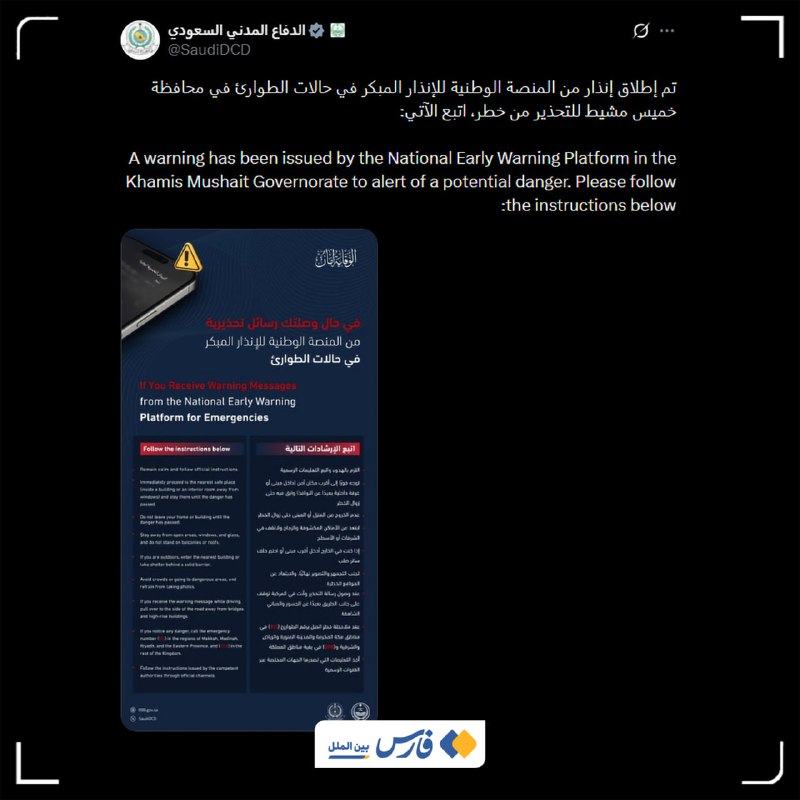
At 07:52 UTC on 17 October 2026, Iran's Mehr News Agency reported that Saudi Civil Defense had activated early-warning sirens in Abha and Khamis Mushait, the two largest cities of Saudi Arabia's Asir Province, on the kingdom's southwestern frontier with Yemen. A minute later, at 07:53 UTC, Fars News Agency, another Iranian state outlet, reported that "Yemeni sources" said the Yemeni army had struck military targets in the same two cities, and that several explosions had been reported. At 08:19 UTC the Saudi National Early Warning Platform ran an explicit danger notice for Khamis Mushait, instructing residents to follow designated safety procedures. By the end of the cycle, the Saudi authorities had announced that the threat had passed.
The sequence inverts the usual priority. On this story, the Iranian wire ran first. The Saudi public-warning apparatus, normally a tier above foreign reporting in the regional information order, reacted to events first carried by outlets aligned with the Iranian state. Read against the decade-long arc of cross-border strikes and Ansar Allah drone and missile operations out of northern Yemen, every element of the sequence is familiar. What is unusual is who got there first, and how the Saudi state chose to close the file.
The shape of the morning
Mehr News's bulletin at 07:52 UTC named Abha and Khamis Mushait specifically and reported the Saudi Civil Defense siren activation as a fact about Saudi internal communications. The post did not, on its face, cite Fars or any other Iranian state outlet for the underlying event; it relays what Saudi Civil Defense had announced. Fars's bulletin at 07:53 UTC added the operational claim, sourced to "Yemeni sources," of Yemeni army strikes on military targets in Asir, and noted that several explosions had been reported. The Cradle carried both the earlier Civil Defense alert and a later National Early Warning Platform notice, and reported that authorities announced the threat had passed without providing details about the cause of the alerts or the nature of the potential danger. Al-Alam Arabic, run by Iranian state broadcasting, relayed the initial early-warning alert with attribution to "Saudi media."
That relay chain matters. Two of the four telegram posts covering the alert (Al-Alam Arabic and The Cradle's later National Early Warning notice) explicitly carry no independent corroboration of the underlying strike claim. The remaining two (Mehr News and Fars) are both Iranian state outlets. The Saudi side's own statement, as relayed by The Cradle, was that the threat had passed; the authorities did not immediately provide details on what triggered the sirens or what nature of danger was involved.
The Iranian framing and its limits
Fars News and Mehr News sit firmly inside the Iranian state media ecosystem. Fars's bulletin, including its "several explosions" framing, is attributed to unnamed "Yemeni sources" and carries no independent on-the-ground reporting in the material available to this publication. The Cradle, which relayed both the Civil Defense alert and the National Early Warning Platform notice and reported the threat-had-passed announcement, is openly critical of Saudi and Emirati policy in Yemen and supportive of the Ansar Allah movement that controls much of northern Yemen. None of these outlets are neutral observers of the southern border.
Monexus analysis: the most economical reading is that the Iranian wire moved first because Ansar Allah's spokespeople have, in past cycles, used Tehran-adjacent outlets as a primary release valve. Mehr's Civil Defense siren report at 07:52 UTC then fed forward the same cycle: sirens first described as a Saudi internal announcement, then attached to an attack narrative once Fars's "Yemeni sources" claim landed. The Saudi announcement that the threat had passed, without a stated cause, is consistent with a small operational event that Riyadh chose to close quietly, or with a precautionary siren pulled back when nothing materialised, or with an intercept that the Saudis are declining to publicise. Each reading produces a different regional signal.
The Saudi calculus
Why activate sirens at all? Two structural pressures are visible from the available reporting. First, Saudi Civil Defense's public-warning infrastructure is itself a political instrument: it tells the kingdom's own population, and its adversaries, that an inbound threat was taken seriously enough to act on. Announcing the threat has passed restores the appearance of normal life without ever formally conceding what triggered the sirens. Second, the Asir frontier has been a recurring flashpoint since the kingdom intervened in Yemen in 2015, and the southern border remains the theatre where Saudi Arabia absorbs the most consistent cross-border pressure from Ansar Allah.
The Cradle's relay is explicit that "the authorities did not immediately provide details about the cause of the alerts or the nature of the potential danger." That is not the same as silence; it is a partial statement. Monexus analysis: a state that has nothing to hide does not run an early-warning alert in two cities and then decline to attribute it; a state that has something operational to obscure does. The available material does not specify which dynamic is in play here.
What to watch before the next siren
Three signals will clarify which reading is correct. First, a Saudi-led coalition briefing, or its conspicuous absence, in the next forty-eight hours. Second, satellite imagery from the Asir border, particularly any visible impact craters near the Khamis Mushait air base, which has been a recurring target of Ansar Allah missile and drone operations. Third, the Ansar Allah military spokesperson's own communique, which typically follows a cross-border strike within twelve to twenty-four hours and is the most reliable external confirmation that any given event actually happened.
Monexus analysis: the practical reading for readers tracking the southern theatre is that the Saudi closing statement ("threat has passed") is real and on the record, while the underlying strike, including Fars's "several explosions" framing, remains single-sourced to an Iranian-aligned outlet citing unnamed Yemeni sources. The most likely outcome is that the next twenty-four hours produce a thin confirmation from one side and a denial from the other, and that the regional balance of risk does not move. The story of the morning is not the sirens, but the order in which they arrived.
Desk note: Monexus framed the lead against the Iranian wire because Mehr News and Fars carried the first telegram posts about both the sirens and the underlying strike claim. The Saudi state's own statement, relayed by The Cradle, is reported as a partial statement ("threat had passed," no cause given) rather than as silence, per the source material.
Wire provenance
This editorial synthesis draws on the following public wire/social posts:
- https://t.me/mehrnews/423201
- https://t.me/FarsNewsInt/263818
- https://t.me/thecradlemedia/69560
- https://t.me/TheCradleMedia/69562
- https://t.me/alalamarabic/511242