South Korea's October exports up 93.7%, the fastest since 1974, by one count
Investing.com put South Korea's October export growth at 93.7%, the fastest since 1974 by its account. The supplied material does not show what sits behind that number.
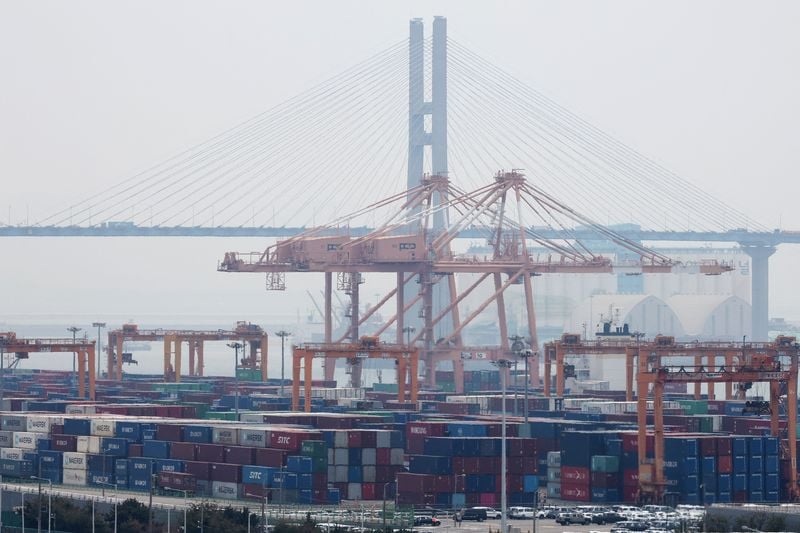
At 00:42 UTC on 1 November 2026, Investing.com published a headline saying South Korea's exports had nearly doubled in October, their strongest growth since 1974. Fifty-eight minutes later, a second Investing.com item logged at 01:40 UTC put the rise at 93.7% and repeated the historical comparison. Two numbers for one month, and the copy supplied for this article contains no body text that shows how either figure was assembled. The supplied items are headlines and short excerpts, and none of them reports the product mix, the destination markets or the prior-year base a reader would need to judge the number.
This article treats the October print as a claim to be tested rather than a verdict to be repeated. A near-doubling is arithmetic performed on a comparison month, and a headline has no room to show the arithmetic. Monexus's view is that the figure should be read against its base and its composition before anyone describes it as a turn in the trade cycle. The piece also takes up two Nikkei Asia items relayed on Telegram, one about Japanese bamboo chopsticks finding buyers in South Korea and one about foreign caregivers facing a certification exam in Japan. They are smaller stories, and they show the same pattern as the export figure: a single number arriving without the context that would let a reader judge it.
Two headlines, one number
The two Investing.com headlines are close but not identical. One reports that exports surged 93.7% in October. The other says they nearly doubled and calls the growth the strongest since 1974. A rise of 93.7% is, in plain arithmetic, a little short of a doubling, and Monexus reads the two headlines as describing one figure at two levels of rounding, though the items do not confirm that. The historical comparison carries more weight than the arithmetic, and it rests entirely on headline wording in the supplied items. The available source items do not specify the series used for the 1974 comparison, and they do not say whether the October figure has been revised since first publication. This article has not independently established either point.
The distinction matters for a reader who wants to repeat the claim. A rounded doubling and a precise 93.7% are the same claim only if the underlying series is the same, and the supplied copy does not show that it is.
A big percentage is usually a base story first
Monexus analysis: percentages this size usually say as much about the comparison month as about the current one. When the base was weak, a modest rise in shipments produces a dramatic percentage, and the number of working days can move a monthly trade figure on its own. The supplied items contain neither the prior-year figure nor any calendar adjustment, so the desk cannot say which force, if either, dominates October 2026. The bullish reading holds that a figure this large cannot be explained by base effects alone and that a broad lift is under way. It may prove right. It is also the reading that travels furthest in a headline, and a headline is a poor instrument for testing it.
The supplied items also do not establish what drove the figure. They contain no product or destination breakdown, so the thread cannot tell whether the surge reflects one industry's order book or a lift across the export base. Monexus analysis: until the underlying release is read for its composition, the product driver should be treated as an open question. If a single sector accounts for most of the gain, the 93.7% would describe that sector's orders more than the wider economy, and a reader who takes the headline at face value would miss that distinction.
Small trade, small print
The chopstick item is the lightest in the set and, in its way, the most revealing about how cross-border trade reaches ordinary buyers. According to the Nikkei Asia item relayed on Telegram and logged at 01:01 UTC on 1 November 2026, bamboo chopsticks made in Japan have gained a following in South Korea. One maker sold more than 100,000 pairs in a little more than half an hour on a television shopping program, according to the relayed excerpt. That is a sales figure attributed to a report, not an export statistic, and it describes a sales channel that a monthly trade total cannot capture. Much of cross-border commerce, for the buyer at the end of it, looks like this: specific, quick and easy to miss.
The caregiver item, logged at 07:31 UTC on 31 October 2026, covers the other end of the same economy. Its headline says foreign caregivers face an exam hurdle as a grace period ends. Its opening lines say Japan plans to bolster support for foreigners seeking care worker certification by devising a test-preparation app, and the relayed excerpt cites a pass rate in the low 30% range for the certification exam. The supplied items do not specify the length of the grace period or the format of the examination, and this article has not established what happens to workers who miss the deadline. What the item does establish is the direction of policy. Monexus analysis: under the reported plan, Japan is treating certification as a hurdle to ease with study tools rather than as a fixed gate. A pass rate in the low 30% range makes the difficulty concrete, and it suggests the bottleneck sits at the examination itself rather than in the decision to work in the sector.
Our assessment, and what would change it
Read together, the trade print and the labour item point at the same problem from opposite ends. An economy can post a near-doubling in exports while the people and products behind the figure move through channels that headlines compress into a single line. The sources do not link the export surge to Japanese chopsticks or to caregiver certification, and this article does not suggest that they are connected. The connection is one of method. In each case the number arrives without the detail that would let a reader judge it.
The stakes are specific. If the October lift proves durable, exporters gain, and any reversal would reach the factory floor first. For foreign caregivers, the certification deadline decides a great deal, and the supplied items do not say what follows a missed exam. For the Japanese maker, a product that sells in South Korea through a television channel shows that consumer demand can cross a border without appearing in any headline total.
What remains uncertain is larger than what is known. The available source items do not specify the prior-year figure, a product or destination breakdown, or the official basis for the export numbers. They do not establish whether the October figure has been revised, how it compares with the underlying release, or whether the caregiver grace period carries an extension. Where the evidence thins, this piece declines to fill the gap with a plausible number.
The desk's expectation, labelled as a forecast rather than an instruction to readers, is that the November print will be the real test. If exports keep a large share of their October gain once the comparison month normalises, the 1974 comparison will stop being a headline and begin to look like a trend. If they fall back, October will read as one strong print against a soft base. Either outcome should show up in the next monthly release, and neither will be explained by the headline that announced the first one.
Desk note: Wire-style copy on this story leads with the percentage; Monexus treated the number as a claim to be tested against its base and composition, and kept the two Japanese items in the same frame because they show the same gap between headline and detail.
Wire provenance
This editorial synthesis draws on the following public wire/social posts:
- https://www.investing.com/news/economy-news/south-korea-exports-surge-937-in-october-fastest-growth-since-1974-4989360
- https://www.investing.com/news/economic-indicators/south-korea-exports-nearly-double-in-october-strongest-growth-since-1974-4989354
- https://t.me/NikkeiAsia/22415
- https://t.me/nikkeiasia/22415
- https://t.me/NikkeiAsia/22413
- https://t.me/nikkeiasia/22413