South Korea's exports nearly doubled while its factories slowed
Investing.com reported that South Korean exports rose 93.7% in October, the fastest growth since 1974, while a purchasing managers' index showed factory activity growth slowing to an eight-month low. The two readings have not been reconciled in the supplied feed.
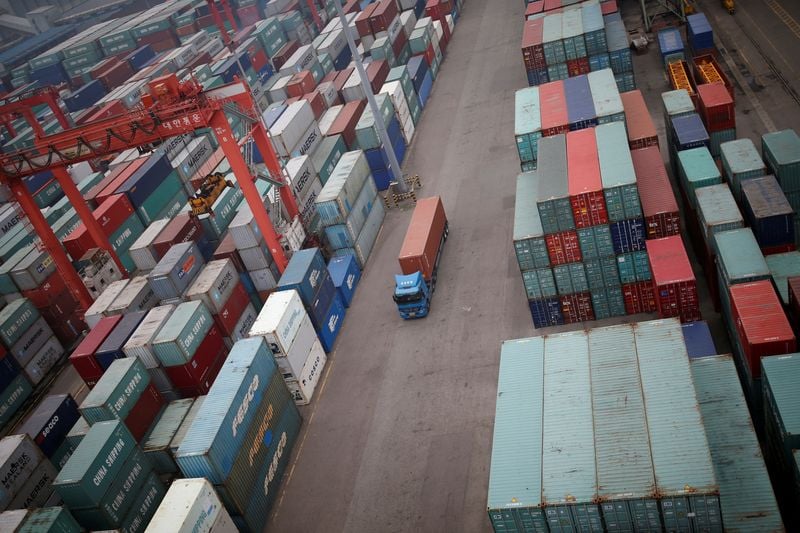
Exports rose 93.7 percent in South Korea in October, the fastest growth since 1974, according to an Investing.com report logged at 2026-11-01 01:40 UTC. A day later, the same wire feed carried a purchasing managers' index showing factory activity growth at an eight-month low. One figure describes a trade surge. The other describes a factory sector losing momentum. Both can be accurate at once, and the supplied items do not reconcile them. Read side by side, the headlines invite a reader to pick a winner. The more useful work is to ask what the export number is made of and whether the factory slowdown is a turn or a pause.
This article argues that the two releases should not be read as rival verdicts on one economy. They measure different things on different schedules: goods that cross a border, and managers' judgements about orders and output. Monexus analysis: the questions that would settle the matter, the composition of the export total and the level of the survey index, are absent from the supplied items. What the feed does provide is enough to frame the argument and to say which evidence would decide it.
The export number arrives first
The export headline is built to travel. Investing.com put the 93.7 percent figure and the 1974 comparison at the front of its report. A companion item from the same outlet, logged at 2026-11-01 00:42 UTC, described the month's exports as nearly doubling. The two framings agree on the arithmetic. Monexus analysis: a 93.7 percent rise leaves exports a little under twice their prior-year level, so 'nearly double' is a fair plain-language rendering rather than a rhetorical stretch.
What the headlines leave out is the decomposition. The supplied items do not specify whether the 93.7 percent is measured in dollar value or physical volume, how much of it reflects a shift in product mix, or how much is a base effect from a weak October a year earlier. Those details decide whether the number describes broad demand or a swing concentrated in a few categories. A reader who stops at the headline should accept the magnitude as reported and treat the explanation as open.
The 1974 benchmark is a statement about the comparison series the outlet used. The supplied items do not describe how that series was built, and the figure says nothing on its own about whether the strength will persist beyond a single month. For a reader weighing the export total against the factory survey, the practical question is which of the two numbers will move first in the data. The feed cannot answer that.
The factory survey pulls the other way
The survey arrived a day later. Investing.com reported on 2 November 2026 that South Korea's factory activity growth had slowed to an eight-month low, according to a purchasing managers' index. The headline describes a change in pace. The supplied items do not give the index level or say whether it stayed above the line separating expansion from contraction, and this article has not independently established that figure.
The most charitable reading is that the two releases measure different things. Monexus analysis: exports are recorded when goods leave the country, while a survey asks managers how orders and output are moving now. Shipments booked in earlier months can clear the border while fresh orders soften. That account reconciles the gap without requiring either release to be wrong, and it implies the export figure should fade faster than the survey recovers.
The less comfortable reading is that the export total is flattered by prices or by a weak comparison base, which would make the survey the earlier warning. Nothing in the supplied items settles which account holds.
One further lead complicates the composition question. A verification search for contradicting reports returned a headline dated 1 November 2026 from NDTV Profit that points to AI-related chip shipments as a driver of the export total. That report is not among the items supplied for this article, its text has not been reviewed here, and its figures are unverified. If it holds, the surge is concentrated in one sector, which would make the broad-demand reading harder to sustain and would make the factory survey more informative about the rest of manufacturing. It would not resolve the question of the survey's index level.
What a chopstick sale can and cannot show
A separate item points away from the macro data altogether. A Nikkei Asia post on Telegram, logged at 2026-11-01 01:01 UTC, reports that Japanese bamboo chopsticks have gained a following in South Korea, with one maker selling more than 100,000 pairs there. According to the thread item, those sales took place in a little more than half an hour on a television shopping programme.
That detail changes what the figure can carry. A half-hour broadcast sale is a concentrated event, closer to a marketing result than to a measure of sustained consumer demand. Monexus analysis: the item shows that a Japanese product can find a buyer base in South Korea quickly, but it cannot be read as a trend, and this desk does not generalise from one maker or one channel. The supplied items do not indicate whether the sales repeated or whether other retail channels carried the product.
What to watch in the next prints
Most of the decomposition remains open. The feed gives magnitudes and benchmarks but not composition, price effects, base effects, or the index level for the factory survey. Any argument about where the economy is heading, built on these items alone, is a hypothesis.
The desk expects the next export and factory-survey releases to narrow the question. This is a forecast, not a reading of current data. If export growth holds near October's pace while the survey keeps weakening, the gap will look less like timing and more like a turn in the factory cycle that the headline has been masking. If export growth fades toward normal while the survey steadies, October will look like a spike the headline magnified.
The stakes fall unevenly. Exporters hold the flattering number, but the survey speaks more directly to near-term order books. Policymakers face an asymmetric risk: treating one strong month as trend invites overcommitment, while treating one soft survey as collapse invites underreaction to a real export boom. The supplied items do not indicate how any official or company has read the two releases.
The clearest test is whether the next export release keeps its magnitude once base effects are stripped out, and whether the chip lead survives a check against the underlying report. If neither holds, October's most quoted number will have been a benchmark rather than a trend.
Desk note: The wire headlines lead with the 93.7 percent export figure and the 1974 comparison. Monexus has set the factory survey beside them, flagged what the feed does not decompose, and kept an unverified chip-sector search lead separate from the reported figures.
Wire provenance
This editorial synthesis draws on the following public wire/social posts:
- https://www.investing.com/news/economy-news/south-korea-exports-surge-937-in-october-fastest-growth-since-1974-4989360
- https://www.investing.com/news/economic-indicators/south-korea-exports-nearly-double-in-october-strongest-growth-since-1974-4989354
- https://www.investing.com/news/economic-indicators/south-korea-factory-activity-growth-slows-to-8month-low-pmi-shows-4989791
- https://t.me/nikkeiasia/22415