New Zealand's 7 November vote may turn on a centrist party at 6 percent
The final 1News–Verian poll has National at 30 percent, Labour at 29 and Opportunity at 6, and the Guardian says the centrist party could decide who governs.
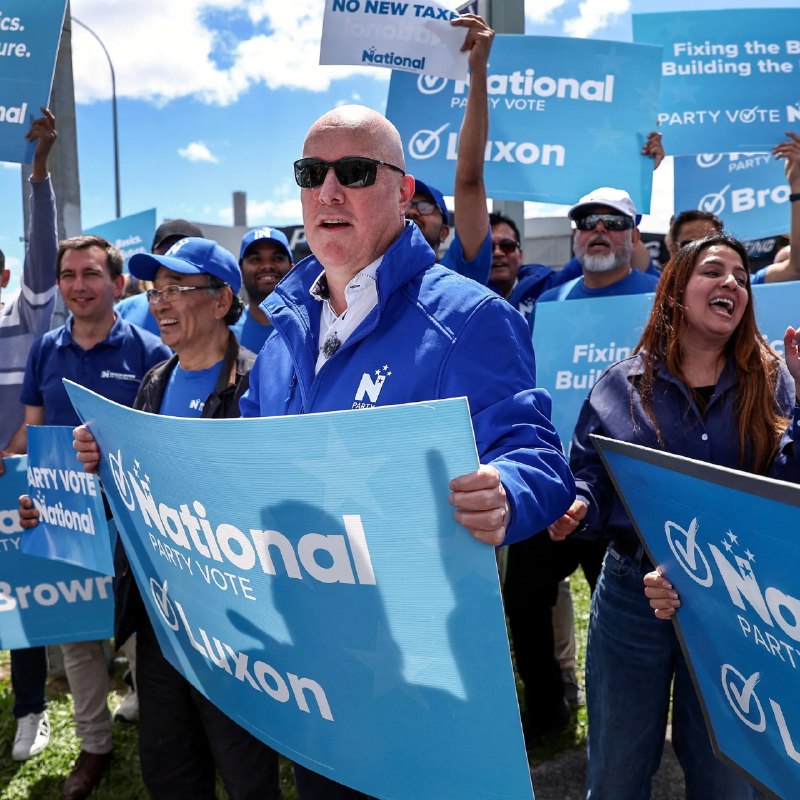
Two days before New Zealanders vote on 7 November 2026, the final 1News–Verian poll puts the National Party on 30 percent, Labour on 29 percent and the centrist Opportunity party on 6 percent. The gap at the top is one point. The party at the bottom is the one the Guardian says could decide who governs. Telegram channels relayed that summary on 5 November 2026 at 06:59, and those relays are the only record this article has of it.
Monexus analysis: the campaign is being framed as a contest for first place between National and Labour. The relayed figures point to a different question. When the two largest parties sit a point apart and a third party holds 6 percent, the arithmetic of who can govern depends on what the smaller party is able to extract, not on the leader's margin. The relayed material says neither the governing coalition nor the opposition bloc would reach a majority without Opportunity's support. If that holds, the election is less a race to finish first than a negotiation that starts after the count.
A one-point gap and a 6 percent party
The poll figures, as the relays carry them, are simple: National at 30, Labour at 29, Opportunity at 6. Three posts across two channels, AMK_Mapping and wfwitness, repeat the Guardian's headline and the same poll line. The material here is therefore one summary seen three times, not three independent readings of the poll. The Guardian's word "potentially" carries much of the weight in that headline. It describes a tight contest and a party that could be decisive, but the relayed material does not show the seat calculation that would make the claim concrete.
The available source items do not specify the poll's sample size, its margin of error or its fieldwork dates. Without a margin of error, a one-point difference between the two largest parties cannot be read as a lead in any meaningful sense. It may be a statistical tie. The relays do not allow a verdict either way, and this article does not offer one.
What the relays do supply is the Opportunity figure, and it is small. Monexus analysis: a party at 6 percent does not win an election on its own vote share. Its importance comes from where it sits relative to the two larger parties, which is a question about seats and coalition arithmetic rather than about the headline number.
The case against a two-horse reading
The strongest objection is that a two-party frame is simply how a close race gets narrated. Calling a party potentially decisive is a claim about how seats will fall after the count, and the poll line does not show that calculation. A reader who meets the words centrist and decisive in one sentence may assume the kingmaker is already known. The relayed material does not establish that.
There is a second, more sceptical reading. If National and Labour are both near 30 percent, the result could turn on turnout, on late movement among undecided voters or on which blocs mobilise in the final days, rather than on any party's coalition choices. That reading is plausible. It does not remove the Opportunity party's leverage, however. In a narrow contest every marginal bloc carries more weight, because each additional seat can change which combination of parties is able to govern.
The reverse risk is also real. Coverage that frames an election as two large parties and a bystander can recast the smaller party's supporters as swing votes to be courted, rather than as voters with preferences of their own. The relayed headline does not say which reading the Guardian intends, and this article does not assume one.
Monexus analysis: the bargaining starts after the count
When two large parties are close, the result is set less by their totals than by the terms on which a smaller party will commit. The relayed summary reports that neither the governing coalition nor the opposition bloc would secure a majority without Opportunity's support. Monexus analysis: if that arithmetic holds, the 6 percent party does not need a majority of its own to shape the government. It needs only to be the partner the arithmetic requires.
Opportunity's leader, Qiulae Wong, is reported in the same material to have said her party will negotiate first with whichever party wins the most seats. That is a sequencing commitment. It gives the party with the most seats the first conversation without guaranteeing that the conversation ends in a government. The relays do not say whether the most-seats party would also be the party able to form one, and that gap matters. A first meeting is not a majority.
For voters, the practical question on 7 November is therefore not only who leads, but how a leading party's seat total converts into a coalition. The available material does not say what either large party has offered Opportunity, or what Opportunity would require in return. Those terms may matter more than the one-point gap, and they will not be visible on polling day.
What the next two days can settle
The desk's expectation is that attention in the final days before 7 November will concentrate on the Opportunity party, because the relayed data leaves the most room for movement there. That is a forecast drawn from one poll summary, not guidance to readers.
Three things would sharpen the picture. The first is the full 1News–Verian release, including its sample and error margin, which the relays do not carry. The second is any published seat projection that tests the no-majority reading against the poll figures. The third is a fuller statement from the parties on coalition terms, beyond Wong's sequencing remark. Neither the relays nor this article can supply them.
The stakes are concrete. For National and Labour, the question is which partner each would need and at what price. For Opportunity, it is whether a centre position converts into leverage or into pressure from both sides. For voters, the composition of the next government may only become clear after negotiations whose length the sources do not specify.
The relays give a headline, a poll line and a short account of coalition arithmetic. They do not give methodology, and the available material does not establish whether the no-majority reading survives the full dataset. This article has not independently verified it.
If the relayed arithmetic holds, the first meeting after 7 November may be the most consequential one in the campaign, and it will take place between a 6 percent party and whichever rival finishes first.
Monexus framed this from Telegram relays of one Guardian summary and one 1News–Verian poll line, where the Guardian headline and the coalition claims are secondhand. Check the original 1News and Guardian texts before reusing any figure or quotation.
Wire provenance
This editorial synthesis draws on the following public wire/social posts:
- https://t.me/AMK_Mapping/40221
- https://t.me/AMK_Mapping/40220
- https://t.me/wfwitness/118843