Trump's Phone Diplomacy With Iran Is a Bargaining Position, Not a Strategy
Tehran's offer to reopen the Strait of Hormuz in exchange for sanctions relief is a concrete proposal dressed as a concession. Washington's preference for phone calls over envoys is not a sign of strength — it is a negotiating posture with an expiration date.
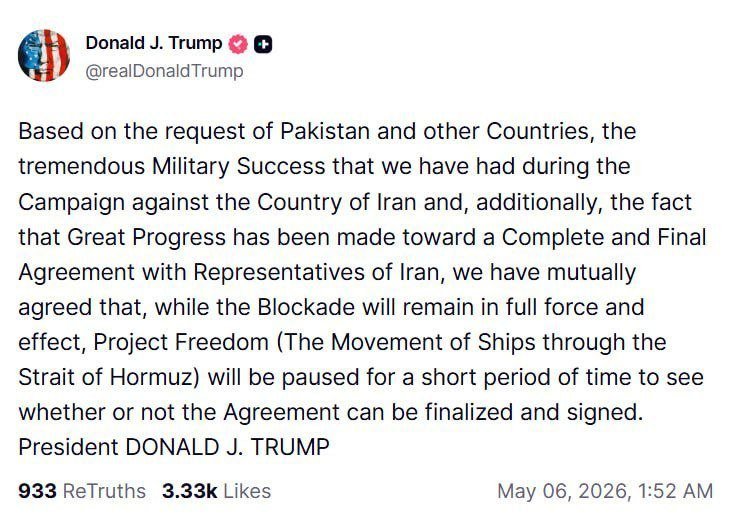
Iran has put a concrete proposal on the table. According to reporting by Axios, Tehran has offered the United States a deal: reopen the Strait of Hormuz and end the current hostilities, in exchange for sanctions relief. Nuclear negotiations — the more sensitive, longer-horizon question — would be deferred to a later stage. That is a legible ask, backed by leverage. It is not the vague diplomatic theatre the phone-call framing might suggest.
The Trump administration responded by dismissing the idea of sending envoys to Pakistan for direct talks with Iranian officials. Peace negotiations, the President told reporters, could proceed by phone. That is a negotiating position — and a deliberately calibrated one. The question is whether it is a coherent one.
Tehran's calculus is rational, not magnanimous
Iran's offer does not emerge from a posture of weakness. The Islamic Republic has watched its economy strangled by sanctions architecture that, by most Western assessments, peaked under the so-called maximum pressure campaign. But Tehran has also demonstrated a durable capacity to absorb economic pain while maintaining regional influence through proxy networks and, more directly, through its control of the maritime chokepoint through which roughly a fifth of the world's oil passes.
To reopen the Strait is to offer something of genuine global consequence. Energy markets, Asian importers — China and India above all — and the European industrial complex all have acute interests in unimpeded Gulf transit. Tehran knows this. Offering to lift the threat of closure in exchange for sanctions relief is not charity; it is a structured transaction. The nuclear deferral, meanwhile, allows Iran to keep the more politically charged question off the table until the immediate economic pressure eases. That is not evasion — it is sequencing that any competent diplomatic team would advise.
Phone diplomacy is posture, not principle
Washington's insistence on phone-based negotiations reads as a refusal to grant Tehran the legitimacy of a formal diplomatic process. It is designed to signal that the United States is not desperate for a deal, that the initiative lies with the White House, not with Iran. That framing has domestic utility in Washington. It does not, however, constitute a strategy.
A negotiation conducted by phone — with no envoys, no back-channel infrastructure, no agreed procedural framework — is a negotiation that cannot manage complexity. The Strait of Hormuz reopening is not a single binary act; it involves military de-escalation in the Gulf, coordination with regional partners, verification mechanisms, and parallel signals to allies in Saudi Arabia, the UAE, and Israel who have their own security calculations. Managing that through a phone line is not serious statecraft. It is the appearance of negotiating without the substance.
The structural context neither side is saying aloud
The real frame here is energy architecture and dollar sanctions enforcement. The Strait of Hormuz is not merely a shipping lane — it is a pressure point through which the global oil trade routes, denominated overwhelmingly in dollars, and the United States' ability to enforce sanctions regimes depends on the coherence of that system. When Iran threatens or actually moves to restrict transit, it does not merely inconvenience Western governments; it attacks the operating assumptions of the petrodollar order.
From Tehran's perspective, a deal that eases sanctions is also a deal that brings Iran back into the formal energy trade, potentially in bilateral arrangements with Asian partners denominated in non-dollar currencies. The nuclear question being pushed to a later stage means Iran can keep its enrichment programme advancing while the immediate sanctions pressure is relieved. That is a structurally favourable outcome for Tehran — and Washington knows it.
The stakes and the horizon
What Washington gains by refusing envoys is a signalling victory. What it risks is a deal that expires on its own terms — or worse, a situation where Iran, having extracted some sanctions relief through informal channels, continues advancing its nuclear programme without a formal framework constraining it. The Strait offer is real. It has a shelf life. If the phone-call posture persists into the summer and energy markets begin pricing in sustained Gulf instability, the political cost of formal talks will become harder to avoid than the political cost of accepting them now.
The honest assessment from the available record is this: Tehran has made a specific, verifiable offer with genuine leverage behind it. Washington has responded with a posture. At some point, posture becomes evasion, and the gap between the two sides widens to the point where the diplomacy the moment demands becomes impossible to conduct. That point may not yet have arrived. It is approaching.
This publication noted the Axios reporting as the primary frame for the Iran deal offer; the Cointelegraph wire carried the phone-call statement as a standalone development without the Hormuz context.
Wire provenance
This editorial synthesis draws on the following public wire/social posts:
- https://t.me/Cointelegraph/13245
- https://t.me/Cointelegraph/13244
Follow the event.
These dated source records provide context. They do not retrospectively verify this archive article.
Separate what the nuclear watchdog reported from what it could not determine after the June 2025 strikes.
- 2 MayTrump's Phone Diplomacy and the Stalled US-Iran Nuclear Gambit
- 1 MayThe Phone That Wasn't Picked Up: How Washington's Diplomatic Reset With Iran Came Undone
- 27 AprUS-Iran Talks Stall as Trump Cancels Pakistan Envoy Mission, Oil Markets Rise
- 27 AprIran's Hormuz Gambit: Tehran Offers to Reopen Strategic Chokepoint as Nuclear Deadline Looms