Trump's Hormuz Pause Isn't Diplomacy — It's an Economic Admission
The decision to pause US operations at the Strait of Hormuz is being sold as a diplomatic overture. Look at the inflation numbers and the IMF warning, and a different story emerges: the administration is pulling back because the economic costs of escalation have become untenable.
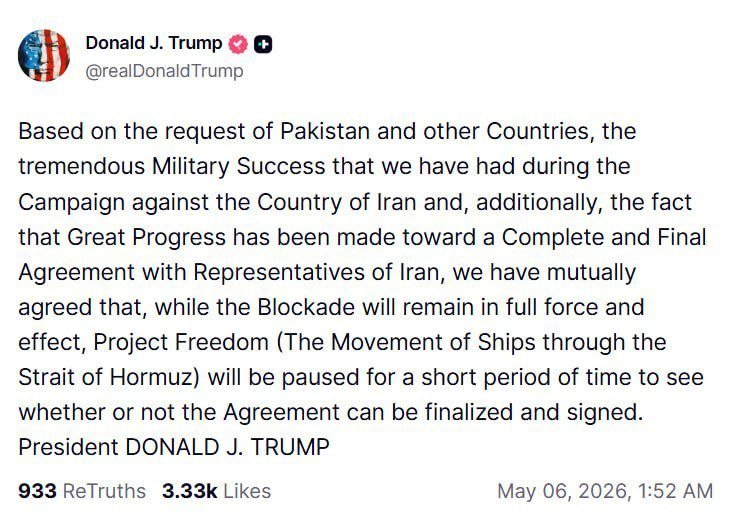
The White House paused its escort operation for commercial vessels through the Strait of Hormuz on 5 May 2026, in what the President described as an opportunity to reach a final agreement with Iran. Hours earlier, the IMF had warned of a much worse outcome for the global economy if the Iran conflict continues. Between those two data points sits an uncomfortable truth: the pause is not primarily a diplomatic move. It is an economic one.
The IMF warning was blunt. If the Iran conflict is not resolved, the global economy faces escalating disruption — energy price shocks propagating through supply chains already strained by years of turbulence. The conflict's costs are not abstract. They are measured in dollars at the pump, in retail price tags that have risen faster than wage growth, in manufacturing input costs that make US businesses less competitive globally. The Trump administration spent months escalating economic pressure on Tehran. Those tools have a documented recoil effect on American households.
The pause at Hormuz is being presented as strategic generosity — an open hand extended to Iran. But the sequence of events tells a different story. The US had been running a costly naval escort operation through waters the Houthis had repeatedly threatened. Iran was under escalating sanctions designed to crater its oil revenue. Yet the Houthis kept firing. Energy markets stayed volatile. The costs — financial and political — mounted. The administration has now stepped back from a strategy that was producing diminishing returns and calling it diplomacy.
There is an irony buried in the sanctions regime that deserves explicit examination. The tools used to pressure Iran — sanctions, oil market disruption, chokepoint controls — do not discriminate between their intended target and American consumers. The Unusual Whales post citing market analysis noted that US consumers are bearing the brunt of inflation stemming from the conflict with Iran. That inflation is not accidental. It is the documented consequence of the same coercive mechanism the administration deployed as a weapon. The IMF's warning about a "much worse outcome" is the institution's way of saying that the current damage is only the leading edge of a larger shock wave.
The political economy of escalation has an inherent tension: the populations most insulated from the direct effects of sanctions are not the ones absorbing the price increases at the grocery store or the gas station. The pause at Hormuz is, among other things, a recognition that the coalition willing to sustain economic pain for strategic goals has a floor — and that floor was reached.
The pause creates a narrow window. Whether it leads to a negotiated framework or simply a managed continuation of the conflict at lower intensity remains to be seen. If it is the former, the economic relief will be real but slow. If it is the latter, the underlying pressures — sanctions, chokepoint leverage, energy market fragility — will resurface, and the question of who absorbs the cost will return with it.
The Strait of Hormuz has become a case study in the limits of coercive economics. The US has the tools to disrupt global energy flows and the military reach to enforce a sanctions regime. It does not have the ability to insulate its own population from the consequences of using those tools. The pause at Hormuz offers a temporary reprieve from the cost spiral. It does not resolve the structural problem: that the same administration deploying economic pressure as a foreign policy instrument is the one that will eventually face the political cost of that pressure landing on American households.
Whether the coming weeks produce a genuine framework or a rebranding of the same strategy under softer language will determine whether the economic damage done to American families represents a lesson or merely a data point in a longer cycle of escalation and managed decline.
This publication's analysis foregrounds the domestic economic consequences of the Hormuz pause — specifically the inflation data and the IMF warning — framing the decision as an admission of coercive economics' limits rather than a diplomatic win. Most wire coverage focused on the optics of the pause and the Iran negotiation angle.
Wire provenance
This editorial synthesis draws on the following public wire/social posts:
- https://x.com/unusual_whales/status/1934567891234567890