One Fighter, One Breach: How a Lone Infiltrator Reopened the Hezbollah–Israel Frontier
On 9 June 2026 a single armed fighter crossed the Blue Line into Margaliot, opened fire on an IDF patrol, and was killed. The incident, small in scale, is large in what it exposes about the northern front's security architecture.
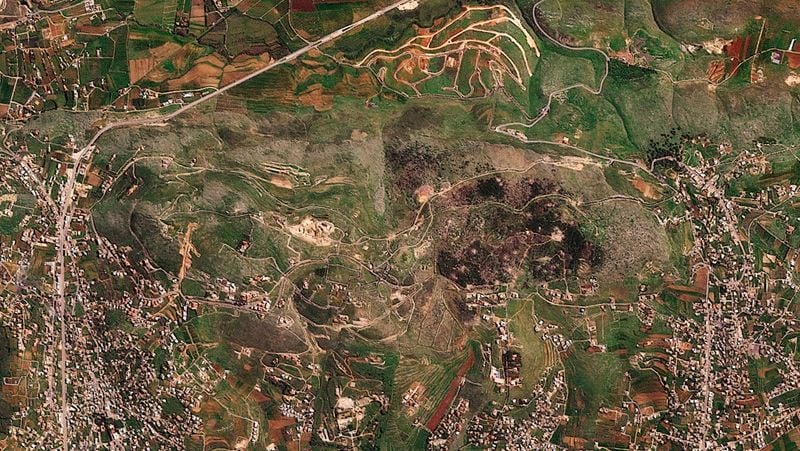
At approximately 12:09 UTC on 9 June 2026, a lone armed fighter crossed from Lebanese territory into Israel near the settlement of Margaliot, waited for an Israel Defense Forces patrol, and opened fire. He was killed shortly afterwards. Initial accounts, circulated by Telegram channels monitoring the frontier in real time, described the gunman as a Hezbollah operative; the militant organisation had not, by mid-afternoon UTC, claimed him. The episode lasted minutes. Its operational and political afterlife is likely to last considerably longer.
The Margaliot incursion is the rare border incident that fits uncomfortably inside every available narrative. For Israeli commanders, the event is a security failure — an armed man moved across a militarised line that has been reinforced for nearly two years and reached an inhabited area before being intercepted. For Hezbollah and its political allies, the same event, stripped of the Israeli framing, can be read as a propaganda success: a single fighter demonstrated that the line is penetrable. For residents of the northern Galilee, the incident is something more concrete — a reminder that evacuation orders, return negotiations, and diplomatic ceasefires in Beirut and Doha do not abolish the underlying physics of the frontier.
The incident, in the time-stamped record
The earliest wire of the day appeared at 12:09 UTC on the AMK_Mapping channel, citing Israeli media: "Israeli media report an unusual incident, where a Hezbollah fighter was able to infiltrate up to the Israeli border and open fire on IDF soldiers. According to them, the militant was killed, while Is[raeli casualties…]" The post was truncated, but the directional fact was clear — a fighter had reached the border itself rather than being intercepted in the no-man's-land buffer.
Two minutes later, at 12:11 UTC, GeoPWatch carried a Lebanese-angle account identifying the location as near Manara, on the Lebanese side of the Blue Line, and reporting that the gunman had been killed and that no Israeli casualties had been confirmed. The eight-minute gap between the Israeli framing ("near the border, injuries") and the Lebanese framing ("near Manara, fighter killed, no Israeli casualties") is itself diagnostic of how the two sides are metabolising the same event in real time.
By 12:17 UTC, Middle East Spectator was carrying a sharper account: a lone Hezbollah fighter had crossed "all the way into the Israeli settlement of Margaliot undetected, with a rifle and ammo," had waited for an IDF patrol, and had opened fire, causing injuries. By 12:23, FotrosResistancee — a channel aligned with the Iranian-axis information ecosystem — was circulating the same Margaliot frame. By 12:31, both AMK_Mapping and Middle East Spectator had converged on a synthesis: one fighter killed after crossing into Israeli territory and firing on IDF troops between Misgav Am and Margaliot, with other reports claiming two rather than one.
The geography matters. Misgav Am and Margaliot are adjacent Israeli communities in the upper Galilee, sitting on the ridge line that overlooks the Houla valley and the southern Lebanese borderlands. They have been among the most consistently evacuated localities since the northern front reopened in October 2023. A fighter reaching either settlement on foot, undetected, is not a long-range infiltration — it is a short, well-known approach corridor. The implication is not exotic; it is procedural.
The Israeli frame: a security failure to be investigated
Israeli security doctrine treats an undetected crossing into a populated locality as a category-A event regardless of outcome. The yardstick is not the body count at the end of the firefight; it is the minutes during which the armed man moved through Israeli territory without contact. On that yardstick, the Margaliot episode is a failure of the detection layer — the sensor mesh, the patrol density, the ground observation posts, the thermal-and-electronic fence line that has been substantially upgraded since the 7 October 2023 Hamas assault.
Initial reporting from Israeli media, relayed by AMK_Mapping, framed the incident as "unusual." The word is doing heavy work. It concedes, implicitly, that crossing the line at speed is not routine — Hezbollah has not been running ground-infiltration cells into Israeli territory at this scale in the current phase of the conflict. It also concedes that a single detection failure was enough to put an armed man in proximity to civilians. The political effect inside Israel is predictable: opposition voices will press the defence minister on whether the 2023 post-mortem reforms have been fully implemented in the north; the defence minister's office will commission a closed inquiry; residents of the Galilee will read the news and re-check their evacuation timetables.
There is no public statement, at the time of writing, from the IDF Spokesperson's Unit confirming the militant's organisational affiliation. Telegram-channel sourcing carried the "Hezbollah" label on all six items in the cluster; the cluster also flagged that the militant had not been publicly claimed. The two are not the same thing. A Hezbollah fighter can cross the line without Hezbollah command having ordered the crossing — a fact the organisation has used, in past episodes, to preserve deniability and to manage its escalation ladder.
The counter-frame: an axis information win, regardless of outcome
The Iranian-aligned information ecosystem treated the Margaliot episode differently within minutes. GeoPWatch — an account that consistently reports from a Lebanese-Hezbollah vantage — framed the incident in the passive voice: an "armed Hezbollah fighter managed to approach the Lebanese border, near Manara, opened fire on Israeli forces, and was subsequently killed. No Israeli casualties were reported." The Israeli-failure datum is omitted; the framing centres the fighter's action and the fact that he was killed only after he had done what he came to do.
FotrosResistancee and Middle East Spectator, both of which operate in the same broader information space, sharpened the line further: a single man had crossed "all the way into the Israeli settlement of Margaliot undetected." The word "undetected" is the propaganda payload. It says, in one syllable, that the much-publicised Israeli border security architecture — the cameras, the ground sensors, the reinforced fence, the new digital surveillance contracts — is not what it has been marketed as. The fighter is dead; the message is alive.
This is the structural context that Western wire reporting tends to under-weight. A one-fighter, one-fence incident is treated as a localised tactical event. In the regional information war, it is a billboard. Whether the fighter was acting on orders, on initiative, or under a tacit understanding with a local commander is, for the purposes of the information war, almost beside the point. The image of a single man crossing undetected is the asset. Both sides know it.
The structural read: what a short episode exposes about a long line
The Israel–Lebanon frontier has, since late 2023, been a quiet front by design. Hezbollah's leadership opted, after the 7 October Hamas assault and the opening of the Gaza war, for a calibrated campaign of anti-tank missile fire, drone incursions, and the periodic infiltration of small teams — the "division of effort" model that allows the organisation to demonstrate solidarity with the Palestinian cause without triggering the full-scale Israeli ground operation that would impose the kind of damage the group suffered in the 2006 war. Israel has reciprocated with a layered air campaign against Hezbollah infrastructure in southern Lebanon and a near-total evacuation of the upper Galilee.
That bargain is what the Margaliot incident stresses. It is small enough not to break the arrangement — a single fighter is not an invasion, and an incident with no Israeli fatalities does not give the Israeli cabinet a casus foederis for escalation. But it is large enough to demonstrate that the arrangement's two preconditions — Israeli detection dominance and Hezbollah restraint at the line itself — are not load-bearing in the way the public conversation assumes.
For Israeli planners, the implication is operational: the detection-and-interception timeline that assumes a fighter will be engaged in the buffer zone, before he reaches an inhabited locality, was missed. Whether that is a one-off procedural lapse or a sign that Hezbollah's short-range reconnaissance has improved is the question that the closed inquiry will try to answer. For Hezbollah's planners, the implication is informational: a single low-cost action, with a guaranteed martyrdom at the end of it, generates a wave of coverage that a battalion of rockets would not. Asymmetric narratives are won with asymmetric means.
The stakes: a return calculus that just got harder
The most concrete consequences of Margaliot are local. Approximately 60,000 Israeli residents of the northern Galilee have been displaced since October 2023; the political argument over their return is, on the Israeli side, a domestic argument about the credibility of the government's security promises. Each successful or semi-successful penetration of the line pushes the return timetable right and reinforces the position of ministers who argue that conditions for return do not yet exist. The episode also gives ammunition to those in the Israeli security cabinet who have argued for a wider northern ground operation, on the grounds that only a permanent military reconfiguration of the border zone can guarantee the kind of penetration-proof line the political system is now demanding.
On the Lebanese side, the calculus runs the other way. A small number of villages in the Houla valley and the Bint Jbeil district have absorbed the costs of the Israeli air campaign over the past two and a half years. For those communities, a Hezbollah-linked fighter crossing the line and surviving long enough to fire on a patrol — even if he is then killed — is read as a partial answer to the question their own displacement has been posing. The question of who controls the return timetable is, in this sense, the question of who pays the political cost of the next phase.
Diplomatically, the episode is a complication for the negotiations over a northern-front stabilisation framework that have been rumoured, in various configurations, since late 2025. A successful penetration of the line, however brief, raises the political cost for any Israeli prime minister of signing an arrangement that Hezbollah can plausibly depict as having been tested, and found wanting, on the day it was concluded.
What remains uncertain
Three things are not, on the available record, established. First, the militant's affiliation. Telegram-channel sourcing uniformly identified him as a Hezbollah fighter; no Hezbollah statement of claim has been reported in the cluster, and the IDF has not, in the public reporting available, named the operative's organisational membership. The label matters for the political effects downstream of the incident. Second, the number of infiltrators. AMK_Mapping and Middle East Spectator both noted at 12:31 UTC that "other reports say two, not one." A second, unaccounted-for fighter would change the operational read from a lone-actor penetration to a coordinated probe. Third, the casualty picture. Israeli accounts cited by Middle East Spectator described "injuries"; GeoPWatch reported no Israeli casualties. The clarification, when it comes, will be the single most consequential fact for the political response inside Israel.
What is established is narrower and sturdier: on 9 June 2026, at approximately 12:09 UTC, an armed man crossed the Blue Line, opened fire on an IDF patrol in the vicinity of Margaliot, and was killed. The line, which is supposed to be one of the most heavily surveilled borders in the world, was crossed. That is the fact the closed inquiry, the public commentary, and the regional information war will all be working from.
Desk note: Monexus framed this as a frontier-security episode with information-warfare second-order effects, not as either a Hezbollah "success" story or an Israeli "collapse" story. The wire reporting available at 12:09–12:31 UTC was consistent on the location and on the fact of a single fighter; it diverged on affiliation, on whether injuries occurred, and on whether a second fighter was involved. Those divergences are recorded in the body, not smoothed over.
Wire provenance
This editorial synthesis draws on the following public wire/social posts:
- https://t.me/AMK_Mapping
- https://t.me/GeoPWatch
- https://t.me/Middle_East_Spectator
- https://t.me/FotrosResistancee
- https://t.me/AMK_Mapping
- https://t.me/Middle_East_Spectator
- https://en.wikipedia.org/wiki/Misgav_Am
- https://en.wikipedia.org/wiki/Margaliot
- https://en.wikipedia.org/wiki/Blue_Line_(Israel%E2%80%93Lebanon)
- https://t.me/AMK_Mapping
- https://t.me/GeoPWatch
- https://t.me/Middle_East_Spectator
- https://t.me/FotrosResistancee
- https://t.me/AMK_Mapping
- https://t.me/Middle_East_Spectator
- https://en.wikipedia.org/wiki/Misgav_Am
- https://en.wikipedia.org/wiki/Margaliot
- https://en.wikipedia.org/wiki/Blue_Line_(Israel%E2%80%93Lebanon