A quarantine centre, a town, and a question about who bears the risk: Nanyuki’s Ebola stand-off
Police fired tear gas in Nanyuki on 9 June 2026 as residents demanded answers about a US-built Ebola quarantine facility on Kenyan soil — a confrontation that puts cost-sharing in global health back at the centre of the conversation.
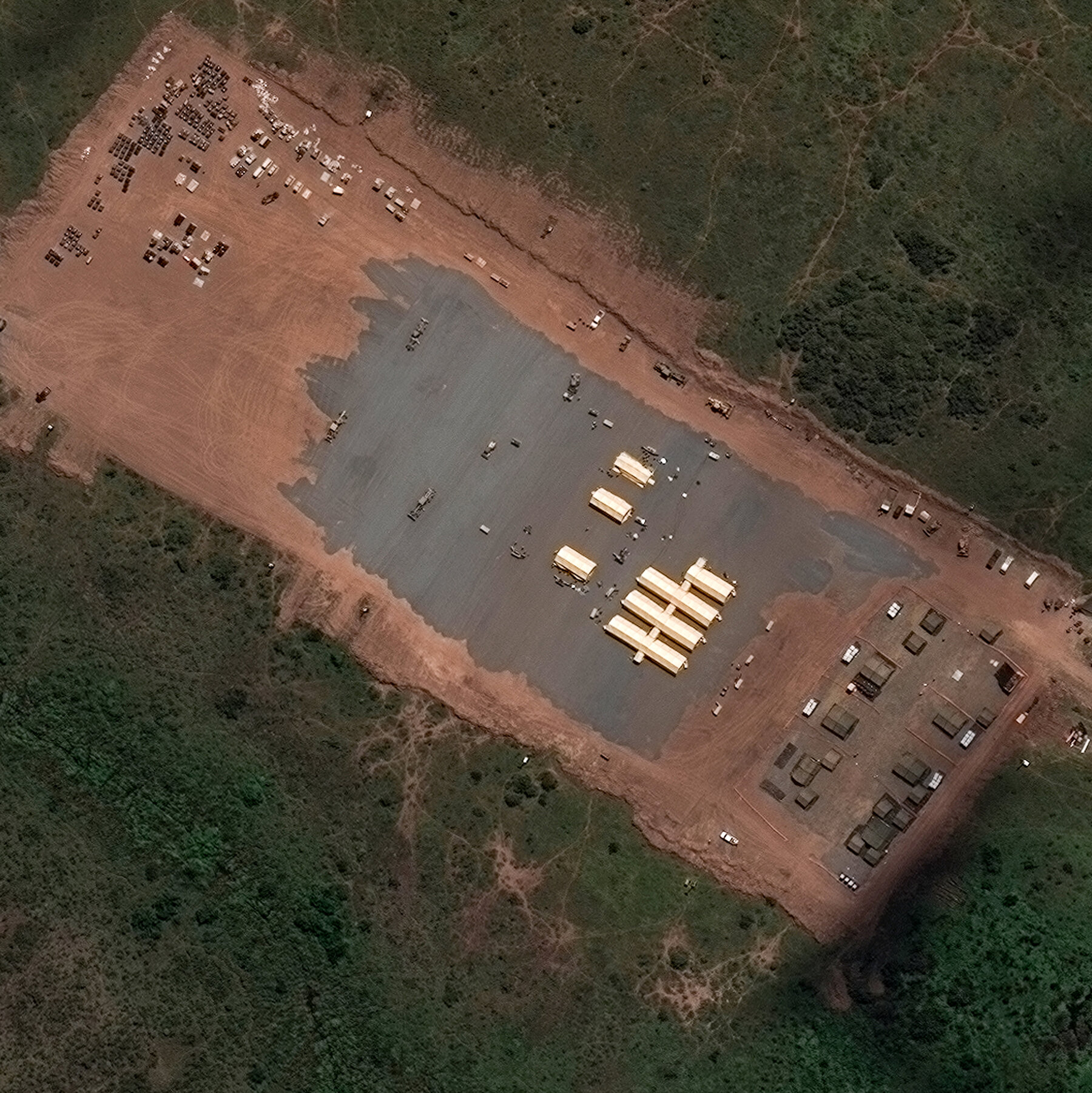
On the morning of 9 June 2026, shopfronts along Nanyuki’s main commercial street pulled their shutters down. By 08:32 UTC, Daily Nation reporters on the ground were filing photographs of tear gas drifting across roundabouts and protesters — many of them traders and matatu operators — pressing against police lines on the edge of town. The proximate cause was specific and contained: a quarantine facility, built at speed by the United States government to house American citizens exposed to Ebola, had been sited inside a Kenyan municipality with little prior consultation, and the town had reached the end of its patience. By 08:19 UTC, Reuters was reporting that Kenyan police had fired tear gas to disperse the crowd, and by 08:18 UTC Al Jazeera had framed the story for an international audience: anger in Kenya at a perceived attempt by Washington to offload Ebola risk onto a host community that had not consented to bear it. The protests are local, but the questions they raise are not.
The dispute is not, on the evidence so far, about whether Ebola is real or whether quarantine is a legitimate public-health tool. It is about who decides, who pays, and who is exposed. A US-built facility inside a Kenyan town — staffed, financed and run by a foreign government for its own nationals — represents a particular kind of bilateral public-health arrangement: one in which the host country lends sovereignty and a community, while the foreign partner retains operational control and the principal benefit. When the disease in question carries the political charge that Ebola does, that asymmetry is not a footnote.
What is known about the facility and the timeline
According to the Reuters wire of 09 June 2026, Kenyan police fired tear gas in the central town of Nanyuki to disperse protesters opposing a quarantine centre intended for Americans exposed to Ebola. The same report describes the United States government as having "raced to build" the site despite Kenyan concerns. Al Jazeera’s breaking-news bulletin of the same morning characterises the project as a US quarantine centre constructed in Nanyuki and frames local opposition as a reaction to perceived risk transfer from the United States to Kenyan residents. The Daily Nation feed of 08:32 UTC documents the visible effects on the ground: shuttered businesses, a contested police line, and a town that had effectively paused commerce for the day.
Beyond these three wire reports, the public record is thin. The sources available to this publication do not specify how many American citizens are slated to be quarantined at the site, what the agreed capacity of the facility is, which US agency is responsible for its construction and operation, or what the formal arrangement between Washington and Nairobi looks like in writing. They do not specify the Kenyan ministry or ministries that authorised the siting, the length of the planned quarantine period, the chain of custody for any biological samples, or the medical-evacuation protocols in the event of a confirmed case. Each of those questions is material — and each is, at the time of writing, unanswered in the material this publication has been able to verify. Monexus will update this article as primary documents or on-record statements become available.
What the protesters are actually saying
The wire characterisations converge on a single substantive grievance: residents of Nanyuki believe the United States has chosen their town as the site of a facility whose principal beneficiaries are American, while the principal risks — a potential breach, an accidental exposure, a stigma effect on local trade and tourism — would land on Kenyan shoulders. The Reuters report describes opposition to the quarantine centre as the trigger for the police action. The Al Jazeera bulletin goes further, reporting that residents accuse the US of "offloading Ebola risks onto Kenyans." Daily Nation, in its on-the-ground dispatch, records the immediate consequence: commercial activity in the town stopped for the day.
That last point deserves weight. Nanyuki is not a generic map pin. It is a market town in Laikipia County whose economy rests heavily on agriculture, ranching, and a steady flow of domestic and cross-border tourism drawn to the Mount Kenya ecosystem. A quarantine facility, even a well-run one, alters the risk perception of visitors and investors in ways that ripple through small-business revenue, insurance premiums, and the willingness of regional suppliers to send trucks in. The protesters, in other words, are not making a generic anti-foreigner argument; they are making a calculation about the future of their own town.
The structural frame: risk, sovereignty, and the geography of global health
It is worth saying plainly what is being negotiated in Nanyuki this week, because the public-health vocabulary tends to obscure it. When a powerful state constructs, on the territory of a less powerful one, an isolation facility for its own nationals in the middle of an outbreak, the standard diplomatic term is "cooperation." The standard community term, in many places, is something closer to "a base." The gap between those two readings is the gap this story is about.
The global health architecture that emerged after the 2014–2016 West Africa Ebola outbreak was built on a deliberate premise: that the countries where filoviruses emerge, or where cases are detected, must be treated as partners with standing, not as receiving terminals for someone else’s emergency. That premise has been unevenly honoured. Research consortia, vaccine trials, and genomics infrastructure were concentrated in the global North well before the 2020s; the debate over benefit-sharing — who gets access to pathogen samples, who gets the resulting intellectual property, who is named first author — has been running for two decades. A quarantine facility, built quickly by one government on the territory of another, sits inside that older debate even if it was not designed to.
Two things follow. First, the protest is a demand for procedural legitimacy as much as it is a demand about Nanyuki specifically. Who was consulted? Who can visit the site? Who can audit it? Who is liable if something goes wrong? Second, the protest is a demand for visibility. A quarantine site that operates without sustained public reporting of its capacity, its discharges, and its outcomes is, from the standpoint of the surrounding community, a black box on their doorstep. The town is asking that the box be opened.
Counterpoint: why the facility may be defensible — and why that defence has not landed
The strongest counter-argument is straightforward. Ebola is a filovirus with high case-fatality rates in untreated populations and a documented history of crossing borders through travel and trade. A government that detects exposure among its own citizens has both a right and a duty to isolate them. Doing so abroad, in a facility that it builds and runs itself, can be read as an attempt to keep a difficult operation out of an American hospital system that is not set up for it — and to do so in a country with which the United States has long-standing health and security cooperation. The faster the build, on this reading, the more lives are being protected on both sides of the ocean.
That case has not landed in Nanyuki, and the reason is procedural. The wire reporting characterises the project as one the US "raced to build" — a phrase that conveys speed, but also the absence of the kind of community engagement that would have given the eventual facility a local mandate. Where Kenyan national authorities authorised the site, what their criteria were, and what information was shared with Laikipia County officials and with the town before construction began are not addressed in the materials this publication has been able to verify. A defensible policy can still be a poorly executed one. The defenders of the facility will need to do more than assert the public-health case; they will need to publish the agreement, the capacity, and the discharge criteria.
Stakes and the next forty-eight hours
Three trajectories are plausible in the short term. The first is a negotiated stand-down: Kenyan national authorities, the US embassy, and Laikipia County officials publish the underlying arrangement, agree to a community oversight mechanism, and reopen commerce in Nanyuki. This is the outcome the protest is, in effect, demanding. The second is an enforced stand-down: tear gas, charges, and a quiet resumption of construction, with the underlying grievance stored for the next triggering event. The third is escalation — a wider set of demonstrations in Laikipia, and a diplomatic exchange between Nairobi and Washington that the sources available to this publication do not yet document.
Whichever path the next forty-eight hours take, the precedent matters. If the model normalises — foreign governments building isolation facilities on African soil for their own nationals, with the host community consulted after the bulldozers have arrived — the cost will be paid in trust, and trust is the asset that outbreak response runs on. If, on the other hand, the model produces a public, written arrangement with named oversight and a clear exit, Nanyuki becomes a template rather than a warning. The town has, at considerable cost to its own commerce this week, insisted on being heard. The question now is whether the answer is delivered.
Monexus framed this as a question of consent and cost-sharing in bilateral public-health operations, not as a generic disease-outbreak story. The wire lines led with police action and US construction; the editorial choice was to read the protests on their own terms, to flag the procedural gaps the available reporting does not close, and to refuse the easy framing of Nanyuki as a backdrop.
Wire provenance
This editorial synthesis draws on the following public wire/social posts:
- https://t.me/s/DailyNation
- https://t.me/s/DailyNation
- https://en.wikipedia.org/wiki/Nanyuki
- https://en.wikipedia.org/wiki/Laikipia_County