Trump's 'Apache' walk-back exposes the hollowness of maximum-pressure theatre
A reporter's question on 9 June 2026 forced the US president to read out loud from his own script. What he read was 'I don't have to do anything.' The question is what that means for Tehran, and for the credibility of the rest of the doctrine.
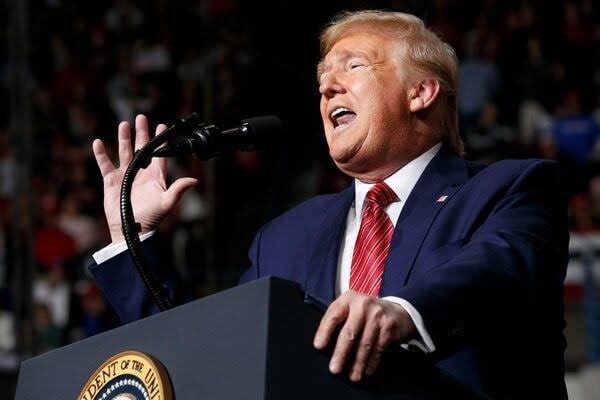
At roughly 20:03 UTC on 9 June 2026, the US president walked up to a bank of microphones, called the downing of an American Apache helicopter by Iran "not a big deal," and then, sixteen minutes later, was forced by a reporter to explain what that meant. The exchange, captured and circulated by Middle East Spectator, Intelslava, and Iran's Mehr News, did not produce a denial of the original comment. It produced a restatement. "I don't have to do anything," Donald Trump said. "We hold all the cards. I don't have to do it, but look, we..." The sentence was never finished on the record captured in the clip. The unfinished sentence is the news.
The walk-back, such as it is, lands at a delicate moment in the US-Iran file. The Apache incident — which Iranian state-aligned channels have framed as a defensive shoot-down of an armed reconnaissance platform — has been cited by war-planners in Washington and by Israeli defence commentators as the kind of event that, under a textbook maximum-pressure doctrine, demands escalation. The doctrine holds that any kinetic contact is met with disproportionate response, that the cumulative cost raises the regime's discount rate, and that time works for the side that bleeds less. The exchange on 9 June suggests the doctrine has a discretionary governor, and the governor is the president's mood.
Theatrical pressure and the discretionary kill-switch
Maximum pressure, as practiced by the second Trump administration, was never a passive instrument. It was a stage-managed performance of brinkmanship, choreographed around sanctions snapbacks, naval deployments to the Strait of Hormuz, and a public cadence of conditional threats — the famous "two weeks" that never quite arrives. What the 9 June clip reveals is the off-ramp built into the staging. When a reporter asks whether the earlier promise of retaliation still stands, the answer is not a substantive recalibration. It is a revelation of the underlying logic: the threat was never a commitment, because a commitment would have eliminated the leverage. The leverage lives in the gap between "we will" and "we did." Iran, presumably, knows this. Tehran has spent four decades mapping exactly how much of Washington's threat catalogue is operational and how much is set dressing.
The most revealing phrase in the clip is not "not a big deal." It is "we hold all the cards." That formulation concedes the framework that Iranian negotiators have argued since the JCPOA collapsed: that US leverage is structural, not contingent, and that a hegemon with a dollar system, carrier strike groups, and an Israeli auxiliary does not need to launch a single sortie to inflict cost. The doctrine, in other words, was always partly self-mythology. The most aggressive moves — the assassination of Qasem Soleimani, the strikes on nuclear-adjacent infrastructure, the squeeze on Iranian oil exports — were also the ones that, in retrospect, did most to consolidate domestic Iranian politics around the security state and to drive Tehran into the arms of the Russian and Chinese diplomatic cover that the doctrine was meant to prevent. The 9 June exchange is the doctrine admitting, in real time, that it is less a strategy than a posture.
What the counter-narrative gets right
The Iranian state-aligned channels that amplified the clip — Mehr News, Intelslava's English-language relay — are not neutral observers. They are operators in the information contest, and the clip is a gift to them. Their preferred frame: Washington blusters, retreats, and tries to have it both ways. The frame is not entirely wrong, and the refusal to engage with it on those terms is one of the sharper failures of the Western commentary circuit. There is a real, documentable asymmetry: the United States can absorb a downed helicopter in a way Iran cannot absorb a downed fighter, and the willingness to publicly characterise the loss as minor is itself a signal of that asymmetry. The Mehr version of events — that Iran successfully deterred a strike — is overdetermined, but the kernel is defensible: a hegemon that declares the loss of a multi-million-dollar military asset to be trivial is communicating, whether it intends to or not, that the threshold for kinetic response is somewhere above what was previously advertised.
The Israeli reading, predictably, runs the other way. Israeli defence commentators in recent days have warned that any US softening in the wake of the incident reads in Tehran as a green light for further probing. That reading is also not crazy. A regime under internal pressure to demonstrate cost imposition on the United States — and the IRGC's domestic political logic, after a year of contested succession around the Khamenei file, is exactly that — does not need to win a war to extract value from a perceived American wobble. It only needs to make the wobble legible.
Structural frame, in plain prose
The pattern here is older than the Trump administration and will outlast it. A global power that has converted its military primacy into a financial and information primacy tends to reach for the kinetic tool only when the other two have been spent. The 9 June clip shows the moment at which the conversion is supposed to be invisible: the hegemon reaches for the gun, the target flinches, the hegemon holsters the gun and claims a win. The mechanism works only as long as both sides agree, quietly, that the cost of the alternative is not worth testing. The reporter's question — do you still feel that way? — is the moment at which the agreement is supposed to be reconfirmed, and the answer — I don't have to do anything — is, in the language of the doctrine, a confession that the trigger was never as live as advertised.
This is also why the clip matters well beyond Iran. The audience for the performance is not Tehran. It is every middle power trying to read the boundaries of US commitment in 2026 — the Gulf monarchies weighing whether to hedge, the Chinese government calibrating its posture toward Taiwan's external backers, the European capitals trying to work out whether the American security guarantee is a contract or a mood. The answer, on the public record of 9 June, is the latter.
Stakes and what to watch next
The immediate stakes sit in the Strait of Hormuz and in the price of Brent, which has been the canary for any escalation noise in the Gulf since the 1980s. The medium-term stakes sit in the credibility of US security guarantees, which depend on a much narrower gap between threat and follow-through than the 9 June clip suggests is operative. The longer-term stakes sit in the architecture of the non-proliferation regime: a nuclear Iran is, in part, the price of a doctrine that visibly prefers theatre to outcome.
What remains genuinely uncertain is whether the walk-back is a tactical pause — the kind of off-ramp that buys time for a sanctions package or a quiet channel — or a strategic admission. The sources do not specify. The president's sentence, in the clip that circulated on 9 June, was not finished. The unfinished sentence is, for now, the most honest piece of US Iran-policy on the public record.
This publication has framed the Apache incident against the structural background of US threat-credibility rather than as a stand-alone anecdote. The wire outlets that carried the clip — Middle East Spectator, Intelslava, and Mehr News — differ in editorial register but converge on the same primary quotation.
Wire provenance
This editorial synthesis draws on the following public wire/social posts:
- https://t.me/Middle_East_Spectator
- https://t.me/intelslava
- https://t.me/mehrnews