Missiles Over Jordan: What a Single Night of Interceptions Reveals About the US-Iran Standoff
A burst of projectiles over Jordanian airspace on 10-11 June 2026 was the loudest signal yet that the United States and Iran are operating on overlapping fault lines. The framing of who fired what, and at whom, is doing as much work as the missiles themselves.
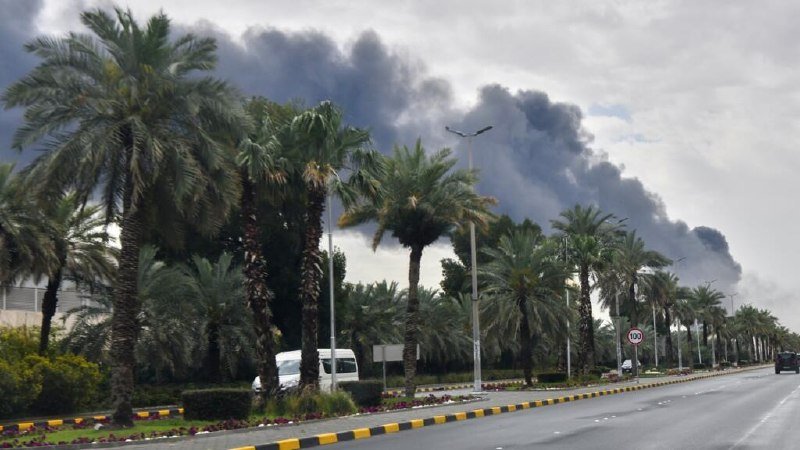
The skies above Jordan lit up in the small hours of 11 June 2026. Within a six-minute window between 01:55 UTC and 02:06 UTC, three Telegram channels — Middle East Spectator, AMK Mapping and GeoPWatch — pushed a cascade of stills and short clips showing what they described as missile interceptions over the kingdom. GeoPWatch reported "at least 5-6 missiles in the air," of which it said "at least 4 of them were launched towards Jordan"; AMK Mapping circulated a frame it captioned "one of the interceptions over Jordan"; Middle East Spectator posted a series of videos under the headline "The skies above Jordan right now." The visual grammar was identical across the three feeds: streaks, a flash, a smoky arc, a second streak. The captions named an Iran-US confrontation.
Strip away the choreography and the harder question is what, exactly, was being intercepted, and at whose direction. None of the channels in this thread is a primary source. They are rapid-relay accounts with military or geopolitical followings, and they share footage at speed precisely because speed is the product. The frame of a missile being shot down tells a reader almost nothing about which side fired it, where it was headed, or whether the target was an aircraft, a drone, or another missile. Yet the composite — Iran, US, Jordan, the same night — has already hardened into a single sentence in the wider information environment.
The dominant read is that Iran launched a salvo, US or allied interceptors engaged, and Jordanian airspace became the corridor. That is consistent with the captions. It is also consistent with what the Jordanian armed forces have been publicly preparing for: a public-facing posture, repeatedly affirmed in 2024-2025, of defending national airspace against spillover from regional conflicts. The alternative read is narrower and more cautious. The same kind of footage has, in previous flare-ups, turned out to show defensive barrages launched by one side at incoming drones launched by a third actor — Houthi, militia-affiliated, or non-state. The channels reporting last night do not specify the launch origin with the kind of coordinate-level detail that would let an outside observer tell a US-aimed Iranian ballistic from, say, an Israeli Arrow engagement with a cruise missile crossing Jordanian airspace en route to or from a target elsewhere. The framing has run ahead of the forensics.
Structurally, the incident sits inside a year-long pattern of competing narratives about escalation in the Levant. Western wire reporting, when it picks up a Jordan-centred intercept, defaults to an Iranian-launch frame; Iranian state-aligned channels, when they acknowledge an engagement at all, describe it as a US-Israeli act of aggression against Iranian assets in transit. Both versions are partially right and partially the product of editorial reflexes built up over a decade of tit-for-tat strikes. The middle ground — that a third party may have been the originating shooter, that Jordan was a transit corridor rather than a target, that the interceptions themselves may have been successful precisely because the defending side had pre-positioned — tends not to survive the first news cycle. The sources available at the time of writing do not adjudicate the question.
The stakes are concrete. Jordan hosts coalition air operations and US Central Command forward-deployed assets. A single night in which a neighbouring power's projectiles cross its airspace — even if intercepted cleanly — is a political fact as much as a military one. It validates the case made by Amman's Western-oriented security establishment for continued integration with US and Gulf air defence architectures, and it stiffens the regional consensus that any future negotiation with Tehran must be backed by demonstrable defensive capacity. For Iran, the framing matters too: an incident that is read as an Iranian launch is read as Iranian escalation, regardless of who pressed the button. The narrative cost is paid by the side whose flag is on the imagery, and last night the imagery carried an Iranian flag.
What remains uncertain is the inventory behind the streaks. The channels in this thread are unanimous on direction-of-fire and on the interceptions themselves; they are silent on warhead type, on the launching platform, and on which air defence system — Patriot, David's Sling, an Iranian TOR-M1 variant — produced the visible flash. The sources do not specify whether any projectile reached Jordanian territory, whether there were ground impacts, or whether the salvo was preceded by a diplomatic signal. Until a wire outlet with on-the-ground reporters in Amman publishes a confirmed count, the working assumption is that interceptions occurred and that the surrounding narrative is being assembled in real time by accounts that benefit from speed more than from precision.
Desk note: Monexus's editorial line on this kind of overnight event is to publish only what the available sources actually support, to flag the framing load that the imagery is already carrying, and to hold back on an attribution of launch authorship that the reporting, as of 11 June 2026 02:06 UTC, has not yet earned.
Wire provenance
This editorial synthesis draws on the following public wire/social posts:
- https://t.me/Middle_East_Spectator
- https://t.me/AMK_Mapping
- https://t.me/GeoPWatch