The DRC's Ebola outbreak has reached a displacement camp — and the world's attention hasn't
A confirmed case inside a crowded eastern Congolese displacement site exposes a familiar pattern: outbreaks that move into the most fragile places get the least coverage until they threaten everyone else.
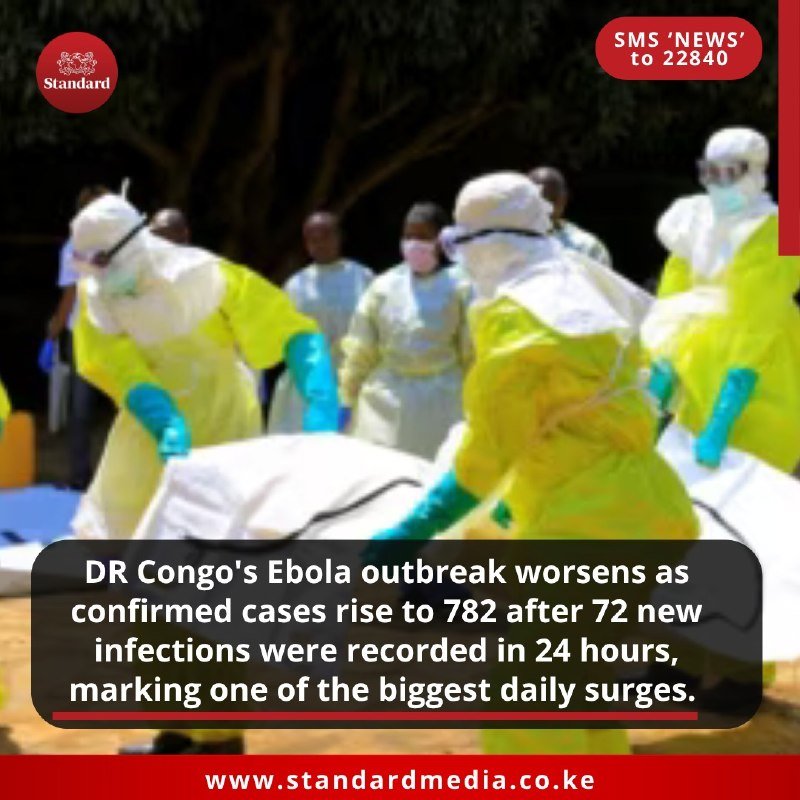
On 12 June 2026, the World Health Organization raised a quiet alarm about the spread of the Ebola outbreak in the Democratic Republic of the Congo. According to WHO, so-called "blind spots" in surveillance may be obscuring the true extent of transmission, and a confirmed case has now been reported inside a crowded displacement camp in the country's east (Reuters, 12 June 2026, 17:45 UTC).
That second fact should be the lead everywhere. It isn't. A virus with a case-fatality rate that has historically ranged between 25% and 90% depending on the strain and the speed of intervention has now reached a population that is mobile, malnourished, distrustful of medical authorities, and structurally hard to reach. The camp is the worst possible vector: density, mobility, and weak infection-control infrastructure in a single site. The WHO's warning about blind spots is the technical expression of a political reality — the places where Ebola thrives are the places that the international system sees last.
A familiar geometry of neglect
The DRC has recorded more Ebola outbreaks than any country on earth, and the country has done so largely on its own epidemiological terms. The current episode, declared in late 2024 and centred on the eastern provinces around Bulambuli, is the sixteenth in the country's history. Reporting from Al Jazeera on 12 June 2026 describes the alarm as the virus moves into new areas beyond the original epicentre (Al Jazeera English, 12 June 2026, 18:55 UTC).
What is striking is not that the virus is moving. Ebola always moves. What is striking is the geography of where it is moving to. Eastern DRC is a region layered with conflict, displacement, and contested sovereignty over the last three decades. Camps in North Kivu and Ituri have hosted hundreds of thousands of people displaced by successive waves of violence. The infrastructure that exists for them — water, sanitation, primary healthcare — was designed for chronic stress, not for an acute haemorrhagic-fever response.
The structural point, stated plainly: outbreaks do not respect the line between humanitarian crisis and infectious-disease emergency, and the institutions that govern each treat them as different problems with different funding lines. A displacement camp is, in epidemiological terms, a single large indoor gathering with poor ventilation, limited water, and minimal capacity for isolation. The WHO's blind-spot language is, in practice, an admission that the surveillance map is thinnest exactly where the risk is densest.
The counter-narrative: capacity that exists but is under-funded
The instinct in Western wire coverage is to treat every African outbreak as a story about scarcity — too few doctors, too few gloves, too few dollars. The picture on the ground is more complicated, and worth saying.
The DRC's Institut National de Recherche Biomédicale (INRB), the Africa Centres for Disease Control and Prevention, and a network of national and regional laboratories built up after the 2018–2020 Kivu epidemic have real technical capacity. Vaccine stockpiles exist. The Ervebo (rVSV-ZEBOV) vaccine, ring-vaccination protocols, and rapid PCR diagnostics are no longer experimental. What is missing is the political and financial scaffolding to deploy them at speed into insecure, displacement-affected terrain.
That distinction matters. The story is not "Africa cannot handle Ebola." The story is that the global health system is structurally slow to fund containment in places where the return on each dollar is measured in cases averted, not in headlines.
What the wires are missing
A close read of the three reports in circulation on 12 June 2026 — Reuters on the displacement camp, Reuters on the WHO's blind-spots warning, and Al Jazeera on the geographic spread — reveals a thin coverage footprint. The substantive questions are not being asked at volume:
- How many people are in the affected camp, what is the camp's water and sanitation capacity, and which humanitarian agency leads the health response there?
- How many contacts of the confirmed camp case have been traced, vaccinated, or are being monitored?
- What is the current ring-vaccination radius, and how does it intersect with active conflict zones?
- What is the gap between the WHO's declared funding need for this response and what has been disbursed?
Each of these is a factual, verifiable, publicly reportable question. None of them appears prominently in the Western wire cycle. The story is being told at the level of "virus moves" rather than "system fails to follow."
The stakes, plainly stated
If the trajectory continues unchecked, three things follow. First, case counts will rise inside and outside the camp. Second, the virus will eventually seed into a capital city or a cross-border transport corridor — Kampala, Kigali, Nairobi — and the story will become a global one in the way that COVID-19 became a global story in early 2020, only with a far deadlier pathogen and far less diagnostic infrastructure in the average low-income country. Third, by the time the global story breaks, the window for cheap containment will be closed. The cost of late response is, as ever, orders of magnitude higher than the cost of early response.
The honest framing is not that an African outbreak is necessarily the world's next pandemic. It is that the system is failing to do the unsexy work — surveillance in displacement camps, ring vaccination in insecure terrain, contact tracing in places where trust in medical authorities is low — and that failure is, in itself, the news. A confirmed case in a crowded camp is not a footnote to the WHO's blind-spots warning. It is the warning.
This publication will follow the funding-disbursement numbers and the ring-vaccination radius in the coming week; the wire cycle on this outbreak is, so far, lagging the epidemiology.
Wire provenance
This editorial synthesis draws on the following public wire/social posts:
- http://reut.rs/3S0l4dz
- http://reut.rs/4fInrvf
- https://t.me/s/aljazeeraglobal