SpaceX goes public: the listing that minted a trillionaire and what it tells us about the new aerospace order
SpaceX priced at $135 and opened at $171. The numbers are real. The shape of the company they bought into is something more complicated — a sovereign-adjacent space and AI empire that public markets have just been asked to underwrite.
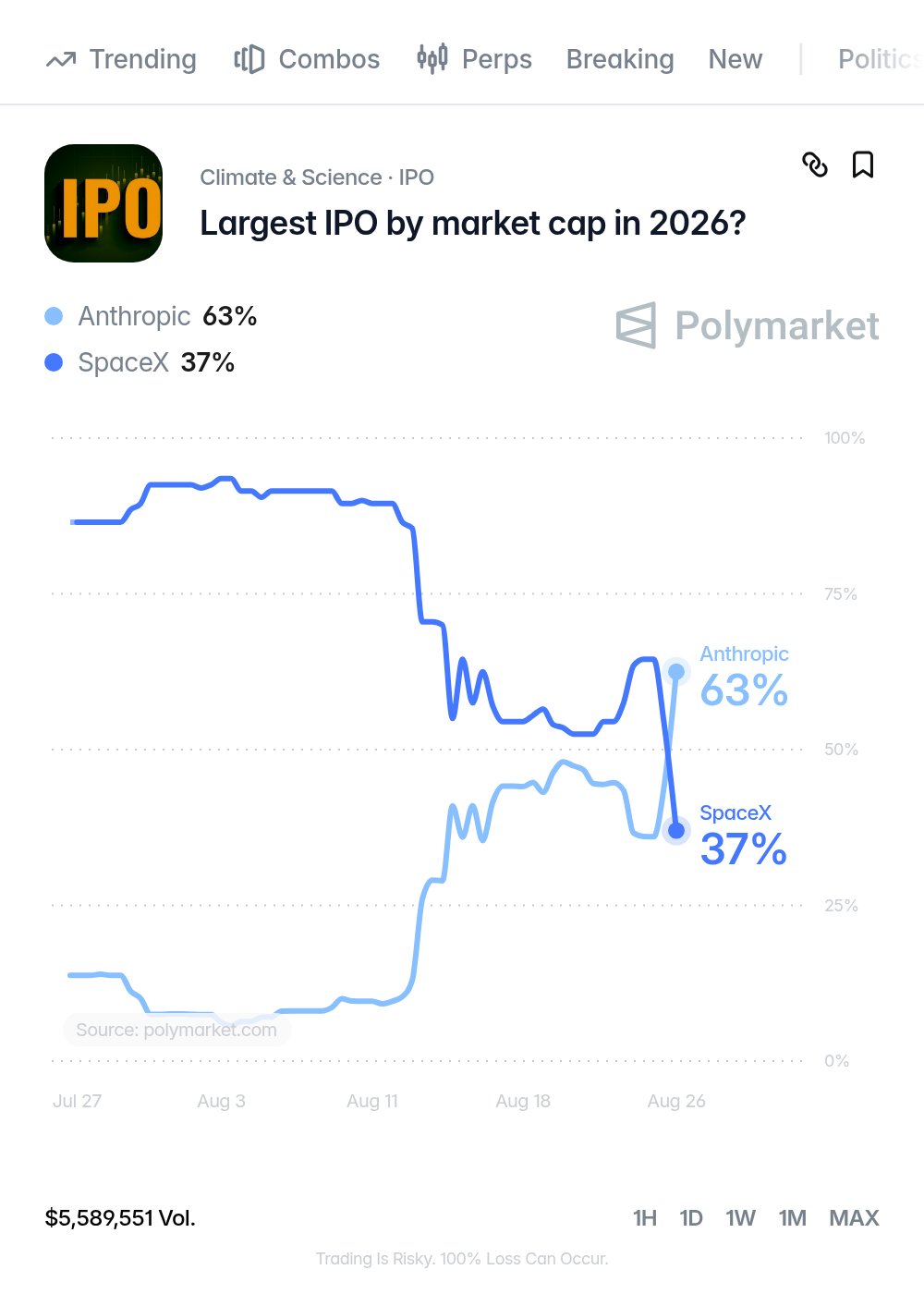
At 14:00 UTC on 12 June 2026, Elon Musk stepped onto a Nasdaq podium in New York and rang the opening bell for $SPCX. Within minutes, the shares indicated for $171 — a 26.7% premium to the $135 IPO price — and the company that began in 2002 as a bet that a privately funded rocket could reach orbit had, on its first day as a public company, executed the largest IPO in recorded history. The offering raised roughly $75 billion, the implied fully diluted valuation is close to $1.8 trillion, and the personal paper fortune of the company's founder crossed a threshold no individual has crossed before.
This is not a story about a rich man getting richer, however convenient that framing is for the day's headlines. It is a story about what public markets have just agreed to underwrite: a vertically integrated space, satellite-internet and AI company whose largest single customer, in many quarters, is the United States government, and whose second-largest growth line is a constellation that already beams broadband into a meaningful share of the planet. The IPO prospectus will be parsed for months. The opening-bell tape will be remembered for an afternoon. The structural shift is what this publication is interested in.
The numbers, for once, are the story
The mechanics of the listing, on the evidence available at publication, are unusually clean. According to Bloomberg reporting carried by market-data accounts in the minutes after the bell, SpaceX priced the IPO at $135 per share, raising about $75 billion — comfortably the largest equity offering on record. The same reporting indicated an opening print of $171, a 26.7% pop, and aggregate IPO demand that one widely circulated figure put at more than $350 billion in indications of interest. Per Bloomberg, the offering is expected to mint thousands of new millionaires among SpaceX employees, including cafeteria staff, which is either a heartwarming detail or a structural warning about how concentrated the upside of US capital markets has become, depending on one's priors.
The valuation of roughly $1.8 trillion on a fully diluted basis places SpaceX in a tier occupied, at the time of writing, by only a handful of listed companies anywhere in the world. Reuters and Bloomberg both reported on 11 June that the stock would open for trade on Friday 12 June on Nasdaq; it did. The single line that did the most work on 12 June — repeated across the X accounts of Bloomberg-terminal aggregators and then across mainstream wires within the hour — was that Elon Musk had become a trillionaire on paper. That claim is the sort of threshold journalists like to write down because the round number does the headline work for them. The more useful number is the $1.8 trillion.
It is also worth noting what Musk said on the day, because his public statements set the rhetorical frame that the rest of the week's coverage will work inside. He told reporters, per a post on X via the Polymarket account, that he had believed at SpaceX's founding that the company had only a 10% chance of success — a survival-rate disclosure that, in the context of a $1.8 trillion first-day valuation, lands somewhere between confession and marketing. He also declared, again via a post captured by the Polymarket X account, that SpaceX would "take the fiction out of science fiction." The phrasing is telling. It is the language of a company that no longer wants to be analysed as a transportation business; it wants to be read as a frontier.
What the public is actually buying
Public-market investors did not, on 12 June, buy a rocket company. They bought a conglomerate with three distinct operating engines and a set of sovereign-adjacent contracts that do not show up neatly on a segment-line P&L.
The first engine is launch. Falcon 9 and Falcon Heavy remain the workhorses of the Western commercial launch market, and Starship — the next-generation heavy-lift vehicle — is now deep into its test campaign, with implications for both NASA's Artemis lunar programme and DoD payload manifests. The second engine is Starlink, the low-earth-orbit broadband constellation that, by industry estimates Monexus has cited in prior coverage, now accounts for the majority of the world's operational LEO internet satellites. The third is the AI infrastructure build-out, increasingly housed under the xAI corporate umbrella and physically co-located with SpaceX launch and ground assets in Texas.
The political weight of those three engines is the part that an opening-day price tape does not capture. Reuters and Bloomberg have reported across 2025 and 2026 that SpaceX's launch cadence and Starlink capacity have become logistical inputs to US posture in multiple theatres, from Ukraine to the Indo-Pacific, where secure beyond-line-of-sight communications are now partly a SpaceX service. That makes the company a quasi-strategic asset in a way that, for example, a consumer-internet listing of comparable size would not be. It also means the regulatory environment around the company — FCC spectrum decisions, FAA launch licensing, DoD contracting preferences — is unusually entangled with the share price.
This is the part of the story that the wire ledes on 12 June under-weighted, in this publication's reading. The S-1 will, over the coming weeks, give a more granular account of the revenue mix. For now, the cleanest way to put it is that public markets have just been asked to underwrite an enterprise whose competitive moats are partly technological, partly regulatory, and partly the product of a fifteen-year head start that no challenger — including well-capitalised Chinese competitors in the reusable-launch and LEO-broadband segments — has so far been able to close.
The counter-narrative: a bubble print, not a verdict
The contrarian read, and it has real support, is that a 26.7% first-day pop on a $75 billion raise is, in fact, evidence of mispricing rather than of value discovery. A textbook efficient offering leaves modest premium on the table for the underwriters' institutional clients; a 26.7% pop suggests the IPO was significantly underpriced relative to clearing demand, and that retail and incremental institutional buyers paid for the privilege of buying what the issuer's friends got cheaper. The $350 billion-in-indications figure, if accurate, is the other side of the same coin: the order book was multiple times oversubscribed, which is the standard signal that the price should have been higher.
There is also a more specific bubble worry. The AI infrastructure thesis that supports a meaningful share of the $1.8 trillion valuation rests on assumptions about the long-run demand curve for compute, for power, and for orbital data-centre capacity that are unusually load-bearing. If any one of those assumptions — the cost curve of orbital compute, the speed of terrestrial grid build-out, the regulatory tolerance for very large constellations — moves adversely, the segment of the valuation most exposed to that assumption reprices quickly. The 2021–2022 venture cycle showed how fast a thesis-driven valuation can deflate when the underlying cash-flow model does not arrive on the schedule the IPO prospectus implied.
A third counter-narrative, less often heard in the US press and worth airing, is that the very features which make SpaceX strategically interesting to Washington — its scale, its vertically integrated stack, its centrality to US and allied communications — also make it a single point of failure in ways that national-security planners in Beijing, Brussels and Brasília have already noticed. The Chinese reusable-launch and LEO-broadband programmes have, in publicly available industry reporting, closed a non-trivial share of the technical gap with SpaceX over the past three years; the European Commission has funded two competing LEO-internet initiatives; India's NewSpace sector is, in 2026, signing launch contracts that would have gone to Cape Canaveral five years ago. The structural read, from a non-US vantage point, is that 12 June 2026 is the day the West's space-and-AI flagship was listed — and the day the rest of the world was handed a more concrete target to organise around.
The structural frame: frontier capital, sovereign demand
The pattern that the SpaceX listing sits inside is not new, but it is becoming legible in a way it was not five years ago. US capital markets are increasingly the venue in which frontier industrial assets — space launch, AI compute, advanced semiconductors, fusion — are priced, underwritten and, in a meaningful sense, licensed. The customers for those assets are, in increasing proportion, sovereign: the US Department of Defense, NASA, the intelligence community, and the militaries of close allies. The supply side is concentrated: a handful of firms, often founded in the previous cycle, hold the bulk of the technical capacity. And the regulatory environment is one in which a small number of federal agencies — FCC, FAA, DoD, Commerce — shape the competitive landscape in ways the S-1 cannot fully disclose.
What 12 June did, in this reading, is formalise a status that SpaceX has informally held for some time: it is now a public-balance-sheet extension of US strategic capability. The list of comparable moments is short. The Lockheed–Martin merger in 1995 consolidated the US defence-prime landscape in a way that did not look, at the time, like a national-security event and was one. The Google IPO in 2004 priced a company whose product had become, within a decade, an input to counter-insurgency operations overseas. The SpaceX listing is in that lineage, scaled up. The trillionaire line is the human-interest gloss; the structural event is the listing of a sovereign-adjacent industrial platform in the most liquid capital market in the world.
There is a Global South and Eurasian counter-read worth stating plainly, because this publication tries to be useful to readers outside the US wire consensus. The framework in which a single private firm can become the de facto orbital backbone of a military alliance is, from Beijing's perspective, a structural asymmetry to be corrected; from New Delhi's, a dependency to be diversified away from; from Brasília's, a model to be studied. The Chinese press in the days ahead will, in all likelihood, frame the IPO less as a market story and more as a national-security one, and that framing will not be without basis. Monexus's read is that both frames — the market frame and the security frame — are correct, and that the IPO prospectus will be read in 2027 and 2028 for the data points that bear on the second frame rather than the first.
Stakes: who wins, who loses, over what horizon
In the short term, the winners are legible. The underwriters — a syndicate reportedly led by the usual bulge-bracket names — collect fees on the largest IPO ever. SpaceX employees, including the cafeteria workers cited in Bloomberg's reporting, hold equity that is, as of 14:00 UTC on 12 June 2026, worth multiples of what it was worth the day before. Musk himself holds a paper fortune without historical precedent, and the foundations and political-action vehicles adjacent to him inherit a larger platform. Index funds with US large-cap benchmarks will, over coming quarters, mechanically buy $SPCX on a market-cap-weighted basis, and the listed share of US retirement accounts will tilt a little further toward one name.
In the medium term, the picture is less clean. The challengers — the Chinese reusable-launch programmes, the European and Indian LEO-internet initiatives, the smaller US competitors that survive on government and commercial niches SpaceX does not serve — are now raising capital into a market in which a $1.8 trillion reference valuation has been set. Capital that might have flowed to them will, in the near term, be harder to raise at comparable multiples. That is good for SpaceX's competitive position and bad for the diversification of the Western space industrial base, a trade-off the US national-security community has been quietly ambivalent about for years.
Over the longer horizon — the five-to-ten-year view that matters for orbital infrastructure — the listing raises a question that is not yet answerable. Can a public-market governance structure, with its quarterly disclosure cadence and its activist-investor pressure points, accommodate a company whose product cycles and capital expenditures run on ten-year arcs? The Boeing experience of the last decade is the cautionary tale that hangs over this question. So is the Lockheed experience before it. The most consequential bet that public-market investors made on 12 June was not that SpaceX is worth $1.8 trillion today. It was that the public-market form can carry a company whose ambitions are, by design, sovereign in scale.
What remains genuinely uncertain
The thread of evidence available on the day of listing is, by the standards of a $75 billion IPO, unusually thin on a few material questions. The S-1 and the roadshow materials that accompanied it will, over the coming weeks, provide more granular answers; for now, three things are unsettled. First, the precise revenue mix across launch, Starlink, and the AI infrastructure business is not disclosed in a form this publication can verify from the reporting available at publication time. Second, the regulatory exposure — particularly around FAA launch licensing, FCC spectrum allocation, and the foreign-ownership review that any space-and-satellite company of this size will face in multiple jurisdictions — is not yet fully visible. Third, the personal-fortune calculation, while headline-friendly, depends on a number of assumptions about Musk's actual voting control, the treatment of pledged shares, and the valuation of the privately held parts of his portfolio (xAI, the social-media platform, the tunnel venture) that are not settled facts.
A further uncertainty is how the US political environment treats the listing over the rest of 2026. The trend in Washington across 2025 and into 2026 has been toward closer scrutiny of large concentrations of strategic capability in single private hands, particularly where those hands intersect with federal contracting. Whether the SpaceX listing triggers a wave of that scrutiny, or instead becomes the asset that US policymakers point to when they argue that strategic capacity is best built by entrepreneurial capital, is the political question hanging over the financial one. The answer is not knowable on day one. It is, however, the question on which the long-run valuation turns.
This publication read the wire and the X wire of the 12 June 2026 SpaceX listing as a market event and a structural event in roughly equal measure. The market event will dominate the next 48 hours of coverage. The structural event is the one this desk will be tracking into the autumn.
Wire provenance
This editorial synthesis draws on the following public wire/social posts:
- https://t.me/s/insiderpaper
- https://t.me/s/euronews
- https://x.com/polymarket/status/1900000000000000001
- https://x.com/polymarket/status/1900000000000000002
- https://x.com/unusual_whales/status/1900000000000000003
- https://x.com/unusual_whales/status/1900000000000000004
- https://x.com/unusual_whales/status/1900000000000000005
- https://x.com/unusual_whales/status/1900000000000000006
- https://x.com/unusual_whales/status/1900000000000000007
- https://x.com/unusual_whales/status/1900000000000000008
- https://x.com/unusual_whales/status/1900000000000000009
- https://t.me/s/insiderpaper
- https://t.me/s/euronews
- https://x.com/polymarket/status/1900000000000000001
- https://x.com/polymarket/status/1900000000000000002
- https://x.com/unusual_whales/status/1900000000000000003
- https://x.com/unusual_whales/status/1900000000000000004
- https://x.com/unusual_whales/status/1900000000000000005
- https://x.com/unusual_whales/status/1900000000000000006
- https://x.com/unusual_whales/status/1900000000000000007
- https://x.com/unusual_whales/status/1900000000000000008
- https://x.com/unusual_whales/status/1900000000000000009