Pakistan brokers surprise US–Iran ceasefire, with Lebanon clause attached
Pakistani PM Shehbaz Sharif announced a US–Iran 'peace deal' on 14 June, including a permanent halt to operations in Lebanon. Sign-off is set for 19 June in Switzerland, with Tehran and Washington still to confirm the text.
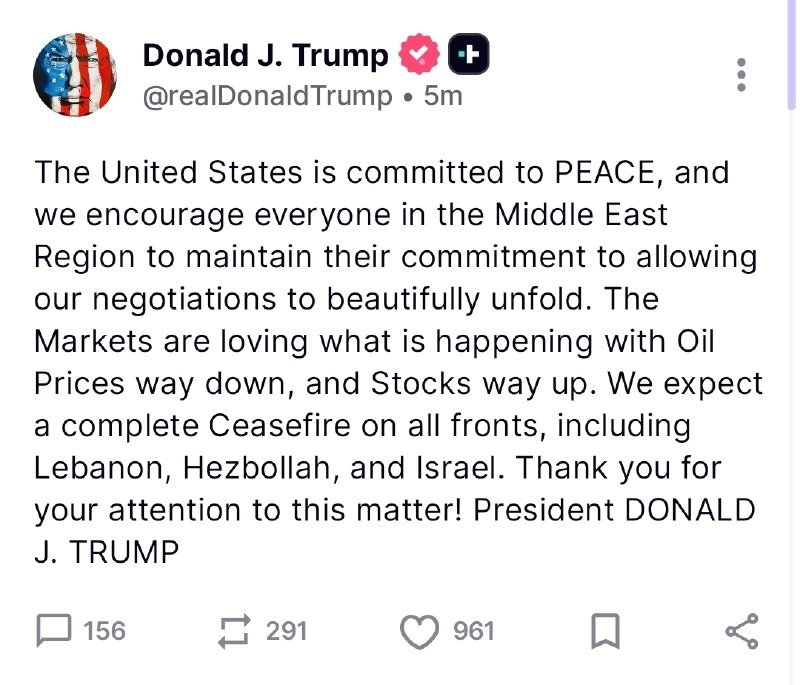
Pakistani Prime Minister Shehbaz Sharif said early on 14 June 2026 that the United States and Iran had reached a "Peace Deal" following "intensive talks," with a memorandum of understanding to be signed in Switzerland on Friday 19 June. In a statement carried by Iranian state-aligned channels and replicated by open-source intelligence accounts within minutes, Sharif declared an immediate and "permanent" halt to military operations "on all fronts, including in Lebanon." The announcement, if confirmed by Washington and Tehran, would mark the most consequential de-escalation between the two adversaries in years, and the first publicly claimed ceasefire to explicitly fold the Lebanon front into a US–Iran framework.
The claim is a single-source declaration at this hour: a Pakistani prime minister speaking on his own platform, against the backdrop of a regional war that has already redrawn Mediterranean and Gulf shipping lanes. Neither the US State Department, the White House, nor the Iranian foreign ministry had issued on-the-record confirmation in the immediate window after Sharif's post. Deutsche Welle's English desk reported the announcement as wire copy, citing Sharif, without independent corroboration from either capital. That asymmetry is the story behind the story.
What was actually announced
The text Sharif released, as captured by multiple Telegram accounts monitoring the statement in real time, frames the outcome as a "Memorandum of Understanding" rather than a formal peace treaty. The four operative claims in the prime minister's statement are: a halt to military operations on all fronts, including in Lebanon; the inclusion of Lebanon inside the deal's scope; a permanent, not provisional, character; and a signing ceremony scheduled for 19 June in Switzerland — a venue consistent with the long-standing back-channel between Iranian and American delegations that has used Geneva and Lausanne as neutral ground.
Lebanon's inclusion is the politically loaded clause. The Israel–Hezbollah front has been the kinetic expression of the wider US–Iran confrontation for two decades, and tying it to a bilateral US–Iran document recasts the fight from a regional conflict into a schedule item in a great-power ledger. The phrasing — "permanent termination of military operations on all fronts, including in Lebanon" — is the prime minister's, not a joint communique, and that distinction matters for any government asked to honour it.
Why Pakistan, and why now
Islamabad has spent two years positioning itself as a candid interlocutor between the Gulf and Tehran, with Shehbaz Sharif personally cultivating relationships with both the Saudi leadership and the Islamic Republic. The mediation is consistent with a longer pattern: Pakistan hosted the 2023 Riyadh-facilitated Iran–Saudi rapprochement that restored diplomatic relations after a seven-year break. That earlier success, brokered with Chinese encouragement and with quiet US acquiescence, gave Islamabad a track record it could now convert into a claim of relevance on a far bigger file.
The timing is harder to read. The war's economic cost — through the Bab el-Mandeb and the Strait of Hormuz, the two chokepoints through which roughly a third of seaborne oil moves — has been politically unbearable for Pakistan itself, which has absorbed energy-price shocks without the fiscal buffers of the Gulf monarchies. Sharif's claim of "intensive talks" is therefore not implausible; it is also exactly the kind of announcement a leader under domestic economic pressure might prefer to be true.
The corroboration problem
Within forty minutes of the prime minister's post, three distinct categories of source had repeated the claim: Iranian state-aligned media (Press TV, the English-language channel of Iranian state broadcasting); Western wire desks reproducing Sharif's statement (Deutsche Welle); and pan-Arab and open-source intelligence accounts (Middle East Spectator, DD Geopolitics, the @sprinteraccount account on X). What was missing was any confirmation from the Office of the Iranian President, the Iranian foreign ministry, the US State Department, the National Security Council, the Israeli Prime Minister's Office, or the Lebanese government — all of whom have direct stakes in a deal that claims to bind them.
In a region where mediated announcements are sometimes floated to test markets, move currencies, or pressure a counterpart, a single-source claim of this magnitude deserves to be read as a claim, not a fact. The next seventy-two hours will determine which it is.
What a real deal would do, and what this one might not
If both governments ratify a memorandum that includes a Lebanon front, the immediate consequences would be: a stop to Israeli–Hezbollah exchanges under an Iranian guarantee; a binding cap on Iranian proxy activation elsewhere; and a tacit US acceptance that Lebanon's armed non-state actors sit inside Tehran's risk envelope. For Beirut, the calculus is asymmetric — Hezbollah's leadership has historically resisted any framework negotiated in its absence, and a Pakistan-brokered text would carry limited legitimacy inside the Shia street that pays the highest cost of the war.
For Israel, the deal architecture, if confirmed, would shift the centre of gravity in the war from the battlefield to the diplomatic table, where Israeli leverage is narrower. For Iran, it would convert a war economy into a sanctions-economy question, and test the gap between the Islamic Republic's maximalist rhetoric and its actual willingness to constrain regional clients. For Washington, it would mean accepting an arrangement whose details have been negotiated without the involvement of the Gulf partners most exposed to the consequences — Saudi Arabia, the UAE, and Qatar — and of Israel.
The structural frame is plain enough without recourse to grand theory: a peripheral power, with strategic depth and a recent mediation win, claims to have converted proximity into leverage. The pattern — a middle state converting diplomatic access into a seat at the great-power table — is familiar from the 2023 Iran–Saudi file, from Norway's Oslo role in the 1990s, and from Qatar's decade-long shuttle between Washington, Tehran, and Hamas. What distinguishes this claim is the scale of the war it purports to end, and the absence, so far, of the parties whose signatures would make it binding.
The uncertainty that should sit at the centre of this story
The sources do not specify who represented Iran in the "intensive talks" Sharif described, nor whether the text in Pakistani hands has been seen by the Iranian foreign ministry, the US special envoy for the region, or the Lebanese government. They do not confirm the agenda of the 19 June signing, the format of the document, or whether the "permanent" character is reciprocal, sequential, or conditional. The most consequential single question — whether Tehran is signalling that it is willing to publicly subordinate its Lebanese front to a bilateral great-power document — is, on the evidence available, unresolved. Sharif has said the deal has been "REACHED." The capitals that would have to sign it have not yet said so.
That is not a reason to dismiss the announcement. It is a reason to read it carefully: as the opening move in a diplomatic week, not as its conclusion.
This publication treats single-source mediated announcements of regional war-ending deals as claims until corroborated by the principals. Where a Pakistani prime minister speaks for Washington and Tehran, we will say so plainly and wait for the principals to do the same.
Wire provenance
This editorial synthesis draws on the following public wire/social posts:
- https://t.me/presstv/
- https://t.me/Middle_East_Spectator/
- https://t.me/thecradlemedia/
- https://t.me/DDGeopolitics/
- https://t.me/osintlive/
- https://t.me/Liveuamap/
- https://t.me/wfwitness/