Knicks title brings Broadway to a standstill — and exposes the city's split-screen problem
A 53-year drought ended on Saturday night, and a city that knows how to throw a parade woke up to 63 arrests, four stabbings and a shooting.
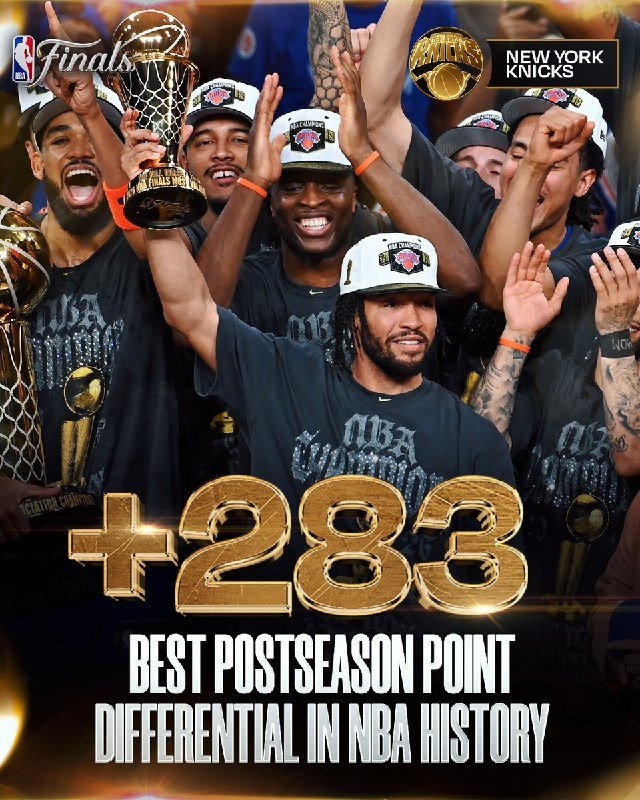
Lead. The confetti had barely settled at Madison Square Garden on Saturday night before the New York Knicks' first NBA championship in 53 years stopped being a sports story and started becoming two stories. On one side: bedlam on Broadway, tens of thousands pouring out of the arena and into the surrounding blocks, a city that has not celebrated anything like this since 1973 finally allowing itself to believe. On the other: a Manhattan overnight that produced 63 arrests, four stabbings and one shooting, the kind of incident sheet the NYPD has learned to expect when a crowd of that size and that emotional temperature takes over the West Side.
Nut graf. Every championship produces a split-screen — the parade route's joy and the casualty count on the back end. What is unusual this time is the scale of both halves. The Knicks' drought is one of the most cited in American professional sports; the celebration that broke it is now producing a public-safety ledger that will define the next 72 hours of coverage, in New York and beyond. Both halves are real. The task is reporting them without letting either crowd the other out.
The win, and the wait behind it
The Knicks' title ended the second-longest championship drought in the NBA, a stretch that outlasted entire generations of New York fans. ESPN's wire on 14 June 2026 described celebrations that erupted across the city, centred on the blocks around the Garden, with fans pouring into the streets within minutes of the final buzzer. The team's last title came in 1973, when the city still had two NBA franchises and Madison Square Garden was, as ever, the gravitational centre of the room.
The framing matters because a drought that long accumulates mythology. Every spring for half a century the question of whether this was the year became a small civic ritual, and the answer was always no. The relief is not metaphorical. A title removes the question from the calendar; it also hands the city something to celebrate that is not a political crisis, a transit failure or a corruption indictment, and a population that has had few such gifts lately has taken it.
The other ledger
The same night produced a public-safety picture that will sit alongside the trophy coverage. A thread posted to the OANNTV Telegram channel on 14 June 2026 at 22:47 UTC catalogued the overnight toll: 63 arrests, four stabbings and a single shooting, with incidents scattered across Manhattan. The figures are preliminary and the channel's framing tends toward amplification, but the underlying count is consistent with what the NYPD typically logs when a major sporting event spills tens of thousands of people onto streets that were not closed to traffic for the volume.
The honest reading of those numbers is neither hand-waving nor moral panic. A city of 8.3 million will, on any given Saturday, log a non-trivial number of stabbings and arrests. What makes championship nights different is the denominator: crowd density, alcohol consumption, and the compression of thousands of emotionally charged people into a small geography. The stabbings and the shooting are not abstractions; the four people involved in those incidents are not abstractions either. So are the tens of thousands who partied, took the subway home, and woke up hungover on Sunday morning.
The structural frame
The split-screen is not new, and it is not specifically a Knicks problem. Every host city that wins a major title has learned to manage the same arithmetic: pre-positioned medical and police assets, surge transit, designated viewing zones, dry-runs of crowd-flow plans that are themselves products of post-mortems from previous celebrations gone wrong. New York is unusually good at this — the city's playbook for victory parades dates to the ticker-tape era — and unusually challenged by it, because the areas where fans actually want to gather are not the areas built to absorb them.
The deeper pattern is that the cost of the celebration is borne unevenly. The hospitals that take the stabbings, the precincts that process the arrests, the small businesses near the Garden that board up and reopen, and the residents of the West Side blocks that become a pedestrian river for the night are the same set of stakeholders every time. The fans who travel in from the suburbs and disperse to the LIRR face none of that. The two groups are celebrating the same thing; they are not paying the same price.
That imbalance is structural, and it is the kind of thing that public-safety planning is meant to address but rarely does, because the constituencies with the loudest voices on parade night are the ones with the most ephemeral exposure.
What remains uncertain
A few things the available reporting does not resolve. The OANNTV thread does not specify which Manhattan precincts produced the four stabbings, the time window over which the 63 arrests were tallied, or whether any of the incidents are linked. The ESPN report covers the celebration in broad strokes and does not attempt a public-safety ledger. The NYPD's own preliminary statement, if issued, has not surfaced in the available materials; until it does, the 63-arrest figure should be treated as an early overnight count rather than a final tally, and the stabbing and shooting figures carry the same caveat.
What is not in doubt is the magnitude of the underlying event. A city that had not won a basketball title in 53 years finally won one, and it celebrated the way it celebrates everything — at full volume, in the streets, and without asking anyone's permission. The price of that celebration is now being tallied. Both halves of the picture deserve the same journalistic weight.
— Desk note: Monexus is framing this as a split-screen, not as a victory parade or a crime story in isolation, because the available reporting supports both halves and the more useful analysis sits in the seam between them.
Wire provenance
This editorial synthesis draws on the following public wire/social posts:
- https://t.me/s/OANNTV