Newsom accuses Trump of weaponising DOJ as 2028 calculus surfaces
California Governor Gavin Newsom used a primetime interview to accuse Donald Trump of steering the Justice Department for political ends, sharpening a Democratic line of attack ahead of the midterms and the 2028 calculus already forming around him.
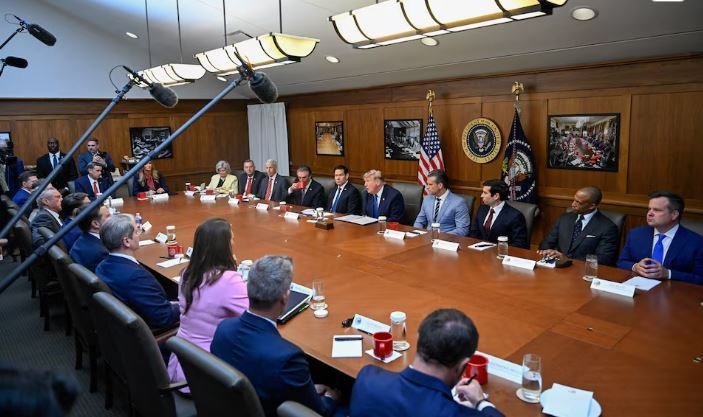
California Governor Gavin Newsom used a national television appearance on Tuesday to accuse President Donald Trump of turning the Department of Justice into an instrument of personal political warfare, sharpening a Democratic line of attack that has migrated from cable panels onto the campaign surrogate circuit and now, increasingly, into the formal posture of governors weighing 2028.
The accusation, delivered in a primetime interview that aired less than four months before the midterm cycle formally closes, lands at a moment when several of Trump's most consequential Justice Department moves have prompted internal dissent and external legal pushback. Newsom's framing, that a sitting president is using the federal investigative apparatus to settle scores with political opponents, mirrors the argument that Democratic strategists have been refining in private for months and that they now appear ready to weaponise in the open.
The allegation, and what it actually claims
Newsom's core charge is procedural as much as it is political: that prosecutorial decisions traditionally insulated from the White House have been steered, in this administration, by the preferences of the president and his political allies. He cited, by name, the public clashes between career DOJ attorneys and political appointees over high-profile indictments, and pointed to the pattern of investigations opening against figures who have publicly clashed with Trump while closing against figures aligned with him. The argument is not new. It is, however, the first time a governor with a plausible 2028 apparatus behind him has made it with this much explicit presidential scaffolding.
The Justice Department has not publicly corroborated or denied the substance of Newsom's claims, and several of the specific matters he referenced remain in active litigation or under seal. That asymmetry is itself the story. A governor can level an accusation on cable; the Department it implicates is, by design, barred from responding in kind while matters are pending.
A familiar playbook, repackaged
What Newsom is selling is not a novel thesis. The claim that DOJ has been politicised is as old as the modern Department, and every modern president has fielded some version of it from the opposition. What is different is the architecture around it: a governor with national fundraising infrastructure, a state-level legal apparatus that can file parallel actions, and a media operation that has spent two years practising exactly this kind of accusation in lower-stakes settings. Newsom has built a brand on direct confrontation with Trump, including the now-notorious podcast appearances and the running meme war. The DOJ allegation is that brand applied to the federal level.
It is also a tryout. The governor's office is not the launching pad it once was for Democratic presidential ambitions, but it remains the most visible non-Washington perch in the party. By staking out a position this aggressive so early in the cycle, Newsom signals to donors and primary voters that he is willing to use the Department of Justice, and the broader question of its independence, as a defining 2028 wedge rather than a procedural complaint.
The Vance factor
The timing of Newsom's comments intersects awkwardly with a separate, less publicised story: reporting from NewsNation's Kellie Meyer, summarised by OSINT aggregators earlier this week, that Republican members of Congress are privately blaming Vice President JD Vance for what many have characterised as a bad US–Iran deal. The two threads are not formally connected, but they share a structural feature. In both, a Trump-administration outcome is being attributed, by members of the president's own coalition, to the influence of a specific senior figure rather than to the president himself.
That is the pattern Democratic strategists believe they can exploit in the midterms and beyond. If the Justice Department is being run for the benefit of the president's political preferences, and if the foreign-policy portfolio is being run for the preferences of the vice president, then the case for a coordinated Democratic response across both fronts becomes easier to make. Newsom's appearance is the first time those two threads have been woven together on a single platform, by a single figure, with a single rhetorical frame.
What the Justice Department actually did
The specific conduct Newsom cited is harder to verify than the framing suggests. Career attorneys have, in fact, resigned publicly from the Department over the past several months, and at least two have done so in formal letters that reference disagreements over the handling of politically sensitive matters. Those letters exist. The interpretive leap from "career attorneys have left" to "DOJ has been weaponised" is the leap Newsom made on television, and it is the leap his own staff spent the following morning reinforcing on social media.
The cases Newsom gestured at are, by long-standing departmental convention, off-limits for public comment by sitting Justice officials. That convention protects the integrity of prosecutions, but it also creates a one-sided information environment in which a politician can build a narrative without contradiction from the institution he is attacking. The Department has, in adjacent contexts, pushed back on similar claims through carefully worded statements defending the independence of its investigations. None of those statements have addressed Newsom's specific allegations by name.
Stakes for 2026 and 2028
The immediate stakes are midterms. Democratic House candidates need a closing argument that motivates base voters without alienating independents, and the proposition that the federal law-enforcement apparatus is being run for partisan purposes is one of the few arguments in the file that does both. Newsom's national visibility gives that argument a surrogate with a press operation already built to scale it.
The longer stakes are the 2028 primary. If Newsom runs, he will not be the only candidate making the DOJ argument, but he will be the only one who made it first, on this platform, in this register. That has a way of mattering in a Democratic primary, where the penalty for being late to a defining frame is severe. The governor knows this. The cable bookers know this. The Justice Department, bound by its own conventions, can only watch.
What to watch next
Three dates will determine whether Newsom's accusation hardens into a defining 2026 closing message or dissipates into the noise of a long cycle. First, any unsealed filing in the cases Newsom gestured at would force the Department into a public posture, by name, for the first time. Second, the next public letter of resignation from a career DOJ attorney will be read, inevitably, through Newsom's frame. Third, the governor's own travel schedule over the next six weeks will tell Democratic operatives whether he intends to make the DOJ argument a surrogate duty or a personal signature issue. The first path is shareable. The second is exclusive. The party is about to learn which one Newsom has chosen.
Sources
- https://t.me/osintlive, OSINTdefender summary of NewsNation's Kellie Meyer reporting on Republican criticism of Vice President Vance over the US–Iran deal
- https://t.me/france24_en, France 24 English wire channel
- https://t.me/aliahzeeraennews, Al Jazeera English news channel
- https://t.me/rnintel, Republican-aligned intelligence and commentary channel
- https://t.me/france24_en, France 24 English wire channel (secondary)
Desk note: Monexus treats Newsom's allegation as a claim by a named public official, not as a corroborated fact. The Justice Department has neither confirmed nor denied the specific conduct described on air; the article reflects that asymmetry by attributing the characterisation to Newsom and his staff rather than asserting it as an established pattern. We will update this piece when primary-source wire reporting supplies a confirmation or denial from the Department itself.