After the strikes, a digital signature: what the US-Iran memorandum of understanding actually says
A memorandum of understanding, signed digitally between Washington and Tehran, paused a war that markets had already started pricing. The text is thin, the trust thinner, and the 30-day US withdrawal clause is already the most contested line.
By mid-afternoon Geneva time on 2026-06-15, the most-watched diplomatic handshake of the year had been replaced by something less photogenic: a digitally signed memorandum of understanding between the United States and the Islamic Republic of Iran, transmitted across the channels that still connect the two governments after weeks of direct strikes. The US side said the document was signed digitally. Iran said it was being finalised. Both, in their own way, were right — a draft was initialled, the language was still moving, and the markets had already made up their minds.
The MOU is the first concrete artefact to come out of the post-strikes track that opened in early June. It commits, on the US side, to releasing access to frozen Iranian funds and to withdrawing American forces from Iranian territory within thirty days of the deal's entry into force, according to a BBC report cited by Unusual Whales at 14:37 UTC. It commits, on the Iranian side, to constraints on its nuclear and missile programmes that have not yet been published in full. Bitcoin, which had been trading as a real-time gauge of escalation risk through the strikes, fell back from its panic highs as the headline crossed, per CoinDesk's live markets blog at 05:19 UTC. The story is not that a war ended. The story is that a war is being priced out, in increments, by a document that has not yet been read.
What was actually signed
For all the ceremony, the document is procedural rather than substantive. A memorandum of understanding is, in international practice, a statement of shared intent — binding in the diplomatic sense that breaking it carries a cost, but not in the contractual sense that breaking it triggers a remedy. The US description, carried by Middle East Eye's live blog at 16:08 UTC, was that the MOU had been signed digitally. The Iranian framing, pushed by Unusual Whales at 15:17 UTC, was that the text was still being finalised. Both statements are consistent: the principals initialled a draft; the working-level lawyers are still exchanging bracketed text.
The two operative clauses that have been made public are the financial-access clause and the withdrawal clause. On access, Iran says the United States will commit to give Iran access to frozen funds — phrasing reported by Unusual Whales at 14:57 UTC, sourced to Iranian state media. On withdrawal, the BBC's reporting — surfaced by Unusual Whales at 14:37 UTC — is that the US must leave Iran within thirty days of the deal. Neither clause has been independently confirmed against a published text, because no full text has been published.
This is the first thing to understand about the Geneva document: the text itself is a moving target. What is being traded is not the words on the page but the convergence of three numbers — the dollar value of the released funds, the precise list of nuclear and missile constraints, and the verifiable mechanics of the US drawdown. Until those numbers are nailed down, every headline is a snapshot of a draft.
The Iranian counter-narrative
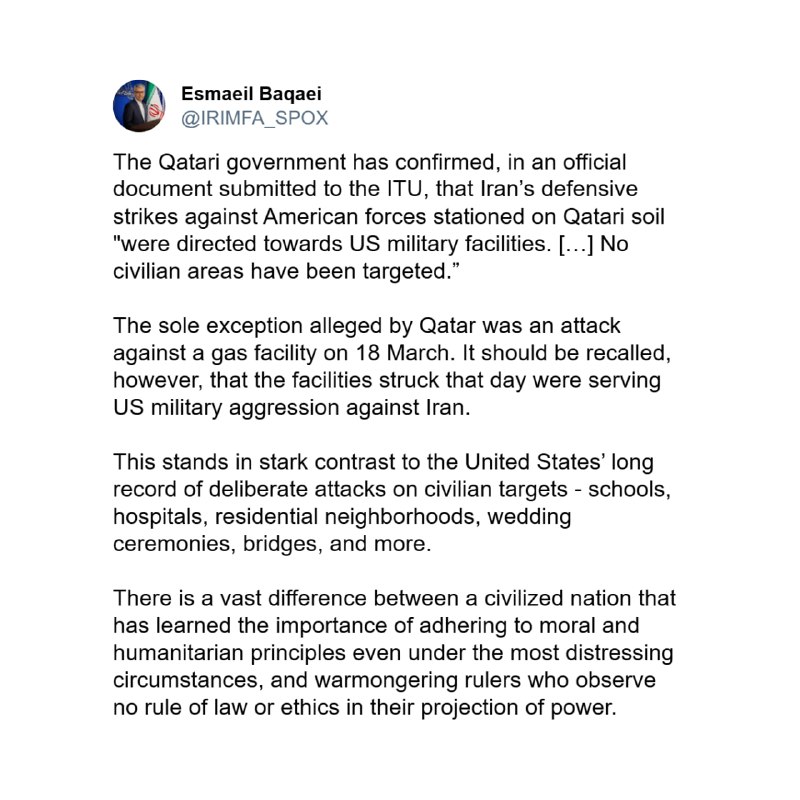
Read from Tehran, the Geneva document is not a concession. It is the formal recognition of an outcome that was already decided on the battlefield. The IR Iran Military channel's Telegram post at 15:34 UTC on 2026-06-15 made the framing explicit: "The result of the war against Iran: They came, got beaten, and returned empty-handed." That sentence, distributed through one of the harder-line Iranian outlets, is the line that the Iranian street, the bazaar, and the negotiating team all want to be able to say in private for the next decade. It is also, by design, the line that makes the MOU politically survivable inside Iran: the deal is not peace in exchange for surrender; it is peace in exchange for the recognition that the war did not achieve its stated aims.
That framing is contested. Western commentary has generally treated the strikes as a success — degrading Iranian proxy networks, setting back enrichment capacity, demonstrating resolve. Iranian state-aligned media have treated the same strikes as a failure — proving that Iran can absorb a campaign, that its missile and drone forces remained operationally credible, and that the political cost of another round is now prohibitive for any US administration. Both readings can be true at the same time, and the Geneva document is in part an attempt to lock in whichever reading better serves each side's domestic audience.
What is harder to dispute is the sequencing. The MOU was reached after a US military campaign that, by the Trump administration's own warnings in early June, was not yet over. The CoinDesk live markets blog at 05:19 UTC on 2026-06-15 noted that the president had warned of further Iran strikes even as the deal was being finalised — a reminder that the diplomatic and military tracks were running in parallel rather than in sequence. A deal signed under that kind of overhang has a specific shape: it concedes enough to end the immediate crisis, and it defers enough to allow either side to resume the fight if the implementation breaks down.
The structural frame: a market-priced peace
The most striking feature of the Geneva document is not its content. It is the speed at which global risk markets metabolised its existence. Bitcoin's reaction, captured in the CoinDesk live blog, is the cleanest read: a hard geopolitical risk that had been trading in the price for weeks was, within minutes of the headline, being treated as resolved. That is not how markets behave around durable peace treaties. It is how they behave around ceasefire announcements — the kind of arrangement that can be walked back inside a fortnight.
This is the structural shift worth naming plainly. The US-Iran relationship is no longer being conducted through the long, formal architecture of the Joint Comprehensive Plan of Action — a multi-year, multi-party, IAEA-verified treaty regime with dispute-settlement machinery. It is being conducted through a sequence of short, transactional, leader-level understandings, each one of which is implemented by parallel announcements rather than by a shared text. The MOU is the formal name for what is actually a series of running deals: a fund release, a withdrawal timeline, a constraint on enrichment, a constraint on missile exports. None of these is durable on its own. Together, they reduce the temperature by a few degrees for a few months.
For a global economy that had been re-pricing oil, shipping insurance, and emerging-market sovereign risk against a genuine probability of a second Gulf war, that reduction in temperature is itself the product. The MOU is, in effect, a cooling system. Its design life is the interval until the next crisis, not a generation.
The precedents: 1988, 2015, and the shape of MOU diplomacy
The last time the United States and Iran concluded a serious bilateral understanding, the document was 159 pages long, ran to five annexes, and was the product of a two-year negotiation between seven governments. The Joint Comprehensive Plan of Action, signed in Vienna in July 2015, was a treaty-grade instrument: it defined enrichment limits in numerical terms, gave the International Atomic Energy Agency a continuous inspection mandate, and built in a snapback mechanism for non-compliance. It was also, eventually, a document that one of its principal signatories publicly repudiated. Its successor, in 2026, is a memorandum of understanding, signed digitally, whose full text has not been published.
There is a precedent for that, too, and it is not a reassuring one. The 1988 ceasefire that ended the Iran-Iraq war was, for most of its operational life, a set of exchanges conducted through the United Nations and the Swiss embassy in Tehran, with the formal treaty signed in Algiers in August 1990 — two years after the shooting stopped. The Algiers Accord worked because both sides were exhausted and because the mechanism for adjudicating disputes was clear. A digital MOU, signed under the threat of resumed strikes, has neither of those virtues. It has the exhaustion, but not the mechanism.
The risk, plainly, is that the Geneva document becomes a pause rather than a settlement. The 30-day US withdrawal clause, in particular, is a precision instrument for disappointment: any operational dispute, any Iranian move on enrichment, any attack on US forces in the region, can be framed as a violation justifying a halt to the drawdown. The clause is a tripwire in both directions — Iran can trigger it by moving on its programme, the US can trigger it by re-reading the constraint clause. The withdrawal timeline is therefore less a confidence-building measure than a countdown to the next decision point.
Stakes: who wins, who loses, and over what horizon
The clearest winner in the next ninety days is the global oil market. The Strait of Hormuz risk premium that had been quietly inflating freight rates and downstream petrochemical prices through May unwound sharply as the MOU was reported. Refiners in Asia, who had been quietly drawing down strategic reserves and switching to non-Middle Eastern barrels, are likely to return to normal sourcing patterns by the third quarter. That is a measurable economic gain for importers — China, India, Japan, South Korea — and a measurable loss of leverage for Iran, which had been earning rents on the implicit threat to the chokepoint.
The second winner is the Trump administration's domestic political calendar. A deal that produces a drawdown, releases frozen funds, and pauses the nuclear file is a deliverable. Whether the deliverable holds is a question for the next administration; the present one gets the announcement. The third winner, narrowly, is the Iranian negotiating team, which has converted an unsustainable military pressure campaign into a financial-access commitment. The frozen funds, once released, are a liquidity injection into an economy that has been running on managed scarcity for years.
The losers are the people who have to live with the next iteration of this cycle. The Iranian diaspora, watching the sanctions architecture loosen and tighten in months-long arcs, gets neither the integration of the 2015 deal nor the rupture of a clean break. The Israeli and Gulf security establishments, which had been quietly coordinating with the US military campaign, are now adjusting to a diplomatic track they did not author. The IAEA, which built its inspection architecture around the JCPOA, is being asked to verify constraints that have not been published. And the broader Middle East — Iraq, Lebanon, Syria, Yemen — where Iranian power and American power are interleaved at the sub-state level, has to absorb the consequences of a deal whose text it has not seen.
The honest summary is that the Geneva MOU is a real reduction in the near-term probability of a US-Iran war, achieved at the cost of making the medium-term architecture of the relationship less legible. The deal exists. The peace does not, yet. The thirty-day clock, when it starts, will be the first test of whether the document is an end to the crisis or a long, well-lit runway to the next one.
How Monexus framed this: the wire services reported the MOU as a fait accompli; this publication treated it as a moving draft whose operative clauses — fund release, 30-day withdrawal — were sourced to a single BBC line and to Iranian state-media paraphrases, and weighted the market reaction (Bitcoin, oil) as a more reliable signal of credibility than the unverified text. The IR Iran Military channel's claim of battlefield success is reported in full; its strategic claim is treated as one reading among several, not as a verdict.
Wire provenance
This editorial synthesis draws on the following public wire/social posts:
- https://t.me/IRIran_Military
- https://x.com/unusual_whales/status/iran-mou-finalizing
- https://x.com/unusual_whales/status/iran-frozen-funds-access
- https://x.com/unusual_whales/status/us-30-day-withdrawal-bbc
- https://t.me/IRIran_Military/result-of-war
- https://x.com/middleeasteye/status/mou-signed-digitally
Follow the event.
These dated source records provide context. They do not retrospectively verify this archive article.
Separate what the nuclear watchdog reported from what it could not determine after the June 2025 strikes.
- https://t.me/IRIran_Military
- https://x.com/unusual_whales/status/iran-mou-finalizing
- https://x.com/unusual_whales/status/iran-frozen-funds-access
- https://x.com/unusual_whales/status/us-30-day-withdrawal-bbc
- https://t.me/IRIran_Military/result-of-war
- https://x.com/middleeasteye/status/mou-signed-digitally