Zircon over Kyiv: a single night that crystallises Russia's long-range strike campaign
A large-scale Russian barrage hit Kyiv and Kharkiv before dawn on 15 June 2026, killing at least five rescuers in the east and wounding civilians in the capital — including what Ukrainian channels say was a Zircon hypersonic impact.
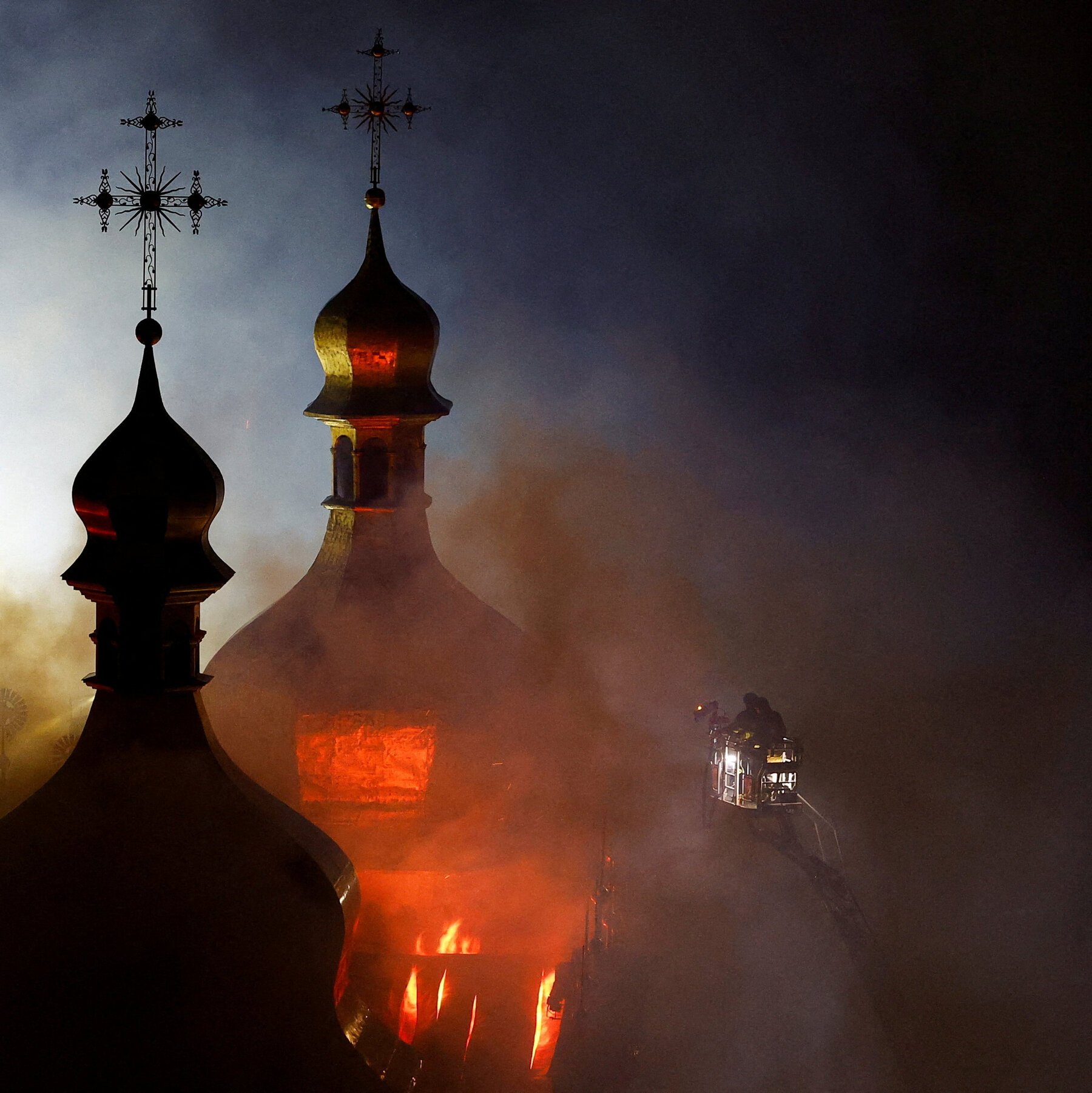
A wave of Russian missiles and drones struck Kyiv and Kharkiv in the hours before dawn on 15 June 2026, killing at least five rescuers in the eastern city and wounding roughly twenty people in the capital, according to initial Ukrainian and Western-wire reporting. Ukrainian mapping accounts, citing air-force and emergency-services briefings, said two of the warheads that hit Kyiv were Zircon hypersonic cruise missiles — among the most advanced systems in Moscow's arsenal. The strikes also set fire to a religious site in the capital and struck a residential block in Kyiv's Holosiivskyi district for the fourth time since the war began, local channel TSN reported.
The night's toll is modest by the standard of this war. The strike pattern is not. Russia appears to be using its most expensive, hardest-to-intercept munitions on civilian infrastructure deep inside Ukrainian cities, on nights when no major military target is in the news, in a campaign that has been grinding on for more than four years.
What the night looked like on the ground
The attack unfolded in the early hours of 15 June, Kyiv time, across at least two cities. NPR's TOPICS wire summarised the result at 05:33 UTC: five rescuers killed in Kharkiv, around twenty wounded in Kyiv, apartment blocks ablaze, and a fire at one of Ukraine's significant religious landmarks. The TSN_ua Telegram channel, reporting at 06:14 UTC, focused on a single high-rise in Kyiv that has now been hit for the fourth time since the full-scale invasion began — a fact, the channel noted, that residents frame less as bad luck than as a pattern of repeat targeting by Russian planners.
By 06:43 UTC, the OSINT account AMK_Mapping had posted imagery of two impact craters it attributed to Zircon hypersonic cruise missiles. The Zircon (3M22, NATO reporting name SS-N-33) is a sea- or ground-launched manoeuvring cruise missile advertised by Moscow as capable of speeds above Mach 8. Western analysts have questioned some of those performance claims, but agree the missile poses a serious challenge to existing air-defence doctrine because it flies a depressed, manoeuvring trajectory at very high speed. If the Ukrainian attribution holds, the use of two Zirons in a single night on the capital is unusual: Russian forces have generally husbanded the weapon for high-value targets and have used it sparingly in Ukraine since 2024.
The casualty figures circulated in the first hours of any Ukrainian strike are almost always preliminary. The number of wounded in Kyiv, around twenty, was reported by NPR's wire and not yet broken down by Ukrainian emergency services at the time of writing. The Kharkiv toll — five rescuers dead — is striking because it points to a secondary strike or a deliberate targeting of the response: Ukrainian emergency crews have been killed in exactly this way at least twice before in the war.
What the Russians say, and what they don't
The thread material available to Monexus contains no Russian-side statement from 15 June 2026. In the absence of a fresh Kremlin or Ministry of Defence readout, the responsible reading is that the strikes fit the established pattern of Russia's so-called "special military operation" — the term Moscow uses for its full-scale invasion — in which long-range strikes on Ukrainian cities are described as retaliation for Ukrainian actions and are presented as striking only military or infrastructure targets. Civilian harm is typically framed in Russian state messaging as either incidental or, in the case of emergency-services deaths, as the fault of Ukrainian authorities for not evacuating. This reporting is consistent with the editorial line of state outlets but is not, on the available evidence, corroborated by independent monitors on the ground.
There is a counter-narrative worth airing, even if the balance of evidence in this case does not support it. Russian and Russian-aligned channels have at various points in the war argued that footage of strikes on churches and apartment blocks is staged, or that the buildings shown were already damaged and then re-filmed. That claim has been repeatedly examined by wire reporters and OSINT investigators and has not held up: geolocation of craters, structural damage consistent with high-explosive warheads, and the consistent pattern of impact sites have all been independently confirmed in multiple previous incidents. The 15 June attacks, on the visible evidence, fit that same confirmed pattern.
The structural frame: what a Zircon salvo tells us
Three things make the 15 June strikes more than a single bad night.
First, the weapon mix. Ukraine's air-defence network has matured considerably since 2022, with Western-supplied IRIS-T, NASAMS, Patriot and — in 2025 and 2026 — limited SAMP/T and domestic systems intercepting a growing share of Russian missiles and drones. The Russian response, visible across several months of strike campaigns, has been to lean harder on the hardest-to-intercept systems: Kh-47M2 Kinzhal aeroballistic missiles, the 9M729 ground-launched cruise missile, and Zircon. The appearance of two Zirons in a single Kyiv barrage suggests Moscow is willing to spend these scarce, expensive weapons in salvos rather than as one-off demonstrations — a change in employment pattern with budget and industrial-supply implications on the Russian side.
Second, the target set. The hit on a religious site and on a repeatedly struck residential block points to a doctrine of cumulative pressure on urban services and on civilian morale, layered on top of strikes that also degrade the electricity grid and rail nodes. Ukrainian officials and outside analysts have argued for some time that the cumulative effect — repeated hits on the same buildings, the same districts, the same rescue crews — is itself the point. That is a more uncomfortable claim than "Russia is targeting civilians": it is a claim about how a campaign of lawful-looking strikes produces unlawful outcomes, and it deserves more direct attention in Western coverage than it usually receives.
Third, the timing. The 15 June attack comes against a backdrop of diplomatic movement on a possible broader settlement — talks that have, at various points in 2025 and 2026, raised expectations of a ceasefire or a pause. The pattern of recent months is that large barrages tend to cluster around moments of diplomatic progress, as if to test Ukrainian and allied resolve, or to shape the terms of any negotiation from a position of pressure. The thread material does not establish a direct link between the 15 June strikes and any specific negotiating event, but the broader correlation is well documented in open-source strike tracking.
What remains contested or unresolved
Several pieces of the picture are not yet settled. The number of wounded in Kyiv is preliminary; the figure of around twenty comes from the wire summary and not yet from a Ukrainian emergency-services breakdown. The exact number of Zircon impacts — two, per AMK_Mapping — depends on fragmentary imagery and on Ukrainian air-force attribution that has not, at the time of writing, been formally published in a public statement. The identity of the religious site set on fire has not been specified in the thread material available to Monexus; Ukrainian outlets and international wires are likely to confirm it within hours. The Russian side has not, in the material available to this publication, commented on the strikes at all.
There is also a deeper uncertainty. Independent monitors including the UN Human Rights Monitoring Mission in Ukraine have repeatedly documented that the great majority of Russian long-range strikes in this war have hit civilian infrastructure, but the question of intent — whether the strikes that miss legitimate military targets in a given barrage are unlawful, or are lawful strikes with incidental civilian harm — is one that international humanitarian law requires investigators to assess on a case-by-case basis. The 15 June strikes will, in time, be one of those cases.
For now, the clearest verifiable facts are these: a large-scale Russian attack hit Kyiv and Kharkiv in the pre-dawn hours of 15 June 2026, killed at least five rescuers in the east, wounded around twenty people in the capital, and left damage that, on the available imagery, is consistent with high-explosive warheads including Zircon-class systems. The pattern is consistent with a long-running Russian campaign of cumulative pressure on Ukrainian cities. The diplomatic context makes the next forty-eight hours worth watching closely.
Desk note: Monexus leads with Ukrainian and Western-wire sourcing on the strike and labels the Russian framing as a framing, not as fact. The "structural frame" section argues, in plain prose, that the cumulative-pressure reading of Russia's strike campaign deserves more direct treatment in Western coverage than it usually gets; the article does not stake that case on any single theorist's name.
Wire provenance
This editorial synthesis draws on the following public wire/social posts:
- https://t.me/AMK_Mapping
- https://t.me/TSN_ua
Follow the event.
These dated source records provide context. They do not retrospectively verify this archive article.
A dated voting record is evidence of one decision. Use the original UN record before turning it into an alignment label.
Visual explainer · historical vote of 2022-03-02 →