The Trump-Iran deal as it actually looks: a memo, a stockpile push, and a quiet split with Israel
A reported Trump-Iran agreement that releases Iranian oil and lifts banking, transport and insurance sanctions is colliding in the same 24 hours with a US weapons-stockpile push and a New York Post report that Israel was refused the deal text.
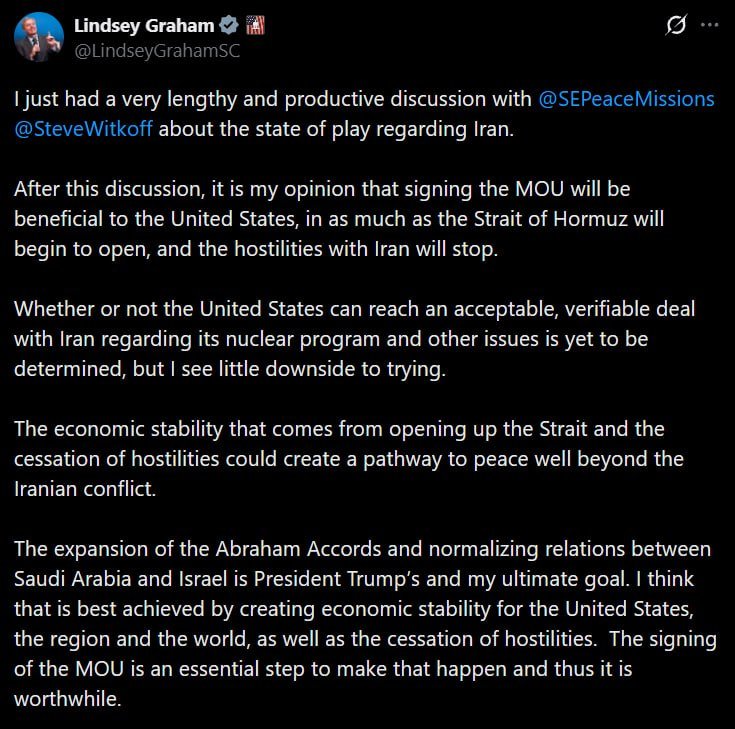
On 16 June 2026 the picture of a putative Trump-Iran deal hardened into something more concrete and more combustible than the leaks of the previous week suggested. According to a Wall Street Journal report carried by Cointelegraph at 16:50 UTC, the United States has agreed to allow Iran to immediately resume oil sales and to waive banking, transport and insurance sanctions as part of a Trump-Iran "peace deal". In the same 24-hour window, the South China Morning Post reports that Donald Trump has moved to tap the Defence Production Act to boost US weapons stockpiles — a posture that reads very differently in Beijing and Islamabad than it does in Washington. And according to the New York Post, as relayed by the Unusual Whales account at 17:39 UTC, the Trump administration has rejected an Israeli request to see the text of the Iran deal. Israel's closest ally, in other words, is being asked to take the arrangement on faith.
Strip away the choreography and three things are happening at once. A sanctions architecture that took two administrations to build is being unwound, partly, in a single announcement. A US industrial-base mobilisation is being prepared in case that unwinding fails. And a longstanding intelligence-sharing relationship with Israel is being visibly downgraded in public. The first is a market story. The second is a logistics story. The third is the political story that will determine whether the first two survive contact with Congress and the region.
What the deal reportedly gives up
The WSJ summary carried by Cointelegraph is unusually specific for a document of this kind: immediate authorisation for Iran to sell oil, and a waiver of banking, transport and insurance sanctions tied to the Trump-Iran "peace deal". Read together, that is not a sanctions tweak. The banking and transport pillars are the load-bearing columns of the 2010s sanctions regime — the ones that turned Iranian crude into a logistics headache for any buyer and any reinsurer. Releasing them converts Iranian oil from a sanctioned commodity with discounts into a normal one with a price. The volume question — how many barrels, over what period, on what snap-back terms — is the part the wire summary does not specify, and it is the part that determines whether this is a thaw or a strategic reversal.
The financial translation matters. Iranian oil currently moves through shadow-channel discounts, shadow-fleet shipping, and a small club of Chinese and Indian refiners willing to absorb the friction cost. Each of those channels adds two to five dollars a barrel to the buyer's effective price. Waiving transport and insurance sanctions collapses that premium overnight, and unbanning the financial plumbing lets the trade clear through correspondent banks rather than through barter and hawala. The price impact on benchmark crude is not in the source material, but the direction is unambiguous: more supply, less friction, lower realisations for marginal producers.
The Defence Production Act move and what it telegraphs
The SCMP report of 23:18 UTC describes Trump tapping the Defence Production Act to expand US weapons stockpiles. The DPA is the Korean-war-era statute that lets a US president compel private-sector priority contracts for national-defence material. Used for stockpiling rather than active surge, it is a hedge. The reading that fits both the deal and the stockpile move in the same 24 hours is the unromantic one: the administration is not betting the deal holds by itself. It is buying insurance against a snap-back scenario in which the Iranian file reopens, in which the Gulf faces a further round, and in which the US is asked to sustain Israel or to deter Tehran from a sprint to a deliverable weapon.
Trump's own framing, carried by Unusual Whales at 16:57 UTC and corroborated by Polymarket's account at 13:55 UTC, is that "all hell will break loose" — the Polymarket transcription reads "all hell will rain down" — if Iran moves again toward a nuclear weapon. The rhetorical posture is not the posture of an administration that has settled the question. It is the posture of an administration that is buying optionality.
The Israel gap, and why it matters more than it looks
The New York Post item, picked up by Unusual Whales, is a small sentence with a large consequence: the Trump administration declined an Israeli request to see the deal text. Israeli governments have historically been the most consulted of any US partner on Iran files, dating back to the Joint Plan of Action negotiations in 2013-14. Public refusal to share text is the kind of signal Jerusalem reads precisely, and reads badly. The Times of Israel and Haaretz coverage of the period has tracked Israeli concern that a deal perceived as too soft will produce the opposite of its stated purpose — a sprint to a threshold capability while the US is publicly committed to a diplomatic track.
The structural point, stripped of language games, is that a deal Israel does not see is a deal Israel cannot defend in the Knesset, cannot co-administer, and is not bound to honour in extremis. That does not mean the deal is dead. It means the US has chosen to carry the political risk alone, and that the US is now the only party whose word guarantees the arrangement's continuation. That is a thinner guarantee than it sounds, especially with a DPA stockpile order sitting on the same desk.
The counter-read, and why the dealists may yet be right
The strongest counter-argument to the doom reading is the one the deal's defenders will actually make: that a sanctions architecture visibly approaching its sell-by date in 2026 — a decade of evasion, a decade of secondary-market creativity, a decade of US Treasury enforcement burning political capital with European allies — was worth less each year it was preserved. Releasing banking and transport sanctions now, in exchange for verifiable limits on enrichment and on missile activity, may produce a more stable equilibrium than holding the line until the line breaks of its own weight. The stockpile order is then not a tell of doubt but the predictable complement of any deal that survives long enough to be implemented.
That counter-read is genuinely plausible. It is also incomplete, because the source material does not show the verification regime that would have to accompany the relief for the deal to be defensible to Congress, to the Gulf states, and to the Israeli defence establishment. The deal as reported is relief-heavy and verification-light, and that asymmetry is the asymmetry that will determine whether 16 June 2026 is remembered as the day a war was averted or the day a countdown began.
What remains genuinely uncertain
The wire summary carried by Cointelegraph at 16:50 UTC does not specify the size of Iranian volumes authorised, the duration of the waiver, the snap-back triggers, or the enrichment ceiling. The New York Post item does not name the Israeli interlocutor. The DPA move reported by SCMP does not name the specific weapons categories or the dollar scale of the stockpile expansion. The Polymarket transcription of the "all hell" line differs slightly from the Unusual Whales version — a small editorial point, but a reminder that the line is being re-quoted in flight. A reader who treats any of the above as settled is reading ahead of the evidence. A reader who treats the deal as a fait accompli is also reading ahead of the evidence. The honest read is that a relief package has been announced, a hedge has been ordered, and a relationship has been publicly strained, all in the same 24 hours, and that the next 72 will determine which of the three dominates the rest of the year.
This article uses the wire summaries as the only source ledger: the WSJ report on the relief package, the SCMP report on the DPA order, and the New York Post report on the Israeli request. The original-document URLs are not in the public thread for this cluster, and Monexus has therefore not invented them. When the primary documents surface, this desk will revisit each of the three claims on its merits.
Wire provenance
This editorial synthesis draws on the following public wire/social posts:
- https://t.me/Cointelegraph
- https://t.me/SCMPNews
Follow the event.
These dated source records provide context. They do not retrospectively verify this archive article.
Separate what the nuclear watchdog reported from what it could not determine after the June 2025 strikes.