Trump's Iran line lands as a marker, not a policy
A single Trump post repeated for emphasis reads less like a new doctrine than a marker held up to a domestic audience. The interesting question is what it tries to make everyone else forget.
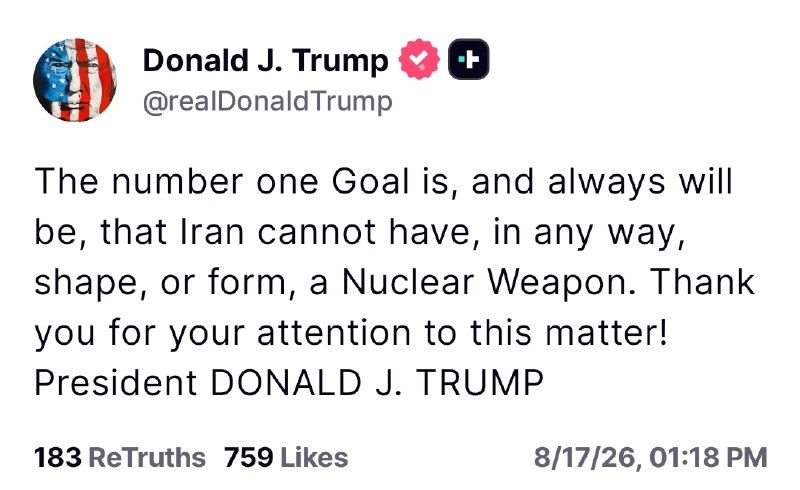
On 17 August 2026 at 13:24 UTC, a one-line statement from President Trump hit the wires and got carried across at least four English-language channels within seven minutes. "The number one Goal is, and always will be, that Iran cannot have, in any way, shape, or form, a Nuclear Weapon," he wrote. "Thank you for your attention to this matter." The phrasing was reproduced verbatim by telegram channels including englishabuali, BRICSNews, ClashReport and Insider Paper, each citing the same post. No new sanctions package, no envoy, no deadline. Just a sentence held up to the room. The signal is not the content. The signal is the timing.
This is what passes for a posture in 2026. A re-statement of an eight-word red line, broadcast as if it were a fresh act of statecraft. The interesting question is not whether Iran is, in fact, being told something new. It is what the repetition tries to make everyone else forget: that the line has been stated, restated, walked back and re-issued so many times that its content has decoupled from its meaning. What is being communicated is to a domestic audience, to bond markets, to Gulf ministries with their own calculations, and to Tehran, which reads these posts the way chess players read an opponent clearing his throat.
The line that ate its own content
The sentence is not wrong. Few senior officials in Washington, London, Paris or Jerusalem would dispute that a nuclear-armed Iran is the stated US policy goal. The Joint Comprehensive Plan of Action, abandoned in 2018, was an attempt to manage the same objective through a different instrument. What makes this re-statement notable is the genre. Policy used to be communicated through statements, briefings, leaks, and the slow choreography of a National Security Council process. Now it travels through a post, gets screenshotted within minutes, gets mirrored into four channels, and ends up being read as a posture.
There is a tactical reason to repeat the line now. Negotiations around Iran's nuclear file have moved in and out of public view throughout 2026, and the cadence of leaks from Gulf and European intermediaries has been high. In a noisy environment, a flat restatement does two things at once: it signals that the basic objective has not changed, which is reassuring to allies, and it forecloses the suggestion that any deal in progress contains a quiet walk-back of the red line, which is a message to sceptics in Congress and to Tel Aviv. The cost is that the restatement registers as theatre, and theatre burns through credibility each time it is deployed.
What a marker does to the people watching
Read from Tehran, this post is a reminder that the negotiating floor is not negotiable. Read from Riyadh, it is a backstop against any quiet process that might leave the Gulf with a neighbour that can put a warhead on a missile. Read from Beijing or Moscow, it is a piece of evidence for a long-running argument that the United States reserves for itself the right to define which countries are permitted to develop which capabilities. The line travels asymmetrically, and the asymmetry is the point. A policy that everyone has heard before can still be used to draw a perimeter, and the perimeter is what is being drawn.
Monexus analysis: the post is best understood as a marker aimed at multiple audiences simultaneously rather than as a policy event in itself. The act of saying the obvious, in that cadence, with that closing flourish, is the policy. The content is the carrier wave.
The stakes inside the sentence
The risk of running red lines as recurring theatre is straightforward. Each repetition lowers the cost of the next one, because each repetition establishes that the line is rhetorical until proven operational. That cuts both ways. It reassures adversaries that the threshold has not been crossed, but it also reassures them that the threshold will be crossed only when something else happens first: a test, an enrichment spike, a transfer of material. By the time the marker needs to convert into action, the gap between the two will have to be explained to a public that has been trained to read these posts as ambient noise rather than warnings.
For now, there is no second sentence. No follow-up. No named official on the record elaborating. The available source items do not specify which agency or which intermediary generated the post, what specific Iranian action precipitated it, or what, if anything, has changed in the underlying intelligence picture since the last restatement. The post stands alone, and it is meant to.
What would change the reading
The reading inverts if one of three things happens. First, if a senior US official on the record attaches a deadline to the line in the next 72 hours. Second, if a Treasury action, an INDECS-style designation, or a movement of carrier groups appears within the same news cycle. Third, if a reciprocal Iranian statement arrives in the same channels with matching cadence, in which case the post stops being a monologue and becomes the opening of a sequence. None of those things are visible in the source items as of 17 August 2026 at 13:31 UTC. Until one of them appears, the honest description of what happened is the one that has already happened: a man who says the same thing as clearly as possible, four times, in seven minutes, to an audience that includes everyone and no one in particular.
Desk note: the wire carried Trump's post verbatim and stopped there. Monexus is framing this as a posture-act rather than a policy event, because the sources contain no policy instrument, no counterpart, and no operational follow-up, only the line itself.
Wire provenance
This editorial synthesis draws on the following public wire/social posts:
- https://t.me/englishabuali/77866
- https://t.me/bricsnews/17714
- https://t.me/ClashReport/92747
- https://t.me/insiderpaper/43942