Live Wire
23:42ZALALAMARABOne killed, 11 injured in southern Lebanon23:41ZDDGEOPOLITTrump says US will only accept 'unconditional surrender' in Iran talks23:40ZFARSNAIsraeli killed, 11 injured in Hezbollah attacks in southern Lebanon23:39ZGEOPWATCHPakistani PM Shehbaz Sharif announces MoU between Iran and United States23:38ZOSINTLIVERepublican members of Congress tell NewsNation VP Vance is to blame for U.S.-I23:38ZOSINTLIVEPolice seek suspect in Kansas highway shootings23:38ZPRESSTVFemale Palestinian detainee describes physical abuse, strip searches in Israeli custody23:32ZOANNTVTrump unifies Oklahoma's 1st District behind Mark Tedford after endorsement shift
Markets
S&P 500745.15 0.55%Nasdaq26,022 1.34%Nasdaq 10029,671 0.99%Dow518.24 0.37%Nikkei94.8 0.36%China 5033.79 0.39%Europe89.05 0.19%DAX41.95 1.39%BTC$64,414 1.86%ETH$1,747 2.48%BNB$601.47 0.62%XRP$1.18 2.67%SOL$71.95 2.16%TRX$0.3214 1.45%HYPE$71.24 3.15%DOGE$0.0858 1.63%RAIN$0.0146 3.28%LEO$9.68 0.23%QQQ$729.07 0.91%VOO$685.24 0.56%VTI$368.1 0.60%IWM$292.21 0.82%ARKK$79.76 1.58%HYG$79.86 0.13%Gold$392.58 1.05%Silver$61.76 1.92%WTI Crude$114.1 0.14%Brent$43.6 0.23%Nat Gas$11.51 0.48%Copper$38.96 0.76%EUR/USD1.1591 0.00%GBP/USD1.3406 0.00%USD/JPY160.31 0.00%USD/CNY6.7595 0.00%
CLOSEDNYSEopens in 13h 39m
The Monexus
Vol. I · No. 168
Wednesday, 17 June 2026
Saturday Ed.
Updated 23:50 UTC
  • UTC23:50
  • EDT19:50
  • GMT00:50
  • CET01:50
  • JST08:50
  • HKT07:50
← The MonexusGeopolitics

Iran's parliament speaker frames Hormuz as a sovereign service — and a reciprocal deal

Mohammad Bagher Ghalibaf says the Strait of Hormuz belongs to Iran by right, that Tehran will collect fees for services to transiting vessels, and that any agreement with Washington rests on a step-for-step exchange — with the reciprocal clause hanging over every clause.
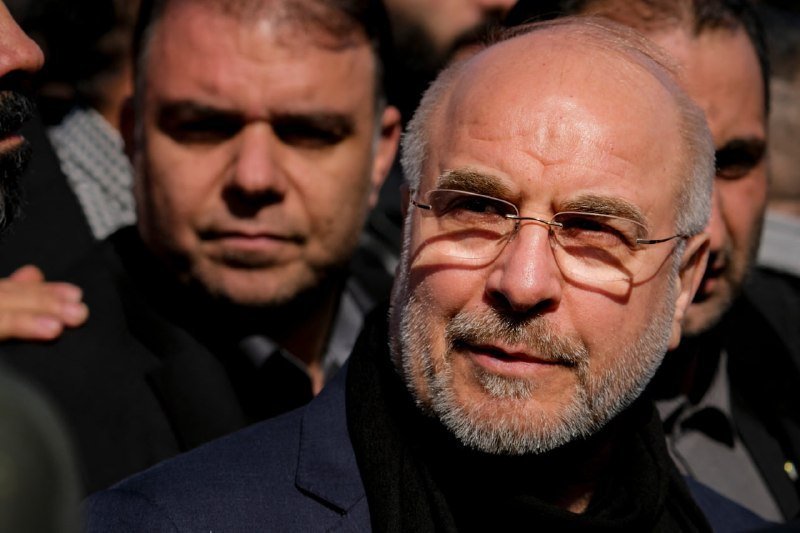
@NYT > WORLD NEWS · Telegram

Mohammad Bagher Ghalibaf, the speaker of Iran's parliament, used a Tuesday evening address to draw a hard line around the Strait of Hormuz and around the diplomatic track running parallel to it. Speaking as relayed by Iranian state outlets al-Alam Arabic and Fars News on 17 June 2026, Ghalibaf argued that Iran holds a "sovereign right" in the waterway, that Tehran will collect fees "in exchange for providing services to ships crossing the Strait of Hormuz," and that any memorandum of understanding with Washington rests on a step-for-step exchange in which non-compliance by one side voids the obligations of the other. The remarks, delivered as Iranian and American negotiators attempt to sequence sanctions relief against nuclear and regional concessions, do more than restate a familiar posture. They reframe the chokepoint itself as a billable service.

The structural claim underneath the speech is the one worth watching. Iran does not merely demand the right to transit fees for oil tankers and LNG carriers; it positions the Strait as infrastructure under Iranian jurisdiction to which third-party users owe payment in kind. That posture converts a geography problem into a contract problem, and a contract problem into a sanctions problem — because any fee mechanism that funnels dollars to an entity under US sanctions quickly becomes a sanctions-evasion vector for the buyers, and a leverage point for the sellers.

A step-for-step frame, on Tehran's terms

Ghalibaf's central formulation — that the memorandum is "based on the principle of step for step" — is not novel in Iranian negotiating rhetoric, but the way he bound it to Hormuz is. In his telling, the agreement holds only so long as "the enemy abides by his pledges." If Washington does not, "our policy will be 'the one who started is more unfair,'" a Persian formulation meaning the initiator of bad faith carries the greater moral burden. The clause is elastic by design: it gives Tehran a standing rationale to suspend compliance without explicitly breaking the deal.

The framing matters because Iranian state media broadcast the address during the same hours that negotiators were reportedly trying to lock in sequencing — sanctions relief first, or nuclear constraints first, or some interleaved version of both. By stating publicly that the deal is conditional and reversible on a single breach, Ghalibaf lowers the political cost inside Iran of walking away. He also told Fars News that "our duty is to implement the measures of the leader of the revolution in the negotiations," binding the talks to the Supreme Leader's framework rather than to a technocratic compromise. That is the language of constrained diplomacy: the negotiators have a narrow lane, and the speaker has just publicly drawn the lane's edge.

The Strait as billable infrastructure

The most concrete claim is the fee. Ghalibaf said the memorandum confirms "the issue of our obtaining sums in exchange for providing services to ships crossing the Strait of Hormuz." He framed it as natural — "it is natural that it will receive sums for the services it provides" — rather than as a novel extraction. The argument rests on a long-disputed reading of the 1982 UN Convention on the Law of the Sea, under which coastal states may levy limited transit-related charges but cannot discriminate against flag states or impede passage through international straits.

Iran's claim is older than the current negotiations. Tehran has intermittently threatened to close or tax the Strait since the 1980s, most acutely during the Tanker War of the late 1980s and again in 2019 after US sanctions on Iranian oil exports. What is new is the bundling: a fee for services is being written into the same document that addresses nuclear constraints. For the Iranian side, that is a win — it converts a tactical threat into a contractual entitlement. For the American side, it is a problem: any payment routed to Iranian state entities exposes counterparties to secondary sanctions, and any payment routed through third-country intermediaries creates the very evasion architecture Washington says it is trying to dismantle.

Continuity with the wartime posture

Ghalibaf closed the loop by referring back to his own public statements during the most recent round of fighting — "During the war, I posted on Twitter that the Strait of Hormuz would never return to its previous conditions, and that remains true today." The phrasing matters. He does not threaten closure. He says the conditions of passage have permanently changed. That is consistent with a service-for-fee model rather than a blockade model, and it suggests the Iranian negotiating team is preparing the domestic audience for a regulated, paid transit regime rather than a return to the pre-war status quo.

The same remarks appeared, almost verbatim, across Fars News and al-Alam Arabic within minutes of each other on the evening of 17 June 2026, with Fars adding that Ghalibaf had thanked the Supreme Leader and that he had been "present in the squares among dear people" during the conflict — a domestic-audience signal that the speaker is positioning himself as a wartime figure rather than a parliamentary back-slapper.

What is contested, and what is not

The contested ground is narrow but real. Western reporting on the negotiations has tended to frame Iranian Hormuz rhetoric as coercion — a threat of disruption to extract concessions. Iranian state reporting frames it as sovereignty — the natural right of a coastal state over its waters. Each reading is internally coherent; the empirical question is whether the negotiated document actually contains a fee mechanism or merely a study of one. The thread material from 17 June does not show the text of any memorandum, only Ghalibaf's description of it. Until the document is published or leaked, the substance remains a moving target.

The structural stakes are easier to read. If a paid-transit regime enters into force, the major importers of Gulf hydrocarbons — China, India, South Korea, Japan, and the European Union — are suddenly paying a sanctioned state for the privilege of moving energy they already need. That revenue sits outside the formal sanctions architecture but inside its shadow. It would also set a precedent other chokepoint states would study: any coastal government able to argue a service relationship with global shipping could in principle mimic the model. The Strait of Hormuz would become not just a flashpoint but a template.

What remains uncertain is whether Ghalibaf's reciprocal clause survives contact with the negotiating room. Iranian speakers are paid to set outer limits; negotiators are paid to converge on a middle. The gap between the two, on this evidence, is unusually wide, and the address was almost certainly designed to narrow it from the Iranian side by widening the domestic consensus behind the negotiating position.

This article relies on Iranian state media transcripts and does not include independent corroboration of the specific memorandum clauses Ghalibaf describes; the text of any agreement has not been published as of 17 June 2026.


Sources:

  • Telegram · al-Alam Arabic — "Qalibaf: the memorandum is based on the principle of step for step" — 17 June 2026, 21:07 UTC — https://t.me/alalamarabic
  • Telegram · al-Alam Arabic — "Qalibaf: obtaining sums in exchange for providing services to ships crossing the Strait of Hormuz" — 17 June 2026, 20:53 UTC — https://t.me/alalamarabic
  • Telegram · al-Alam Arabic — "Qalibaf: Iran has a sovereign right in the Strait of Hormuz…" — 17 June 2026, 20:49 UTC — https://t.me/alalamarabic
  • Telegram · al-Alam Arabic — "Qalibaf: in any country where the enemy does not abide by his pledges…" — 17 June 2026, 21:21 UTC — https://t.me/alalamarabic
  • Telegram · Fars News — "Ghalibaf: our duty is to implement the measures of the leader of the revolution in the negotiations" — 17 June 2026, 20:33 UTC — https://t.me/farsna
  • Telegram · Fars News — "Ghalibaf: if America does not fulfill its obligations, it is impossible for Iran to fulfill its obligations" — 17 June 2026, 20:33 UTC — https://t.me/farsna
  • Telegram · Fars News — "Ghalibaf: I was present in the squares among dear people…" — 17 June 2026, 20:41 UTC — https://t.me/farsna
  • Telegram · Clash Report — "Ghalibaf: the Strait of Hormuz would never return to its previous conditions" — 17 June 2026, 20:24 UTC — https://t.me/ClashReport

Wire provenance

This editorial synthesis draws on the following public wire/social posts:

  • https://t.me/alalamarabic
  • https://t.me/farsna
  • https://t.me/ClashReport
© 2026 Monexus Media · reported from the wire