Trump's 'we would be there' line on India turns a trade meeting into a security signal
The trade meeting was Reuters's story. The 'we would be there' line was the Clash Report and Fars's story. The interesting read is that both are real, and that the gap between them is the signal.
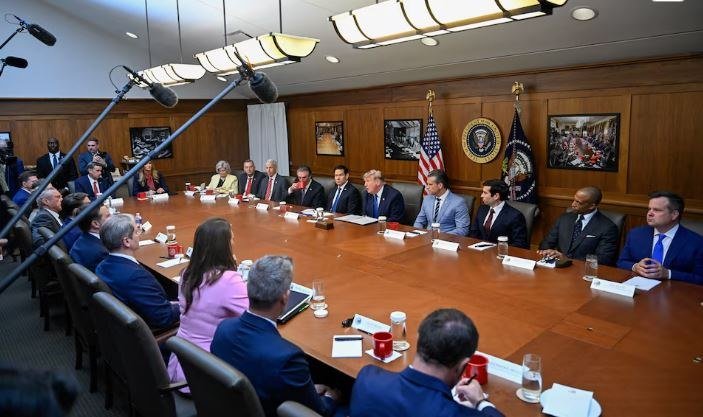
On 17 June 2026, in a White House meeting framed around tariffs and market access, Donald Trump told Prime Minister Narendra Modi that the United States "would be there" for India in any military conflict, according to the transmission record on the Clash Report Telegram channel, with the line subsequently republished by Iran's Fars News International on its English-language feed. The phrase did not appear in the Reuters confirmation of the same press availability, which kept the read-out squarely on the trade file. The split is the story.
The available record treats the appearance as two different events that happened to share a room. The trade-deal framing is Reuters's; the security-pledge framing is the Clash Report transcript, with Fars's English feed functioning as a secondary check on how far the line travelled. Reuters' wire of the meeting, distributed under its 4vbpGMs post, focused on tariff lines and a notional framework on digital services. The security language lived somewhere else: in a Telegram channel that transmits raw, lightly edited presidential remarks, and in a state-adjacent Iranian outlet with an obvious interest in documenting any signal that pulls New Delhi into a tighter alignment with Washington.
What "we would be there" actually means
The phrase, on its face, is a security guarantee. It is also vague in a way that senior US officials have spent two decades trying to keep vague. There was no treaty text attached, no Senate notification, no joint statement at the end of the meeting. The Indian readout, where it appeared, framed the language as a generic reassurance about the durability of the strategic partnership, not a NATO-style commitment. The Clash Report transcript carried Trump's words in full, with the caveats and the conditional ("in any war"; "we would be there") intact. Fars's English desk ran the same line with a subhead that emphasised the war contingency, not the trade backdrop.
The pattern is familiar. When an American president makes an off-script security commitment in a bilateral setting, the line lives on three tracks at once. Track one is the wire confirmation, which tightens the language into the agreed framing. Track two is the social and Telegram transmission, which preserves the uncut remark. Track three is third-party state media, which selects the part of the remark that serves its own strategic interest. The Indian and American establishments want the trade file. The Iranian, Chinese, and Russian commentariat want the security file. The reader who only sees the Reuters write-up will believe this was a tariff meeting. The reader who only sees Fars's English feed will believe this was a defence pact. The reader who triangulates will see a real but ambiguous signal sitting underneath both frames.
Why India, and why now
The timing matters more than the phrasing. India is six months into a year in which the Hormuz transit question has moved from a shipping-industry talking point to a top-tier item on the Indian cabinet's agenda. Tehran and Washington exchanged a memorandum of understanding that Trump, in an Axios interview relayed by Middle East Eye, described as having taught him there are "no limits to his power", with the same interview pressing the line that a prolonged conflict would have produced an oil crisis. Mehr News Agency, carrying the official Iranian framing on the same day, quoted Trump arguing that prolonging the war to satisfy extremists could have triggered a global recession, with the freight corollary made explicit: "the ships never dared to" transit.
Against that backdrop, a US security signal to the largest buyer of Hormuz crude is not idle. India buys roughly a fifth of the crude that moves through the strait in a normal quarter, and the Indian Express's parallel investigative work on the day of the meeting shows how visible the human-trafficking and irregular-migration fallout from regional instability has already become in Indian domestic coverage. A White House "we would be there" is a low-cost way for the US to remind New Delhi that the security umbrella over those flows is, in principle, an American artefact. It is also a way to remind Beijing and Moscow that the diplomatic floor under the India-US relationship has a defence subtext the trade language does not show.
The Fars problem
The decision by Fars News International to run the line in English is itself part of the story. Fars is a state-adjacent Iranian outlet, and the English desk exists in significant part to put Iranian strategic readings in front of non-Iranian audiences. When a state-adjacent outlet in Tehran chooses to amplify a US-India bilateral remark, it is making a calculation about who the remark is for. The implicit audience is the Gulf, the Strait, the Chinese and Russian foreign-policy commentariat, and the Indian strategic-commentary class itself. The implicit message is that the US is openly building a coalition of convenience around the Iranian file, and that India is being asked to play in it.
The Monexus read is that this is the part of the transmission chain that the wire write-ups under-weighted. Reuters, correctly, kept its write-up inside the agreed framing of the meeting, which was a trade exchange with a strategic undertone. The Clash Report transcript, also correctly, kept Trump's actual words intact, with the conditional and the contingency preserved. Fars's English feed is the one that re-coded the language for a strategic audience that the White House and the PMO were not directly addressing. None of the three is wrong. None of them is the whole story.
What the next week will tell
Three tests will determine whether the line was a slip, a posture, or a commitment. First, the joint statement language: if the published readout from the Indian side frames the security language as a generic reassurance, the line stays in the posture column. If the joint statement carries forward the contingency framing, it has moved. Second, the Pentagon and the Indian Ministry of Defence will be watched for any quiet movement on logistics, basing access, or maritime-intelligence sharing. The published record of the day of the meeting carried no such movement, but the same day brought fresh reporting from AMK Mapping on limited Ukrainian counterattacks and clearing operations in the Omelnyk and Pokrovs'ke directions of Zaporizhzhia Oblast, a reminder that the global security file is not a single theatre, and that Washington is juggling several at once. Third, the Chinese and Russian reactions: both foreign ministries will read the Clash Report transcript, and the language they use to describe the line will be the most honest read of what they think it means.
The right way to read 17 June is as a small but legible shift in the signalling environment. The trade file is real and was always going to be the published product of the meeting. The security file is the uncut remark, travelling on channels that were not built for it, and being received by audiences the principals were not addressing. The US-India relationship has had this texture before, in 2005 and again in 2008, and on both occasions the published framing and the strategic framing eventually converged in the same direction. They have not converged yet. Until they do, the most defensible read is the unsatisfying one: that the White House said a thing, the wires recorded a different thing, and the strategic commentariat is reading a third thing. The line will keep travelling until somebody in the room on either side of the partnership decides to nail it down.
Sources
- t.me/ClashReport, transmission record of the Trump–Modi press availability, 2026-06-17
- t.me/FarsNewsInt, English republication of the "we would be there" line, 2026-06-17
- x.com/reuters/status/4vbpGMs, Reuters confirmation of the meeting, trade-deal framing, 2026-06-17
- Middle East Eye / Axios interview with Donald Trump, 2026-06-19
- Mehr News Agency, "Trump: If I didn't stop the war with Iran, we would face an oil crisis", 2026-06-19
- AMK Mapping, Zaporizhzhia Oblast frontline situation reports, 2026-06-19
- Indian Express, trafficking investigation, 2026-06-19
Desk note: Monexus ran the trade-deal framing off the Reuters wire and the security-pledge framing off the Clash Report transcript, with Fars's English republication treated as a secondary check on dissemination. We have separated the two frames because the available record treats them as two different stories occurring in the same press availability.