Trump Praises Syria's Jolani as a Parallel Rises Over US Policy Language
In remarks carried on 17 June 2026, the US president lavished praise on Syria's transitional leader and offered a public theory of war that puts speed above restraint. The statements sit awkwardly beside the official line on civilian protection.
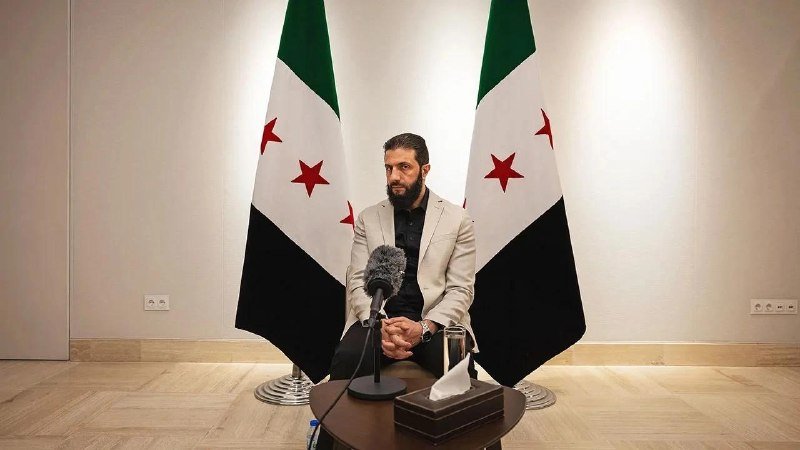
At roughly 16:35 UTC on 17 June 2026, a public appearance by US President Donald Trump produced two sets of remarks that, taken together, sketch a more permissive theory of American power than the official statements of recent months would suggest. The first was a tribute to Abu Mohammad al-Julani, the former al-Qaeda affiliate who now leads Syria's transitional government as president. The second was a set of remarks on the conduct of war, summarised by Telegram channels covering the appearance as a counsel to "slaughter the enemy quickly, efficiently, and convincingly." Both clusters of remarks were carried in the same hour and a half, by channels that have built followings on rapid verbatim transcription of US presidential appearances.
The Syria comments are the more immediately consequential. In remarks carried by the Telegram channels Englishabuali, Abualiexpress and Clash Report, Trump referred to al-Julani as "the gentleman from Syria, who is now the president," and credited him with having "managed to unite the country within a year and a half" — a comparison the president extended, pointedly, to his own political project: "a bit like us," he said, "a year and a half, pretty similar." The remarks amount to a personal endorsement of a leader whose biography inside Washington's own counter-terrorism architecture is recent, contested, and unresolved.
Reading the endorsement
That a sitting US president would publicly praise al-Julani is not, in itself, a surprise. Washington has spent the better part of two years adjusting to the fact that the man the State Department once designated for ties to al-Qaeda in Iraq now runs a state from Damascus and that several Arab governments, Saudi Arabia and the United Arab Emirates foremost among them, moved to rehabilitate him first. What is new is the register. Trump did not speak of al-Julani as a former militant who has pivoted, nor as a transitional figure being tested. He called him "outstanding" and credited him with a national project.
The reading inside the Syrian opposition and among the families of detainees held in facilities run by the transitional authorities is darker. Critics inside Syria and in the diaspora, including Syrian Network for Human Rights analysts, have documented the killing of civilians in coastal and Druze areas in 2025 and recurring abuses in former regime prisons now run by HTS-led security services. Those critiques do not appear in Trump's framing, and the absence matters. By locating al-Julani's achievement in unification and by drawing a domestic American parallel, the US president has, in effect, offered international legitimacy to a record that the human-rights community continues to dispute.
The political risk for Washington is not diplomatic. The Syrian government is not in a position to snub the endorsement. The risk is that the language travels. Gulf states, Jordan, Egypt, and the EU's Syria envoy have all calibrated their engagement with Damascus around the question of what al-Julani actually delivers on transitional justice, minority rights, and security sector reform. A US president calling that record "outstanding" raises the cost, for those governments, of pressing for more.
The second statement: speed over restraint
In the same window, Trump was reported to have set out a philosophy of warfare that several of the channels summarising the appearance rendered in unusually blunt terms. The Englishabuali channel's account of the remarks reads, in part: "You need to slaughter the enemy quickly, efficiently, and convincingly, and not drag things out. Bringing down buildings makes too much noise." The remarks do not name a theatre, and the same channel's summary of the Syria comments is more substantive. Read together, the two passages suggest a president articulating a doctrine of decisive, fast, and visible force.
The contrast with the administration's public line on the rules of war is sharp. The State Department's civilian casualty mitigation policies, the Pentagon's Law of War Manual, and a generation of US strategic communication on discriminate and proportionate force all sit, in spirit, on the opposite side of that remark. Whether the president meant it as a stand-alone theory of war, as commentary on a particular recent operation, or as a rhetorical exaggeration is not clear from the transcripts. The Telegram channels do not provide a question-and-answer sequence. The most that can be said is that the words were spoken in a public setting and have been carried verbatim by multiple channels, which is how the comments now reach the international audience.
The structural frame, in plain terms
The two statements sit inside a broader shift in how Washington talks about its Middle East policy. The post-2023 consensus — visible in the language used by the Biden administration around Gaza, Lebanon, and Iran — emphasised de-escalation, humanitarian access, and the rebuilding of rules-based order. The Trump-era version of that language, in this appearance at least, leans the other way: personalist rather than institutional in its Syria framing, and unapologetic about the use of force in the second set of remarks. The throughline is a White House that is comfortable speaking about foreign policy in a vernacular its audience can repeat at a rally, and that is less interested in the institutional vocabulary that previous administrations treated as a non-negotiable frame.
The implications for US partners are real. For Israel, which is managing its own war in Gaza and a high-tension standoff with Iran and Hezbollah, a US president who publicly admires the Syrian strongman and is loose with language about slaughter reduces the political value of Washington's humanitarian framing as a shield against international legal pressure. For the Gulf monarchies, the endorsement of al-Julani ratifies the bet they have already placed on his government. For Europe, the second set of remarks complicates a discourse about the conduct of war that the EU has tried to keep on the rails, particularly around Ukraine and Gaza.
Stakes, and what is still uncertain
The immediate stakes are limited but not trivial. al-Julani gains a piece of US presidential legitimacy he could not have imagined eighteen months ago, and that is itself a fact of regional politics. The longer-term stakes depend on whether the remarks harden into doctrine or fade into the news cycle. On the Syria file, the test will be whether the US lifts remaining sanctions and whether the transitional government uses the next quarter to consolidate minority protections or to consolidate its own security services. On the doctrine of force, the test is whether the language appears in a formal policy document or whether it remains a transcript artefact, carried by Telegram and disputed by the State Department press office.
The most uncertain element is the simplest. The transcripts circulating on Englishabuali, Abualiexpress, and Clash Report are paraphrase-and-quote mixes, not full videos. They are consistent with each other, and they are consistent with what other channels have carried in similar settings, but they are not White House transcripts. The most cautious reading is that Trump spoke in these terms; the most cautious reading is also that the channels' own editorial choices shaped the specific words that reached readers. Monexus flags that uncertainty rather than resolving it.
Desk note: Monexus treats al-Julani as the president of Syria's transitional government, in line with the language used in the transcripts, while noting that his biography inside US counter-terrorism records remains contested. The wire and the human-rights community read the same record differently; this article carries both.
Wire provenance
This editorial synthesis draws on the following public wire/social posts:
- https://t.me/englishabuali/1760
- https://t.me/englishabuali/1759
- https://t.me/abualiexpress/
- https://t.me/ClashReport/