Macron rolled out the Hall of Mirrors for Trump. The optics tell you everything about who's negotiating from strength
The Palace of Versailles is France's most extravagant calling card. That Emmanuel Macron chose to deploy it for a working visit with Donald Trump is itself the headline.
The Palace of Versailles is the most over-determined piece of real estate in European diplomacy. Louis XIV built it to humiliate visitors; Napoleon refurbished it to crown himself; the Germans proclaimed a German Empire there in 1871 and the French, with characteristic patience, chose the same hall in 1919 to sign the document that undid it. When Emmanuel Macron invites a foreign head of state to the Galerie des Glaces, he is not hosting a meeting. He is making a point.
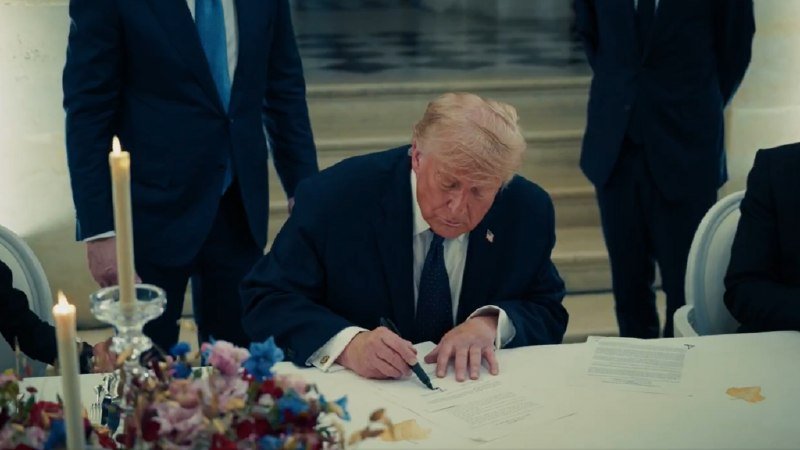
On 18 June 2026, the point was made for Donald Trump, who confirmed on 18 June that he signed a memorandum of understanding electronically from inside the palace itself, according to a Polymarket news bulletin timestamped 00:57 UTC. Italian daily Corriere della Sera's morning wire, dispatched at 06:45 UTC and again at 07:00 UTC, framed the venue choice explicitly as a question of why Macron opened France's most famous palace to a US president whose second term has unsettled the transatlantic relationship.
That is the right question to ask, and it is the question Western coverage has tended to skip past in favour of the policy deliverables.
The setting is the signal
There is a short, unglamorous reason Trump's working visit landed at Versailles rather than the Élysée Palace: the smaller residence is under renovation. A grander reason, and the one Macron's team appears to have calculated, is that Versailles broadcasts. It tells the visiting delegation, the French public, and the global press that this is not a routine bilateral — it is an event at which France intends to be seen as a civilisational peer of the United States, not a supplicant.
In an era when European leaders complain privately that Washington now treats the alliance as a transaction, the choice of venue reads as a soft-power counter-argument. You do not schedule a transactional meeting in a hall built to perform absolutism. Versailles implies duration, inheritance, and a continuity the United States, at 250 years old, cannot match.
The MOU is the subtext
The substance, such as it is, sits beneath the staging. Trump's electronic signature on a memorandum of understanding — confirmed in the early UTC hours of 18 June — gives the visit a deliverable without specifying what the deliverable is. MOUs are, by diplomatic convention, not treaties: they signal intent, not obligation. That is precisely why they are useful when neither side wants to be tied down. A French government that wants to demonstrate to domestic audiences that it secured a presidential audience; a US president who wants to claim another bilateral win; a document that satisfies both without committing either. The form is the content.
Italian coverage, in the Corriere della Sera wire item circulated at 07:00 UTC, treated the venue choice as the lead and the MOU as the corroboration. That ordering is correct. When a host spends the diplomatic currency of Versailles on a guest, what was signed matters less than what the signing was seen to mean.
What the optics argue against
The dominant Western framing of late has been that Europe is on the back foot: scrambling to recalibrate defence spending, absorbing tariffs, watching Washington warm to Moscow and Beijing in equal measure, and discovering that the security guarantee has a price tag attached. Read through that lens, the Versailles gambit looks like compensation — grandeur substituting for leverage.
There is something to that. A palace does not move armoured divisions. But the counter-read is worth its airtime. France is the only EU nuclear power with a permanent UN Security Council seat, the only EU member with full-spectrum force projection in the Pacific, and the continent's leading diplomatic broker in the Russia–Ukraine file. Versailles is not a substitute for those assets; it is the stage on which the holder of those assets performs the legitimacy that comes with them. The optics argue, in short, that the country which feels it has the most to lose from a transactional Atlantic is also the country best placed to insist that the alliance remain something more than a deal.
The serious paragraph
The risk for Macron is that grandeur ages quickly. A palace is a defensible symbol on day one; by day ninety it is a photograph. If the MOU produces no follow-through — no movement on Ukraine terms acceptable to Kyiv, no relief on the tariff schedule that has hit French wine and aerospace, no consultation machinery on the China file — then Versailles becomes the memory of a moment when France was seen trying, and trying is what you do when you cannot dictate. The risk for Trump is the mirror image: that a venue designed to amplify the host ends up amplifying him as the guest who was received there, feeding a domestic narrative of restored American prestige that the actual ledger of deliverables does not support. Neither leader appears to have paid a price for the pageantry on 18 June. Both may pay for what comes, or fails to come, after it.
This publication framed the Versailles visit as a soft-power negotiation rather than a policy event, on the reading that the choice of venue was the most consequential decision of the day. Corriere della Sera's wire led on the same question; the Polymarket bulletin confirmed only that the MOU was signed, not what it contained.
Wire provenance
This editorial synthesis draws on the following public wire/social posts:
- https://t.me/s/CorriereDellaSera
- https://t.me/s/CorriereDellaSera
- https://x.com/polymarket/status/