A 'ceasefire' on paper, a war by other means: Israel strikes southern Lebanon within minutes of the announced deal
Within minutes of an announced Israel–Hezbollah ceasefire on 19 June 2026, Israeli warplanes hit the Lebanese city of Nabatieh and eleven other southern towns. The pattern exposes the gap between the language of de-escalation and the logic of an air campaign that has not paused.
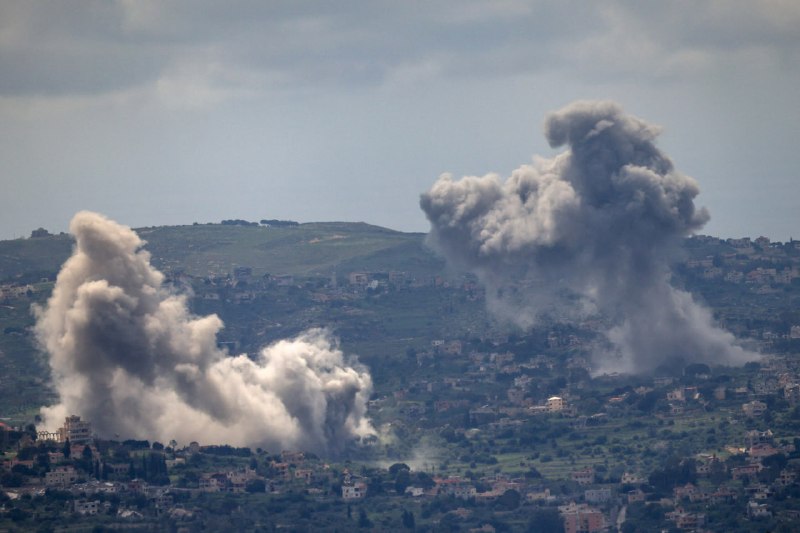
At 13:23 UTC on 19 June 2026, an Al-Mayadeen correspondent embedded in southern Lebanon reported that an Israeli airstrike hit the city of Nabatieh at the same moment a publicly announced ceasefire was supposed to be taking effect. By 13:44 UTC, the same outlet had counted additional Israeli strikes against multiple areas of southern Lebanon. By 14:01 UTC, the Beirut-based outlet The Cradle had tallied Israeli air activity against eleven towns and villages since the deal was announced, with some struck more than once. The sequence is the news: the words "ceasefire" and "operation" do not, on this evidence, describe mutually exclusive states of affairs.
What the public was told and what the public was shown diverged inside a forty-minute window. The substance of the diplomatic announcement — that Israel and Hezbollah would halt strikes contingent on reciprocity — is real. The substance on the ground, documented by correspondents on both sides of the border, is that Israeli aircraft and artillery kept flying. The gap between the two is the story, because it tells you something about who decides when a deal is alive and who decides when it is dead.
The diplomatic theatre
The terms of the arrangement, as reported in Hebrew-language media on 19 June, were narrow and contingent. A senior Israeli official told Channel 13 that Israel was "currently in a ceasefire situation" and that, absent an attack by Hezbollah, "it is not a war situation," as relayed by Fars News at 13:16 UTC. Yediot Aharonot, cited by the same outlet at 13:51 UTC, paraphrased an Israeli official as saying the two sides had agreed to a ceasefire and that Israel would not attack provided Hezbollah did not attack first. The structure is classic deterrence logic: a hot line of conditional restraint, not a peace.
The arrangement does not appear to have addressed the wider architecture of the Israel–Hezbollah front, including the dispute over northern Israeli towns depopulated since October 2023, the Lebanese demand for a full Israeli withdrawal from contested points, or the question of enforcement. A 19 June commentary thread on the Middle East Spectator Telegram channel, captured at 14:01 UTC, framed the situation in sharper regional terms, urging Iran to carry out an operation against Israel and to threaten withdrawal from an unspecified memorandum of understanding should Israel continue. Whether the memorandum in question is the broader Iranian-Saudi détente brokered by Beijing, the Islamic Republic's cooperation framework with Moscow, or a reference to the dormant Syrian file, the source does not specify. The framing matters because it indicates how one pro-Iranian analytical channel reads the contingency of the deal: not as a settlement, but as a test of resolve.
The air war that did not stop
The Cradle's tally, captured at 14:01 UTC, is the clearest single-sentence summary of the operational record. "Since the latest so-called 'ceasefire'," the outlet reported, "Israel has targeted 11 towns and villages in south Lebanon, with some being struck by Israeli aerial attacks multiple times." The phrasing — "so-called" — signals the editorial read: the deal exists as text, not as a binding constraint on air tasking orders.
Two additional data points sharpen the picture. Fars News, citing an Al-Mayadeen reporter, reported at 13:23 UTC that the Nabatieh strike occurred at the moment the ceasefire was due to enter into force. Fars News at 13:52 UTC, citing Israeli Channel 12, added that since the announcement, more than ten Israeli airstrikes and artillery attacks had been recorded inside Lebanon, with twelve cumulative incidents referenced. Whether the figure is precisely ten or twelve is less important than the structural fact: even by Israeli media's own count, the tempo of strikes did not drop at the moment the deal was supposed to begin.
The pattern is not new. Airstrikes and artillery shelling in southern Lebanon have continued on a near-daily basis since the October 2023 outbreak of the wider front, punctuated by Israeli operations in Baalbek and the Bekaa, Israeli strikes on the Beirut southern suburbs, and repeated rounds of diplomacy in Doha, Cairo, and Washington that did not translate into a sustained halt. The 19 June episode is notable not because it broke a pattern of restraint, but because the rhetoric of restraint was deployed at the same time the pattern was reaffirmed.
Why the gap matters
Two readings of the 19 June events are plausible, and a serious account should hold both in view.
The first is operational. The Israeli military, by this reading, treats ceasefire declarations as political statements that take operational effect only after a verification window during which any launch, movement, or radar emission from the other side is treated as a violation. Under that reading, strikes in the minutes after the announcement could reflect pre-tasked missions, an internal lag in de-confliction, or a deliberate demonstration that the air force can still fly. The 19 June Israeli official quoted by Yediot Aharonot — that Israel would not attack absent a Hezbollah attack — is consistent with this reading: it implies the burden of the next move sits with Hezbollah, and that any pre-tasked strikes will be defended as defensive.
The second is structural. Ceasefires of this kind, in this corridor, are widely understood by both sides as instruments of pause rather than instruments of settlement. They exist to allow political talks to begin, to relieve donor pressure on Lebanon's collapsing economy, to give the Israeli public a window of normalcy, and to give Hezbollah time to reconstitute. Under that reading, strikes in the minutes after the announcement are not a bug; they are the price of admission to the next round. The diplomatic language of "we agreed to a ceasefire and if Hezbollah does not attack, we will not attack either" is less a commitment than a description of the trigger conditions for the next escalation.
This publication's reading is that the second framing is closer to the truth, and that the first framing, while tactically intelligible, obscures the political economy of the front. The arrangement as reported on 19 June does not give either side what it would need to call the war finished. Israel has not secured the demilitarisation of southern Lebanon north of the Litani. Hezbollah has not secured a full Israeli withdrawal from contested points or a credible reconstruction track for the Shia south. A deal between two parties who have not secured the underlying objectives of their war is a deal designed to be broken, and the first minutes of its life will read the same as the last minutes of the war it nominally ended.
The wider front
The 19 June events are also a reminder that the Israel–Hezbollah front is a sub-front of three larger structures: the Israeli campaign in Gaza, the Iranian regional posture, and the US–Iran track that has periodically produced deconfliction understandings.
On the first, the continuation of Israeli air activity over Lebanon in the same week that humanitarian access to Gaza has been the subject of renewed international pressure is not coincidental. A government in Jerusalem that has had to defend the conduct of the war in Gaza has, at the same time, a strong political incentive to keep the northern front at a level of low-intensity operation that demonstrates control without producing mass-casualty events that complicate coalition management.
On the second, the Middle East Spectator framing — that Iran should respond to continued Israeli action by threatening to withdraw from a memorandum — is significant because it points to a Tehran that is calculating the cost of the current arrangement in its own terms. A Hezbollah-supplier that is told the cost of restraint is that its ally's airspace is treated as Israeli-controlled may decide that the price of the deal is too high. The 19 June episode, in that light, is a stress test of the regional architecture: it tells the Iranian side what kind of ceasefire it has bought.
On the third, the diplomatic traffic around Lebanon has historically been most productive when Washington has had leverage on both Israel and Iran simultaneously, and least productive when that leverage is asymmetric. The arrangements of November 2024 and the various Doha tracks in 2025 all depended on US quiet diplomacy with Tehran. If a track of that kind is now alive in mid-2026, the 19 June strikes are a stress test of it; if it is not, the strikes are an unconstrained operational reality. The source material available to Monexus does not allow a confident answer to that question.
The information ecosystem
A final point concerns the sourcing of the reporting on which this article rests. The Cradle is a Beirut-based outlet that frames itself as a counter-hegemonic voice on regional affairs and is widely read in the Shia Arab world. Al-Mayadeen is a Beirut-based outlet with close ties to Hezbollah's political orbit. Fars News is the Islamic Republic of Iran's English-language newswire, and its framing of Israeli officials reflects a long-standing practice of translating Hebrew media into an English register that emphasises Israeli aggressiveness. Channel 12, Channel 13, and Yediot Aharonot are mainstream Israeli outlets whose accounts Monexus is reading only through the Fars News wire summary; the underlying Hebrew-language originals are not in this source set.
The epistemic consequence is that the operational facts of the 19 June episode — that strikes hit Nabatieh at the moment the deal was due to begin; that, by multiple counts, more than ten strikes followed; that eleven towns were targeted in the first hour — are attested by sources whose editorial framing is uniformly opposed to Israel. The Western wire corpus in Monexus's research set does not contain independent verification of the 19 June events; the Israeli outlets cited here are cited only via Fars News paraphrase. This publication reads the convergence between the Lebanese and Iranian sources on the basic operational record as a meaningful signal, but it does not treat the convergence as proof. A reader wanting to verify the strikes from sources outside the Iran-aligned information ecosystem should wait for wire confirmation from Reuters, the AFP, or the BBC, none of which appears in the source set underlying this article.
Stakes and time horizon
If the 19 June pattern holds, three things follow. The first is that the announced deal will be priced into the market for regional risk as paper-thin: insurance and shipping rates in the eastern Mediterranean, reconstruction commitments to southern Lebanese municipalities, and the political fortunes of the Lebanese government will all be marked down relative to what a credible deal would imply. The second is that the Hezbollah political–military leadership will face internal pressure to respond, both because the air-strike tempo on Shia-majority civilian areas is politically unsustainable inside the community, and because Iran-aligned commentary is already framing continued strikes as a test of deterrence that demands an answer. The third is that the United States will face a choice between investing diplomatic capital in reviving a wider track, and treating the announced deal as a useful fiction that buys time without committing either side to outcomes. The history of the front suggests that a useful fiction, in this corridor, has a half-life measured in weeks, not months.
What remains uncertain, on the evidence in Monexus's research set, is whether the 19 June strikes were pre-tasked missions that crossed into the ceasefire window, a deliberate demonstration of the air force's reach, or a measure of how thin the coordination between the political leadership that announced the deal and the operational headquarters that executes it actually is. The sources do not specify. They do, however, agree on a fact that should be enough for now: at the moment a ceasefire was supposed to begin, the war did not stop.
— Monexus framed this episode by treating the announced deal and the air activity as a single object, on the working assumption that a ceasefire which does not produce a halt is best read as a political signal whose actual content is the continuation of the war. Western wire confirmation of the operational record was not in the source set; the article makes that gap explicit rather than papering over it.
Wire provenance
This editorial synthesis draws on the following public wire/social posts:
- https://t.me/Middle_East_Spectator
- https://t.me/thecradlemedia
- https://t.me/FarsNewsInt
- https://t.me/FarsNewsInt
- https://t.me/FarsNewsInt
- https://t.me/FarsNewsInt
- https://t.me/FarsNewsInt
- https://en.wikipedia.org/wiki/South_Lebanon_conflict_(2023%E2%80%93present)