The Nabatieh bombardment and the cost of treating southern Lebanon as a footnote
At least 16 people were reported killed in a single morning of strikes on the Nabatieh district. The reporting gap is now as significant as the strike itself.
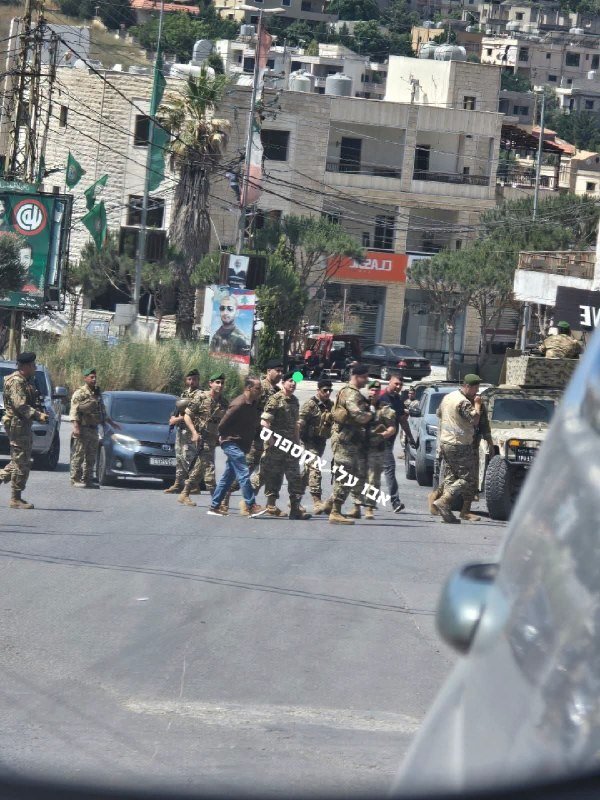
At roughly 05:24 UTC on 19 June 2026, a series of Israeli raids hit the town of Habboush in the Nabatieh District of southern Lebanon. By 06:20 UTC, additional strikes had reached the vicinity of Nabatieh al-Fawqa, and the morning's toll was being reported by Middle East Eye as at least sixteen killed in the district before sunrise.
The pattern is no longer remarkable; it is the routine. The reason it is still worth pausing over is that the news infrastructure covering it is, once again, thinner than the news.
The thinness of the wire
The visible record of this morning's bombardment runs through a small, telling set of channels. The strike notifications arrived on Telegram via Al-Alam Arabic, an Iranian state broadcaster that maintains a near-real-time feed of Israeli operations on Lebanon's southern front. The casualty framing was carried by Middle East Eye, a London-based outlet with deep regional reporting capacity and a documented editorial line sympathetic to the axis of resistance. Reuters, AFP and the Associated Press — the wires that have historically defined the daily news picture from the Litani south — have not, as of this writing, moved a standalone bulletin naming the Habboush, Deir al-Zahrani and Nabatieh al-Fawqa strikes with the same granularity. The Israeli military, the IDF Spokesperson's Unit, has not been cited in the thread material as issuing a per-strike readout. Without that, the burden of attribution and the burden of counting fall, by default, on the same outlets the Western wire infrastructure tends to discount.
This is the structural problem, and it is not new. When the only actors reporting the strike in real time are the Iranian-aligned and the Beirut-based independent regional press, the Western reader is left with a choice: treat the absence of confirmation as evidence the strike did not happen, or treat the absence as itself a story. The honest answer is the latter.
What the sources actually say, and what they do not
Al-Alam Arabic's Telegram feed, run by Iranian state media, names the locations: Habboush, Deir al-Zahrani, Nabatieh al-Fawqa. The framing is denunciatory and the cadence is urgent. Middle East Eye's live blog, surfaced at 06:08 UTC, gives a body count — at least sixteen — and a location — the Nabatieh district. The Israeli government and the IDF have, in the thread material before this publication, made no specific claim of responsibility for the named strikes, and no claim of a targeted-operative justification. The Lebanese state, the Lebanese Armed Forces, and the UN Interim Force in Lebanon have not been cited in the thread material as issuing parallel statements.
That is what we know, and a list of what we do not. We do not know the specific military target the Israeli side identified, if one was identified. We do not know the breakdown of the sixteen reported killed between combatants and civilians — a distinction that matters under the laws of armed conflict and that, in southern Lebanon, the wire routinely cannot make in the first hours. We do not know whether the strikes are part of a declared operation, a continuation of the post-ceasefire pressure campaign against Hezbollah infrastructure south of the Litani, or a discrete escalation. The thread material does not say. Monexus will not say what the thread material does not say.
The structural frame, in plain language
Coverage of southern Lebanon has long been mediated by three filters that have nothing to do with what is actually happening on the ground. The first is institutional access: the IDF and the Israeli political system issue regular readouts in English; Hezbollah does not, in any language, on a comparable cadence. The second is wire habit: Reuters, AFP and AP have, in the post-2024 phase of the conflict, run Israeli operations in the south as a story about Israeli security policy, with the Lebanese body count as context, rather than the inverse. The third is a quiet editorial ceiling: when a strike hits a town whose name most Western editors cannot place on a map, the story gets a line in a wrap, not a bulletin.
None of this is a conspiracy. It is how the news machine is built. It is also why a single morning in the Nabatieh district can produce sixteen reported dead and a coverage footprint that would, in another theatre, produce a special correspondent on the ground within hours.
Stakes
The stakes are not abstract. The Litani corridor, declared under successive understandings as a zone from which armed non-state actors should be cleared, is also home to villages whose inhabitants have been displaced, killed and rebuilt over for two years. If those villages are struck and the only first-day record is an Iranian state feed and a London-based regional outlet, the international community's picture of whether the strikes meet the legal threshold of proportionality, distinction and military necessity is being built on a thinner evidentiary base than the gravity of the action warrants. The pattern compounds. Each unverified-or-thinly-verified morning becomes, in the next week's reporting, the established baseline against which the next morning is measured. That is how a displacement becomes a footnote. That is how a body count becomes a number in a wrap.
The alternative read of the facts is the one the Israeli government has consistently offered: that operations south of the Litani are aimed at dismantling militant infrastructure that has, in previous rounds of conflict, fired into Israeli territory, and that civilian harm is a function of that infrastructure being embedded in populated areas. The structural objection to that read is not that it is false in principle; it is that the international community has no reliable, independent mechanism to test it strike by strike. The body of verification work that would normally fall to UNIFIL, to the Lebanese Armed Forces, to a robust wire presence, to Israeli military advocate-general reviews released in real time — that body of work is, on the morning of 19 June 2026, visibly incomplete.
What remains uncertain
The thread material does not specify whether the sixteen reported killed in the Nabatieh district were from a single strike or the cumulative count across the Habboush, Deir al-Zahrani and Nabatieh al-Fawqa incidents. It does not specify the type of ordnance. It does not specify whether the Israeli side has, in parallel channels, claimed the strikes. Until those questions are answered by sources not named in the thread — the IDF, the Lebanese health ministry, the UN coordinator, an on-the-ground wire stringer — the count is a starting figure, not a final one. Monexus treats it as such, and the reader should too.
Desk note: Monexus framed the Habboush / Deir al-Zahrani / Nabatieh al-Fawqa strikes as a coverage-gap story as much as a strike story, because the source material is dominated by an Iranian state-aligned feed and a sympathetic regional outlet and the Western wire had not, at publication, moved a comparable per-strike bulletin. That is the picture; the picture is the point.
Wire provenance
This editorial synthesis draws on the following public wire/social posts:
- https://www.middleeasteye.net/live/iran-war-live-israel-says-it-will-control-bridges-and-area-south-lebanons-litani-river
- https://t.me/alalamarabic
- https://t.me/alalamarabic
- https://t.me/alalamarabic