A ceasefire that never took: Israeli strikes on Nabatieh reopen the Lebanon question
Less than a day after Israel and Hezbollah announced a ceasefire, warplanes hit Nabatieh and the Bekaa. The numbers on the ground — and the silence from the deal's guarantors — suggest the announcement was not the agreement.
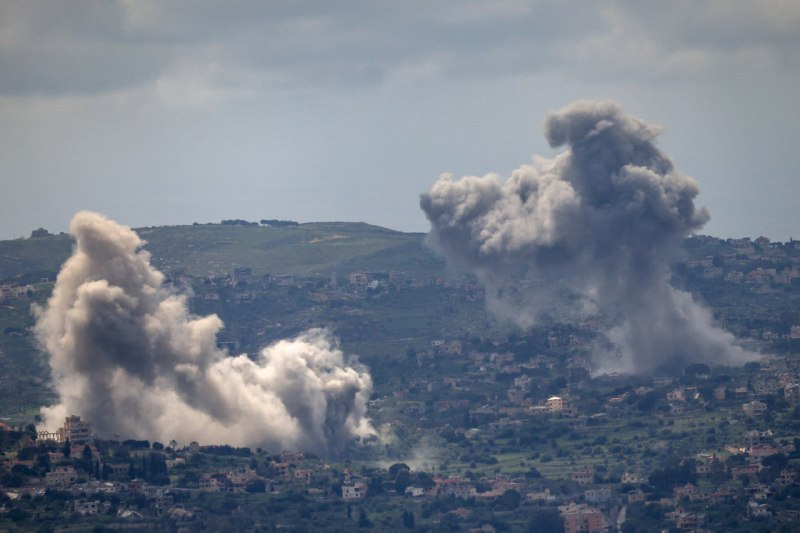
At 09:46 UTC on 20 June 2026, Lebanon's Civil Defense said sixteen people had been killed and twelve wounded in Israeli airstrikes on the Nabatieh area of southern Lebanon. By 10:57 UTC, Telegram channels monitored by the field were reporting a running total of sixteen dead across Nabatieh from a single morning's bombardment, alongside strikes on the Bekaa town of Sohmor. By 10:58 UTC, Lebanese channels tallied eighty-three airstrikes since the day's opening — sixty-nine by fighter jet, fourteen by unmanned aircraft. The Star Kenya's wire, posted at 10:00 UTC, framed the strikes as taking place "less than 24 hours" after a ceasefire between Israel and Hezbollah had been announced. The arithmetic of those hours is the story: a deal announced in one timezone, a war resumed in another, and a press release that the planes never read.
What unfolded on 20 June is not, on the surface, a story of new doctrine or new weaponry. It is a story about what a "ceasefire" means when one party's security cabinet reserves the right to define violations in real time, and when the diplomatic channel that produced the announcement is not the same channel that controls the sortie schedules. The structural question is whether the announcement of an end to hostilities, in the absence of a verified monitoring architecture and a single authoritative read of what counts as a breach, is a diplomatic instrument at all — or merely a description of intent that survives only until the next cabinet meeting.
The morning of 20 June, by the numbers
The sequence matters because the day's chronology is itself a counter-narrative to the ceasefire framing. Telegram channel @englishabuali posted at 10:58 UTC that Lebanese outlets were tracking eighty-three Israeli airstrikes "since this morning" — a count that, if accurate, places the air campaign's resumption in the pre-dawn hours, well within the post-announcement window. @Megatron_ron logged at 10:57 UTC that Israeli warplanes had continued strikes across southern Lebanon and the Bekaa, with sixteen killed in Nabatieh alone. @wfwitness, the earliest source in the thread, posted at 11:17 UTC on a strike targeting Nabatieh city directly, while the same channel at 10:48 UTC relayed Lebanese Civil Defense figures: forty-seven citizens evacuated, sixteen dead, twelve injured.
The Cradle's two posts, both timestamped 09:46 UTC, fix the Civil Defense casualty figure at sixteen killed and twelve wounded in Nabatieh. @TheCradleMedia and @thecradlemedia also carried, at 09:43 UTC, a separate strike on the town of Sohmor in Lebanon's western Bekaa — geographically distant from the southern front, which suggests an air tasking order that is operating against targets across multiple Lebanese districts rather than a localised response to a specific incident. The Star Kenya's reporting, syndicated through Telegram at 10:00 UTC, placed the toll at "at least eleven" killed in strikes the outlet framed as a violation of the newly announced ceasefire; the figure later converged on the Civil Defense count of sixteen as the day progressed.
What can be verified from the sources is the existence of the strikes, the location of the most lethal cluster (Nabatieh and the surrounding Nabatieh district in south Lebanon), the geographic extension of the campaign into the Bekaa, and the casualty figures as reported by Lebanon's Civil Defense. What cannot be verified from the sources is the Israeli government's operational rationale: the thread contains no IDF Spokesperson briefing, no Israeli security cabinet readout, and no Hebrew-language wire confirmation of either the strike tally or the targeting criteria. That asymmetry — Lebanese figures cross-confirmed by a Beirut-based outlet and a regional outlet, Israeli framing absent — is the article's most important caveat.
What the ceasefire actually covered, and what it did not
The Star Kenya wire characterised the airstrikes as a violation of "a ceasefire between Israel and Hezbollah." The phrasing is itself revealing. The November 2024 arrangement that paused the Israel–Hezbollah war was brokered through US and French intermediaries and contained, in its published terms, a 60-day window during which Israeli forces would withdraw and Hezbollah's armed presence south of the Litani River would be disarmed under international monitoring. The arrangement on the table in mid-2026 — the one referenced as having been "announced" in the 19 June reporting window — appears, on the available evidence, to be a narrower political understanding: an announcement of intent, an exchange of commitments, possibly a softening of operational tempo, but not the same instrument as the November 2024 framework.
The distinction matters because it determines what "violation" means. A formal ceasefire with a UNIFIL-supervised ceasefire line, written rules of engagement, a Joint Monitoring Cell, and a complaint mechanism has a vocabulary for breach: a panel is convened, a violation is recorded, a protest note is filed. A political announcement of a deal, with no published text, no third-party guarantor visible in the sources, and no agreed monitoring architecture, has no such vocabulary. In its absence, "violation" becomes a political charge rather than a procedural finding, and the burden of evidence shifts entirely to the side whose civilians are under the bombs.
This is not a counsel of cynicism. It is a description of the diplomatic surface area. The sources do not show an Israeli readout that explains the targeting of Nabatieh — a populated city, the capital of south Lebanon's Nabatieh Governorate, and a site with documented civilian infrastructure. They do not show an Israeli confirmation that the strikes on Sohmor, in the western Bekaa, are part of any stated defensive operation. The Lebanese framing, by contrast, is internally consistent: Civil Defense, the Lebanese state news agency (as relayed by The Star Kenya), and regional outlets converge on the same casualty figures and the same geographic description. The evidentiary asymmetry is not trivial.
The structural frame: announcements, tasking orders, and the gap between them
The pattern visible on 20 June is not new to the Israel–Lebanon file, and the lesson it carries is structural. Diplomatic announcements and military tasking orders are produced by different bureaucratic machines, on different timelines, under different chains of accountability. A cabinet can declare a ceasefire; a sortie schedule is set by operations officers who answer to a different set of incentives. When the two are not synchronised by a written text, a shared monitoring body, and a procedural complaint mechanism, the result is exactly the picture the thread paints: a deal announced, strikes executed in the interval before the deal is operationally absorbed, and a press cycle that must then explain the contradiction.
In plain editorial terms: when a ceasefire does not name a monitoring authority, does not specify the geographic scope of permissible defensive action, and does not establish a complaint mechanism with publication obligations, it functions less as an agreement and more as a description of a mood. Moods do not intercept aircraft. The November 2024 arrangement, for all its later strain, at least named a mechanism — UNIFIL, the United States, France — and gave each side a procedural address for complaints. Whatever was announced in the 19 June window appears, on the available evidence, to have lacked that procedural spine.
There is a second structural element that the thread does not surface but that any honest analysis must flag: the role of the guarantors. When a deal is announced under US, French, or UN auspices, the guarantors are expected to do work — to call a violating party, to suspend implementation, to issue a public statement of dissatisfaction. The thread contains no such statement from Washington, Paris, or Beirut's international partners. The silence of the guarantors, on the morning of 20 June, is itself a fact about the deal: it is a fact about how much enforcement weight the announcement actually carried.
Counter-reads: what the dominant framing underplays
The dominant wire framing on the morning of 20 June, as represented by The Star Kenya's syndication, treats the strikes as an Israeli breach of a Hezbollah agreement. The framing is defensible on the visible evidence, but it is not the only plausible read, and the most analytically useful exercise is to name the alternatives.
The first counter-read is operational. The Israeli security establishment has, since the November 2024 arrangement, maintained that it reserves the right to strike specific targets that it judges to be re-armament sites, precision-missile production facilities, or command nodes operating under civilian cover. From that premise, strikes on Nabatieh and the Bekaa can be described as compliance operations — defensive, targeted, predicated on intelligence about specific violations. The thread contains no Israeli readout to support this read, but it would be analytically dishonest to omit the read itself. It holds or fails on the basis of evidence not present in the source set: the specific targets struck, the intelligence cited, the proportionality of the response, the warning given (or not given) to civilians in the area.
The second counter-read is timing. A "ceasefire" announced late on 19 June, with implementation understood to begin at a specific hour, may simply have not yet been in effect at 09:46 UTC on 20 June. The Star Kenya's framing — "less than 24 hours after" the announcement — is true but does not specify the implementation clock. If the deal's clock had not yet started, the strikes are not a violation of an operative ceasefire but a final action under the prior authorisation. The thread does not resolve this question; the timing caveat belongs on the record.
The third counter-read is the question of reciprocity. A ceasefire is bilateral. If the Israeli government believed, in the post-announcement hours, that Hezbollah or its affiliates had conducted an action that, under the deal's terms, constituted a material breach, the doctrine of "responsive self-defence" gives a state the right to act. The thread does not surface such an alleged action; the absence is itself significant, because an Israeli claim of breach would normally be the first thing an Israeli readout would establish.
The honest summary is this: the available evidence supports the description of strikes on populated areas of south Lebanon and the Bekaa, with sixteen killed and twelve wounded in Nabatieh per Civil Defense, and a running tally of eighty-three strikes across the country by 10:58 UTC. The available evidence does not establish, on its own, whether the ceasefire was operative at the moment of the strikes, whether Israel had a stated cause, or whether the guarantors were consulted before the sorties. Each of those questions is load-bearing, and each is unanswered by the source set.
Stakes: what the next 72 hours decide
The forward question is not whether the 20 June strikes were legal or illegal under international humanitarian law — that is a question for the International Committee of the Red Cross, for any subsequent commission of inquiry, and ultimately for courts with jurisdiction. The forward question is whether the announced deal survives the next 72 hours, and the answer depends on three decisions that the thread does not yet capture.
The first decision is Israeli. The Israeli security cabinet must decide whether the strikes were a one-off enforcement action, a deliberate test of the deal's limits, or the opening move of a campaign that the announcement was designed to soften diplomatically. Each option produces a different forward trajectory: a one-off enforcement action allows the deal to limp forward; a deliberate test requires a Hezbollah response to validate the test; a campaign requires a political cover that the announcement was meant to provide. The thread does not resolve this.
The second decision is Lebanese. Beirut's government, already operating under severe fiscal strain and with a population that has borne the cumulative cost of a year of cross-border fire, must decide whether to characterise the strikes as a violation triggering a formal complaint, or as a regrettable incident that does not yet warrant the deal's collapse. The Lebanese state's capacity to enforce any ceasefire on its own soil is, in the thread, not visible — there is no reference to LAF deployment, to a Lebanese complaint to the UN Security Council, or to a formal request for guarantors' intervention. The decision space is narrow.
The third decision is the guarantors'. The US, France, and the UN have, at the moment the thread was filed, not made a public statement. Their silence can be read as caution, as diplomatic engagement behind closed doors, or as a signal that the deal was always understood to be a soft commitment. The 72-hour window is the period in which the guarantors' voice — or its absence — will most clearly indicate which read is operative.
The underlying pattern is older than 20 June. A diplomatic instrument that lacks a written text, a named monitor, a complaint mechanism, and an enforcement backstop is, in the worst case, a press release. The press release can perform the function of reducing kinetic tempo for hours or days. It cannot, on its own, hold a sortie schedule. The 20 June thread is a near-textbook instance of the gap between the announcement and the tasking order, and the question for the coming days is whether the gap is closed by a written instrument, a guarantor intervention, or a wider war.
This publication's framing departs from the standard wire line in one specific respect: where the wires have treated the day's strikes as a violation of an operative ceasefire, the source set does not establish that the ceasefire was in fact operative at the moment of the strikes, and the article flags that uncertainty as load-bearing rather than incidental. The wire treatment of casualty figures — sixteen killed, twelve wounded in Nabatieh per Civil Defense, eighty-three strikes countrywide per Lebanese channels — is preserved in full.
Wire provenance
This editorial synthesis draws on the following public wire/social posts:
- https://t.me/wfwitness/
- https://t.me/wfwitness/
- https://t.me/englishabuali/
- https://t.me/megatron_ron/
- https://t.me/TheStarKenya/
- https://t.me/TheCradleMedia/
- https://t.me/thecradlemedia/
- https://t.me/TheCradleMedia/
- https://t.me/thecradlemedia/