Ukrainian drones reach Tyumen as Russia warns of fresh strikes on Ukrainian cities
A Ukrainian strike on a Tyumen oil refinery 2,000 km from the front coincided with President Zelenskyy's warning that Russia is preparing another major attack on Ukrainian cities.
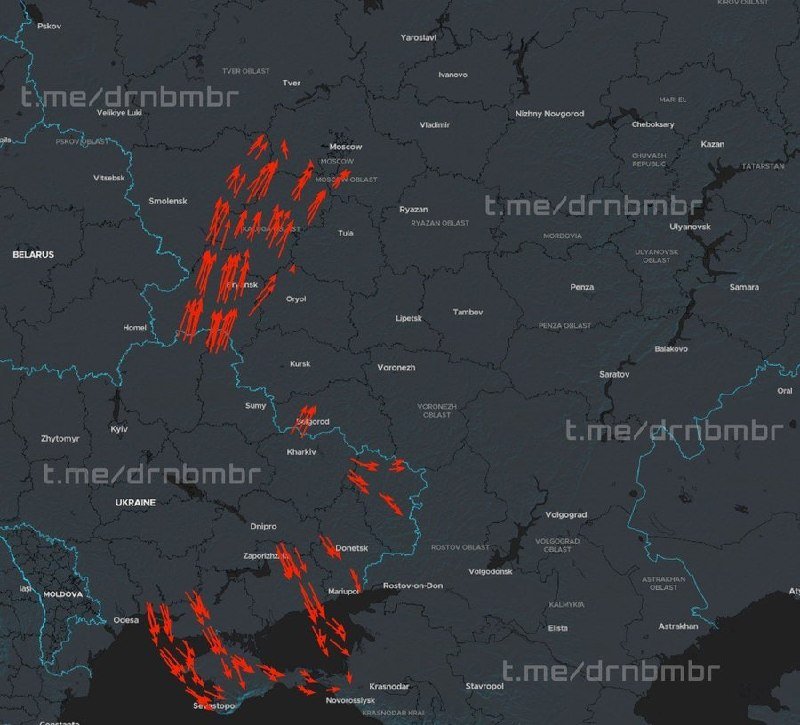
A Ukrainian drone struck an oil refinery in Tyumen on the evening of 20 June 2026, roughly 2,000 kilometres from the nearest stretch of the frontline, in an operation President Volodymyr Zelenskyy publicly confirmed. The same 24 hours saw the Ukrainian leader warn citizens of a fresh wave of Russian strikes, a reminder that the long-range exchange between the two countries is now running on a near-continuous loop, with deep-strike drones and missiles moving in both directions on the same news cycle.
What the Tyumen strike and Zelenskyy's warning amount to, taken together, is a war in which the operational frontier has become a circle. Energy sites, military airfields and arms factories deep inside Russian territory are now treated by Kyiv as legitimate targets; Ukrainian cities, by Moscow's own doctrine, have been such targets for four years. The contest has shifted from a localised ground offensive to a long-range attrition duel in which each side measures the other's will by how much pain it can deliver at distance.
A refinery 2,000 km from the front
Reports of fires at the Tyumen refinery began circulating on Telegram channels tracking the conflict on the evening of 20 June 2026, with the wartranslated channel — which translates Ukrainian and Russian military sources in real time — carrying initial accounts of the strike and Zelenskyy's confirmation that a Ukrainian drone had hit the facility. Tyumen sits in western Siberia, well beyond the Urals; for a Ukrainian drone to reach it is to cross Russian air space over a distance comparable to London–Moscow. Deutsche Welle, reporting on the same day, framed the strike as part of a widening pattern in which Russian air defences, once treated as near-impenetrable, are now visibly strained by the volume and variety of Ukrainian long-range systems.
The strategic logic is straightforward. Russian oil refineries fund the federal budget. Disrupting them raises the domestic cost of the war without requiring a single soldier to cross a border. Refinery strikes are not new — Ukrainian services have hit facilities in Krasnodar, Rostov and Volgograd oblasts repeatedly through 2025 and 2026 — but Tyumen is on a different scale of geography and symbolism. A successful hit there tells Moscow that the airspace over the Urals is contested too.
The Russian counter-threat
Within hours of the Tyumen reports, Zelenskyy addressed Ukrainian citizens directly, warning that Russia was preparing another large-scale attack and urging vigilance in the face of expected heavy strikes. The warning was carried by Jahan Tasnim, an Iranian outlet that frequently relays English-language summaries of Ukrainian official statements, and is consistent with a rhythm that has become familiar: a deep Ukrainian strike, a Russian signalling round of missile and drone launches against Ukrainian cities, a further round of Ukrainian long-range work in response.
Russia's long-range doctrine is also pointed. Strikes on Ukrainian energy and rail infrastructure during the summer of 2026 have repeatedly targeted substations, transformer yards and rail hubs rather than purely military sites — a pattern that Western analysts read as an attempt to degrade Ukraine's war economy and to remind Kyiv's European backers that sustaining the country carries a continuous humanitarian price. The Russian approach is not a symmetrical mirror of the Ukrainian one. Moscow is striking the grid that keeps Ukrainian hospitals, water pumps and apartments running; Kyiv is striking the refineries that keep Russian tanks moving. Both are acts of war; they are not the same kind of act, and conflating them obscures the asymmetry in capability and intent that still defines the contest.
The air-defence question
Deutsche Welle's reporting on 20 June 2026 put the question plainly: are Ukrainian drones now exposing Russian air-defence gaps? The honest answer is that they are exposing Russian air-defence costs. Russian layered air defence — long-range S-300 and S-400 systems, medium-range Buk and Tor batteries, short-range Pantsir units and a dense network of radar — was designed for a peer air force fight and for cruise-missile defence. It was not designed to absorb nightly waves of cheap, slow, low-flying drones launched in salvos of dozens or hundreds. Each drone shot down is, on Russian accounts, a relatively expensive interceptor spent; each one that gets through is a refinery, an ammunition depot or a command post.
That does not mean Russian airspace is open. Interceptors still engage drones over Crimea, the Donbas, the Krasnodar coast and the Moscow region with regularity, and the Russian defence ministry reports large monthly tallies of downed Ukrainian systems. What the Tyumen strike and the wider 2026 pattern show is that saturation — the cumulative pressure of cheap systems launched at volume — can stretch coverage thin and force defenders to choose what to protect. The economic arithmetic favours the attacker.
Stakes for the coming months
The short-term stakes are operational. If Ukrainian deep strikes continue to degrade Russian refining capacity, Moscow faces a familiar choice: accept higher domestic fuel prices, increase imports, or draw on strategic reserves. Each option has a political cost. If Russian strikes on Ukrainian infrastructure continue at the current tempo, Ukraine enters the heating season with a grid that is functional but fragile, dependent on Western-supplied air defence and on a rolling cycle of repairs that consumes engineers, transformers and money.
The medium-term stakes are political. Sustained deep strikes on Russian soil give Kyiv leverage in any future negotiation: proof to a domestic and European audience that Ukraine can hurt Russia without Western soldiers crossing a border. They also raise the cost of the war to Russian households, which is the only audience that can, in time, change the Kremlin's calculus. The risk is escalation — a Russian response calibrated to broaden the war, whether through direct action against Ukrainian government targets in third countries, through mobilisation shocks at home, or through a deliberate targeting of the nuclear-power stations that supply a large share of Ukrainian electricity. That risk is real, and Zelenskyy's warning is, among other things, a recognition of it.
What remains uncertain
The reporting available on 20 June 2026 leaves several questions open. The extent of damage at the Tyumen refinery — whether it is a one-day outage or a multi-month reconstruction — has not been independently confirmed. Russian sources have, on past refinery strikes, sometimes understated damage and sometimes overstated Ukrainian losses, and Telegram-channel accounts of fires are not the same as satellite imagery or refinery operator statements. The size and composition of the Russian strike Zelenskyy is warning about is also unknown: warnings of this kind have preceded barrages of dozens of missiles and drones, but they have also preceded smaller, more limited salvos. Both sides have an interest in framing the exchange in ways that suit their own narratives, and a sober read of the evidence requires holding that framing pressure in mind until the post-strike picture clarifies.
What is not in doubt is the trajectory. Each side is now operating, in practice, on the other's territory at a depth that would have looked fanciful in 2022. The war is being fought, in part, by drones launched across the Urals and by missiles launched across the Dnieper. That is the strategic reality the diplomacy of the next year, if there is to be any, will have to absorb.
Desk note: Monexus treats Ukrainian strikes into Russia as legitimate responses to an invasion and reports them on the same evidentiary footing as Russian strikes into Ukraine. Telegram-channel reporting is cited here only where it is the operative public source; mainstream-wire confirmation of damage assessments is pending.
Wire provenance
This editorial synthesis draws on the following public wire/social posts:
- https://t.me/wartranslated
- https://t.me/JahanTasnim
Follow the event.
These dated source records provide context. They do not retrospectively verify this archive article.
A dated voting record is evidence of one decision. Use the original UN record before turning it into an alignment label.
Visual explainer · historical vote of 2022-03-02 →