Pakistan's prime minister and army chief meet US delegation in Switzerland: what is actually on the table
On 21 June 2026, Pakistan's prime minister and army chief sat down with a US delegation in Bürgenstock, Switzerland. The agenda has not been disclosed, and that silence is the most telling signal.
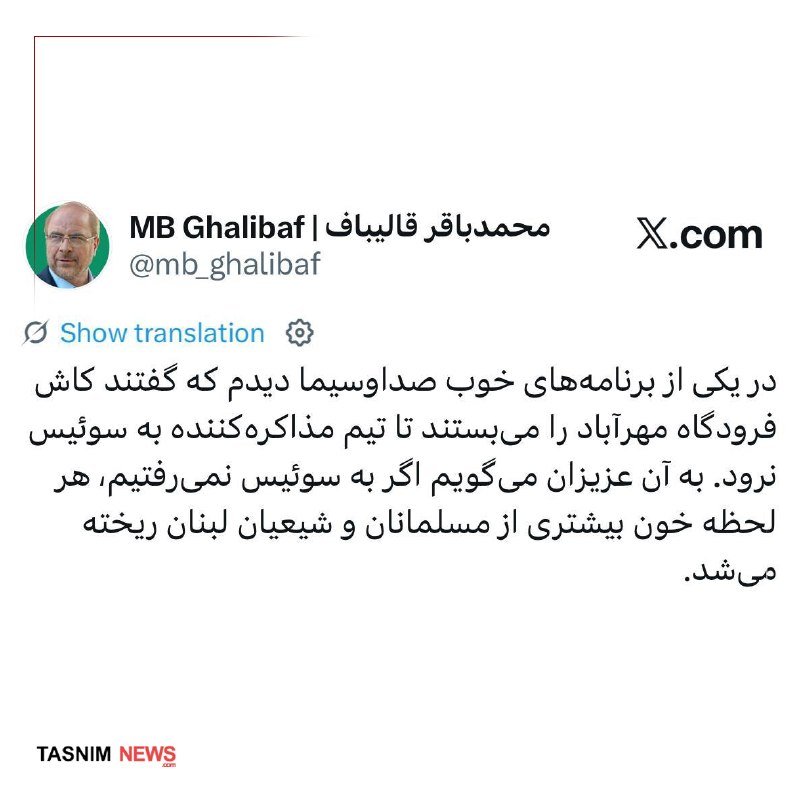
On 21 June 2026 at roughly 10:19 UTC, Iranian state-aligned outlet Fars News circulated video of Pakistani Prime Minister Shehbaz Sharif and Pakistan's army chief meeting with an American delegation in Bürgenstock, Switzerland. Within twenty minutes, the same scene had been confirmed by Iran's Mehr News, by Tasnim News, and by Al-Alam, the Arabic-language outlet of Iranian state television. The four reports describe the same photograph and the same location: a high-level Pakistani civilian-military delegation sitting across from American officials at the Bürgenstock resort above Lake Lucerne, the venue better known for hosting the 2024 "Summit on Peace in Ukraine."
What the four reports do not describe is what the two sides are actually discussing. That omission is the story. A meeting of this composition, at this venue, brokered through back-channel intermediaries, is the kind of diplomatic choreography that is constructed precisely to keep the agenda off the public record until both principals are ready to claim it.
The composition of the delegations
The Pakistani side is the more straightforward to read. Prime Minister Shehbaz Sharif is the civilian head of government; the presence of the army chief — the post is held by General Asim Munir, who also chairs the Joint Chiefs of Staff Committee — signals that the conversation is not confined to the civilian portfolio. In Islamabad's constitutional order, the army chief is the senior security principal, and his travel alongside the prime minister is the convention for any meeting where defence, intelligence, or nuclear-policy matters are on the table. Mehr News, Tasnim, and Al-Alam all specify the dual civilian-military Pakistani representation; Fars also shows both figures in its footage.
The American side is less specified. None of the four reports name the head of the US delegation or the agency they represent, which is unusual for a bilateral at this level and points to one of two institutional tracks. The first is the State Department, the channel that handles most publicly acknowledged diplomacy, including the recent Trump-administration engagement with Pakistan on trade and counter-narcotics. The second is the Central Intelligence Agency, which has run the most sensitive bilateral channel with Islamabad — including the 2011 raid that killed Osama bin Laden, the drone strikes along the Afghan border, and the running arrangement that has kept Pakistani nuclear assets under quiet American scrutiny for two decades. The four Iranian-allied sources reporting the meeting do not say which, and the framing of the coverage — visual emphasis, no named US principal — is consistent with an intelligence-channel meeting that the principals on both sides want acknowledged without being characterised.
Why Bürgenstock, and why now
The venue matters. Bürgenstock, in the canton of Nidwalden, is Swiss and therefore presumed confidential; it is also high-status and identifiable, which makes it a useful place to be seen meeting without being seen negotiating. The 2024 Ukraine peace summit, hosted there in June of that year, demonstrated that Bürgenstock can absorb a high-profile gathering without leaking its substance — a quality that made it attractive then and makes it attractive now.
The timing is harder to read. June 2026 falls inside a dense diplomatic cycle for Pakistan. The country is several months into a civilian government working with a military establishment that retains decisive influence over foreign and security policy; relations with Washington have cycled between transactional cooperation and open friction through 2025 and into 2026, with the Trump administration's aid-and-tariff posture repeatedly testing the relationship. A meeting of this profile, with the prime minister and army chief both travelling, suggests a substantive agenda rather than a courtesy.
What the four reports share, and what they leave out
The Iranian state-aligned coverage is the only coverage in the public record of this meeting as of 21 June 2026. That fact is itself worth registering. Tehran's English- and Arabic-language outlets — Tasnim and Al-Alam in particular — have an institutional interest in highlighting any US-Pakistan engagement, both because Pakistan is a regional neighbour and because American diplomacy with Islamabad has historically been read in Tehran as a counter-Iran alignment. The four reports are not independent; they are coordinated amplification of the same footage and the same scene, and they should be read as a single Iranian state-media package rather than as four separate confirmations.
What that package does establish, on the record, is that the meeting happened, where it happened, and who on the Pakistani side attended. What it does not establish is the agenda, the deliverables, the US delegation's composition, or the next step. Each of those four gaps is also a piece of information that someone has decided not to disclose.
The structural frame
The US-Pakistan relationship has historically been conducted in two parallel registers: a public register of aid, trade, and counterterrorism cooperation, handled by State and USAID; and a private register of nuclear, intelligence, and great-power balancing, handled by CIA and the Pentagon. The two registers do not always align, and the friction between them is often where bilateral stress shows up first. A meeting in Bürgenstock, with the army chief present, in a venue previously used for a major multilateral summit, fits the second register. The fact that the first public confirmation came through Iranian state media, rather than through a Pakistani foreign-ministry readout or a State Department briefing, fits the second register as well.
This is a relationship in which both sides have reason to deny each other a clean diplomatic win. Washington wants cooperation on counterterrorism, on Afghan border management, and on the containment of any nuclear-proliferation signal — without underwriting a civilian government in Islamabad that it cannot fully control. Islamabad wants market access, IMF support, and a degree of strategic autonomy from both Washington and Beijing — without losing either patron. The Bürgenstock meeting is the kind of conversation that happens when the two governments need to recalibrate which of those wants has moved.
What remains uncertain
The sources available to Monexus at 10:39 UTC on 21 June 2026 do not specify the agenda, the US delegation's head, the duration of the meeting, or whether a joint statement is contemplated. The four Iranian-aligned reports agree on the venue, the date, and the Pakistani principals; they are silent on every other variable. It is also not yet clear whether the meeting was preceded by a Pakistani readout, an Indian comment, or a Chinese reaction — all of which would be standard first-order responses in the regional media environment and whose absence is notable.
The dominant framing this story invites is that the US is tightening its alignment with Pakistan's military establishment at a moment of regional flux. The plausible alternative is that the meeting is narrower than it looks: a routine security-dialogue session with the venue chosen for confidentiality rather than symbolism, and the Iranian reporting simply a function of Tehran's interest in flagging any US-Pakistan contact. The available evidence does not yet distinguish between the two. Read closely, what the four reports confirm is the meeting; what they do not, and what the next forty-eight hours of coverage will need to confirm, is what the meeting was for.
Desk note: Monexus has relied here on a tight cluster of four coordinated Iranian state-aligned reports. We have avoided the temptation to over-read a single photograph. The story will sharpen if and when Pakistani, American, Indian, or Chinese readouts appear; until then, the meeting is a confirmed fact and a still-opaque agenda.
Wire provenance
This editorial synthesis draws on the following public wire/social posts:
- https://t.me/alalamfa
- https://t.me/tasnimnews_en
- https://t.me/FarsNewsInt
- https://en.wikipedia.org/wiki/B%C3%BCrgenstock