Vance meets Sharif in Bürgenstock: a quiet US–Pakistan reset, or a tactical photo-op?
A bilateral on a Swiss lake. The readouts are thin, the optics are loud, and the question is whether Washington is recalibrating with Islamabad or simply using a convenient stage.
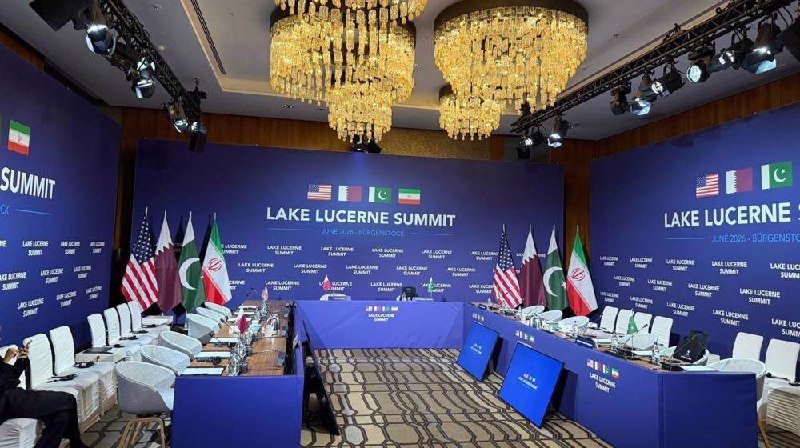
On 21 June 2026, US Vice President JD Vance sat down with Pakistani Prime Minister Shehbaz Sharif on the sidelines of a summit in Bürgenstock, Switzerland, with Pakistan's army chief reported to be in the room. Four outlets — Iran's state-aligned PressTV, Al Alam Arabic, Tasnim News, and Jahan Tasnim — pushed the meeting within a seven-minute window between 09:59 and 10:07 UTC, a coordination of framing that itself is part of the story. None of those channels typically leads its morning brief with Pakistani premier-arriving-in-Switzerland content; the volume signals intent.
What is actually on the table is harder to read. The official communications are thin. The optics — a US vice president meeting the leader of a nuclear-armed state of 240 million people that sits astride the route out of Afghanistan and the approach to the Arabian Sea — are loud. The question this piece attempts to answer is whether Washington is using Bürgenstock as the backdrop for a quiet recalibration of the US–Pakistan relationship, or whether the meeting is a tactical photo-op layered onto a summit calendar that no one has yet explained.
What the sources actually say
Strip the four Telegram items down to their hard claims, and they reduce to two: a US delegation led by Vance met Sharif, and the meeting took place in Bürgenstock. Iranian state media's Al Alam Arabic adds a third — that Pakistan's army commander was present alongside the prime minister, which matters because in Islamabad the chief of army staff is not a ceremonial figure but a co-equal principal at any conversation with Washington. PressTV frames the meeting in the neutral language of diplomatic hospitality: "met and consulted." Tasnim and Jahan Tasnim echo that register almost verbatim, down to the spelling of the Swiss town.
What is conspicuously absent is more informative than what is there. No read-out names a deliverable. No announcement references a specific dossier — sanctions, IMF tranches, F-16 sustainment, the Afghanistan border, the China-Pakistan Economic Corridor, the May 2025 episode in which India and Pakistan exchanged military strikes, or the counter-terrorism cooperation that has defined and derailed US–Pakistan ties across four administrations. The press items do not specify which side requested the meeting, whether it was scheduled in advance of Bürgenstock or assembled on the margins, or how long the delegation stayed in the room. The pattern across the four dispatches is presentation, not negotiation.
Why Iranian state media is leading the read-out
It is worth pausing on who is shaping the first draft of this story. PressTV, Al Alam, Tasnim, and Jahan Tasnim are Iranian state or state-aligned outlets. They are competent, professional wires with their own audiences, and their Telegram reporting routinely surfaces regional diplomatic movements the Western wires bury or skip. But they also have a structural interest in any US engagement with Pakistan: Tehran watches Islamabad carefully because the two share a 959-kilometre border, because Pakistan hosts a large Shia minority and a sizeable Sunni-extremist ecosystem that has historically spilled both ways across it, and because both countries are immediate neighbours of Afghanistan under Taliban rule.
A US vice president sitting down with the Pakistani prime minister and the army chief is, from Tehran's vantage, a regional-security event, not just a bilateral nicety. That is why the four wires moved within minutes of each other. The alternative read — that this is a coincidence of coverage windows — strains credulity. The framing also runs in one direction: every item characterises the meeting in soft, consultative terms, with no reference to sanctions, Iran, or any specific friction point. For Tehran, the desirable reading is that Washington and Islamabad are talking around the region, not about it.
The structural frame, in plain prose
Bilateral meetings between US vice presidents and Pakistani prime ministers are not rare, but the location matters. Bürgenstock has hosted Ukraine-focused peace talks and other discreet diplomacy since the early 2020s; the Swiss canton of Nidwalden offers neutral ground, secure infrastructure, and a media cycle that does not belong to either capital. Holding the meeting there rather than in Washington or Islamabad lowers the political cost for both sides. Sharif does not have to host an American in the prime minister's house; Vance does not have to extend the ceremonial weight of the White House. That asymmetry of venue is itself a tell.
Inside that, two patterns are worth naming. The first is the convergence of South Asian security, Gulf energy routes, and Afghan counter-terrorism into a single agenda item that no single ministry owns — a structural fact that has made every US–Pakistan reset since 2001 fragile in the same way. The second is the emerging pattern of US regional engagement conducted on neutral European ground rather than in the theatres where the underlying disputes live. The June 2026 Bürgenstock meeting fits that second pattern; the four-channel Iranian framing suggests that, whatever was discussed, it will be parsed first in Tehran, then in Riyadh, then in New Delhi, before it lands in Washington.
Stakes, and what remains uncertain
If this is the opening move of a real recalibration, the near-term beneficiaries are obvious: Pakistan's government gets visibility with a senior US official at a moment when its IMF programme is politically vulnerable; the US gets a face-to-face with the Pakistani army chief without the optics of a flag-rank visit. Pakistan's opposition parties — including the jailed Imran Khan's PTI — will read the meeting either as a vindication of the current government's diplomatic standing or, more cynically, as a transactional alignment with a US administration that is unpopular in Pakistani public opinion.
If it is a photo-op, the costs are smaller but not zero. Bureaucratic relationships between Washington and Islamabad run on institutional memory: meetings that produce no read-out erode the trust of mid-level officials in both foreign ministries who do the actual work of sanctions licensing, counter-terrorism nominations, and arms-package coordination. Several rounds of "reset" since 2018 have ended in mutual disappointment precisely because they were framed as breakthroughs and delivered only atmospherics.
What the four Telegram items do not let this publication answer, and what no subsequent wire had clarified at the time of writing, is the substantive content of the conversation. The sources do not name a deliverable, do not cite a participant, and do not specify duration. They agree on location, principals, and the consultative register of the meeting. They disagree, by silence, on everything else. The honest reading is that something was discussed, that it was considered newsworthy by four Tehran-aligned wires within seven minutes, and that the read-out will tell us more than the read-in has.
How Monexus framed this: where the Iranian wires led with neutral bilateral language, this piece reads the coordinated timing as a regional signal and the missing read-out as a substantive gap. We treat the four items as primary inputs rather than as window-dressing, and flag that the underlying story is what the meeting was not about as much as what it was.
Wire provenance
This editorial synthesis draws on the following public wire/social posts:
- https://t.me/presstv/
- https://t.me/alalamarabic/
- https://t.me/tasnimnews_en/
- https://t.me/JahanTasnim/
- https://en.wikipedia.org/wiki/B%C3%BCrgenstock
- https://en.wikipedia.org/wiki/Pakistan%E2%80%93United_States_relations