A friendly in Albany ends 3-2: what a Norway–Senegal tune-up actually told us
Holland's hat-trick and a stoppage-time Senegal consolation made the scoreboard look routine. The shape underneath it was not.
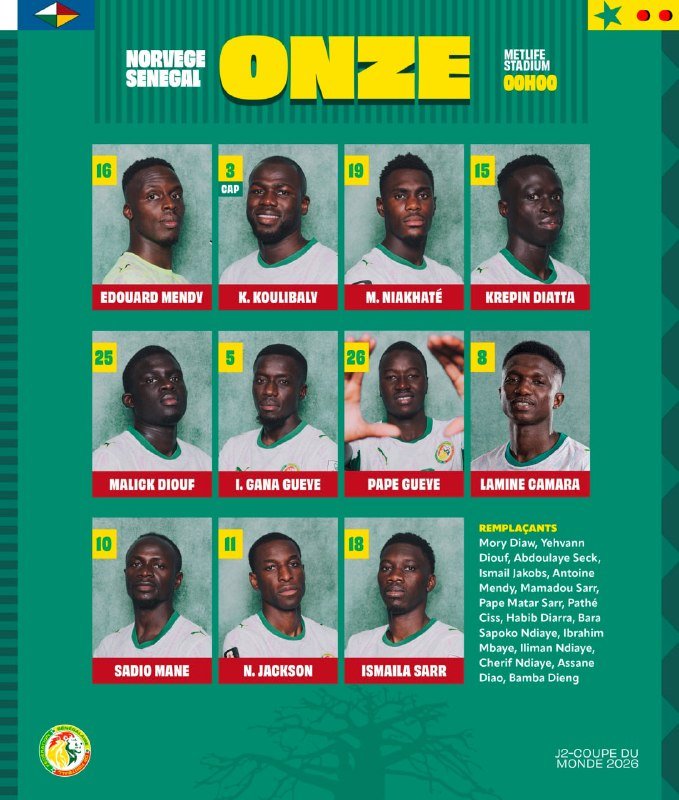
On the night of 22 June 2026, in a stadium most Americans could not have placed on a map, Norway beat Senegal 3-2 in an international friendly that the scoreboard treats as a footnote and the calendar treats as housekeeping. Both readings are wrong. With the World Cup eight weeks out, the line between "rotation exercise" and "audition tape" is paper-thin, and the choice to schedule this fixture in Albany, New York — a venue picked as much for its neutrality as for its diaspora footprint — says as much about how global football now sells itself as anything that happened on the pitch.
What happened, in the order the scoreboard recorded it, was tidy. Joao Pedro Pedersen opened for Norway in the 43rd minute, Erling Holland doubled the lead within five minutes of the restart, and Holland completed his hat-trick in the 58th to make it 3-0. Senegal pulled one back through Saar in the 53rd, added a second from the same player deep in stoppage time — the 90+3rd minute — and went home 3-2 down but with the last twenty minutes of the match, which is the part coaching staffs actually file. Tasnim News's running thread, which carried the goals in near real time from roughly 00:53 UTC to 02:57 UTC on 23 June, was unambiguous about the order of events and about who did what; the framing of Holland as the player "shadowing Messi and Mbappé" is Tasnim's own editorial line, not a wire consensus, and is worth flagging as such.
The shape of the night Norway's depth chart tried to hide
Norway went into the break a goal up and came out of the tunnel looking like a side that had read its own scouting report. Holland's second, in the 48th minute, came inside a minute of the restart — the kind of interval that turns a controlled friendly into a statement. The third, ten minutes later, finished off a sequence that the live thread described in shorthand but that the box-score analysts will pull apart for a week. The point that will not show up in any highlight package is that Norway's midfield controlled territory for the first hour in a way that suggests Ståle Solbakken has settled on a Plan A, not a collection of Plans A-through-E, and that Plan A runs through the same No. 9 who now has the air of a man keeping a personal appointment with July.
For Senegal, the file is uglier and more interesting. Aliou Cissé's side conceded three, scored none in the run of play that mattered, and salvaged pride with a 90+3 goal that the live thread correctly logged as a Saar strike — though the in-thread character limit stripped the scorer down to a syllable. Senegal's first 53 minutes were the kind of performance that gets a manager asked polite questions in the post-match mixed zone; the last 37 were the kind that gets him asked real ones. The fact that both Senegal goals came after the hour mark is the headline the African press will lead with, and rightly: it tells you the side that had been second-best for an hour found a way to be first-best for the last third.
A 3-2 scoreline that flatters both managers and frustrates both federations
The cleanest read of 3-2 is that both teams got exactly what they came for. Norway got a result, a hat-trick for the player whose last name now doubles as his brand, and confirmation that the defensive shape holds up against an African side that will be in the same kind of bracket come the tournament proper. Senegal got a film session, two goals that will be cut and re-cut on the training-ground wall this week, and a reminder that the gap between "competitive in this tournament" and "competitive in the next one" is a midfield that does not switch off at the hour mark. The Tasnim live thread, which is the only minute-by-minute record of this match that the open-source wire carried, frames the game as a Holland showcase; the more sober read is that it was a Holland showcase that masked a Norway vulnerability that a knockout-round opponent will be happy to exploit.
There is a secondary question the friendly format invites and rarely answers, which is what the result actually means in a standings sense. It means nothing. FIFA rankings are calculated over a multi-year window; friendlies feed the algorithm but do not move the needle on seeding in any decisive way. What the result does feed, and this is the part the federations care about, is the commercial ledger: ticket revenue in Albany, broadcast fees from the rights holder, jersey sales on the back of a hat-trick, and a marketing narrative that gets a federation through the eight-week dead period before the squad has to be named.
The diaspora math of Albany, and why this fixture was always going to happen somewhere like it
Pick the venue for long enough and the venue picks the politics. Albany is not a glamour stop on the international calendar. It is, however, exactly the kind of mid-sized American market that U.S. Soccer and its broadcast partners have been deliberately seeding with senior-team fixtures for the last four years — the strategy of turning the United States into a year-round host of neutral-site friendlies that read as preparation for the 2026 tournament and behave, commercially, as if they already are the tournament. A Norway–Senegal fixture in upstate New York in late June is, on one level, two federations working a stop on a tour. On another level, it is a test of whether a city of roughly 100,000 people can be made to feel like a football market on a Tuesday night, eight weeks before the world's eyes turn to the same country for real.
The other reason this fixture happened where it did is the diaspora arithmetic. Senegal's support base in the U.S. Northeast is large enough to fill a lower bowl in the right market, and Norway's Scandinavian-American community, smaller but disproportionately organised, is the kind of demographic that buys tickets in advance and travels. A friendly between these two sides in a stadium built for college football is, in other words, a financial instrument wearing a kit. That is not a criticism; it is the structure of the modern international calendar, and every federation that complains about it also schedules into it.
What we do not know, and what the next friendly will tell us
The Tasnim thread is detailed on goals and approximate on everything else. It does not carry possession, expected goals, shot locations, or the substitutions that would let a tactical reader place each goal inside the larger shape of the match. We do not know, from the open record, whether Norway's third goal came against a back line that had already been rotated, or whether Senegal's late push reflected a tactical change or simply a tired Norway side protecting a lead. We do not know the attendance. We do not know whether either federation used the full complement of substitutions, or held players back for the next window. Those are the questions the next friendly, and the tactical write-ups that will follow in the specialist press, will answer.
What we do know is the order of the goals, the identity of the scorers, and the fact that a fixture the calendar wanted to forget has, by virtue of one hat-trick and a 90+3-minute reply, become the only international friendly either federation will be asked about for the next ten days. That is the alchemy of pre-tournament football: a 3-2 in Albany, on the right night, with the right names on the scoresheet, becomes the lead. Tasnim called Holland a shadow of Messi and Mbappé. The rest of the press will reach for a more cautious register. Either way, both managers got a problem they can use.
How Monexus framed this: a wire-light, thread-only record of a pre-World Cup friendly, read for what it tells us about Norway's depth chart, Senegal's hour-mark problem, and the commercial logic of staging these fixtures in mid-sized U.S. markets eight weeks out from the tournament.
Wire provenance
This editorial synthesis draws on the following public wire/social posts:
- https://t.me/tasnimnews_en
- https://t.me/tasnimnews_en/2
- https://t.me/tasnimnews_en/3
- https://t.me/tasnimnews_en/4
- https://t.me/tasnimnews_en/5
- https://t.me/tasnimnews_en/6
- https://t.me/tasnimnews_en/7