Pakistan's PM names a missile dispute, then walks it back: what the Tehran memorandum actually says
In Tehran, the Pakistani prime minister publicly named the gap — Iran's missile programme — even as he insisted it was off the table. The contradiction is the story.
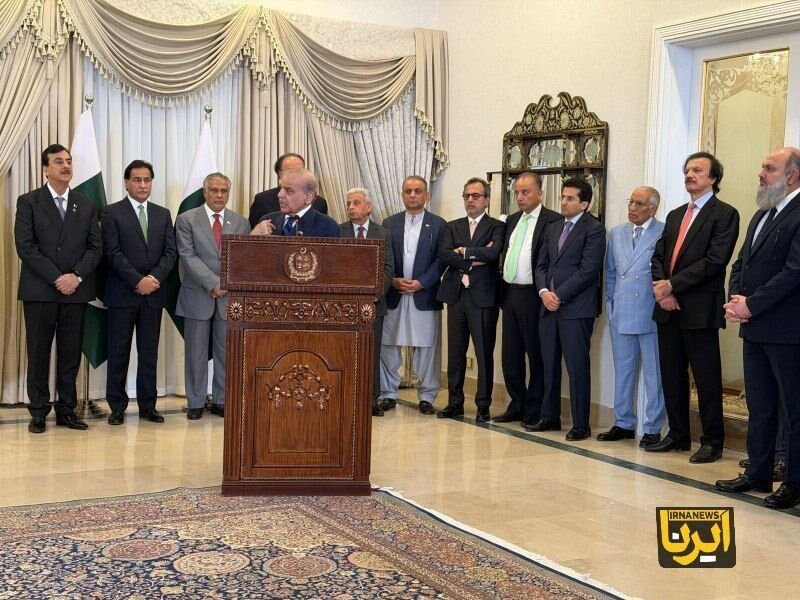
At 16:03 UTC on 23 June 2026, a medical aircraft escorted by six Pakistani air force fighters landed in Tehran, and the prime minister of Pakistan, Shehbaz Sharif, stepped off to offer condolences on what Iranian state media described as the martyrdom of Iran's supreme leader, Ayatollah Seyyed Ali Khamenei. Within the hour, Sharif was on camera, naming a fault line that no signed memorandum could paper over: ballistic missiles. By 16:32 UTC he was back on screen insisting the opposite — that Iran's missile programme had never been on the table at all.
The contradiction is not a slip. It is the working language of a deal in which Pakistan is performing regional mediation on Tehran's behalf, and both sides have an interest in letting the gap show to a domestic audience while keeping it closed on paper.
What Sharif actually said, in order
Fars News, the Iranian state outlet, carried three Sharif remarks in quick succession on the afternoon of 23 June. At 16:03 UTC, Fars reported Sharif offering condolences on the death of the supreme leader. At 16:06 UTC, the same feed had Sharif praising Ayatollah Khamenei as having "led Iran in this critical situation" and adding that "we admire the resistance of the Iranian people." At 16:36 UTC, the feed carried the most pointed line: "I tell the countries that want to throw stones in the path of agreement, how can you have ballistic missiles yourself, but you do not give this right to" — a sentence that Fars truncated in the same post. The earlier version of the same remark, attributed to Sharif in the Fars Telegram channel, completed the thought as: "how is it possible that you yourself have ballistic missiles, but you do not give this right to" others.
Four minutes earlier, at 16:32 UTC, Israeli journalist Amit Segal — whose channel carried the comment in English — quoted Sharif on the same Tehran visit as saying the opposite: "I confirm that the memorandum of understanding that was signed does not include any reference to Iran's ballistic missiles. This issue was not part of the negotiations."
Two Sharifs, on the same stage, four minutes apart: one calling out unnamed powers for hoarding a weapons category; the other insisting that very weapons category is outside the document he had just signed. The audience for each line is different. The missile line is for the Iranian street, the Arab wire services carrying Fars content, and the Pakistani opposition that wants proof the prime minister is not giving Israel and the Gulf states a free pass. The denial is for the Western press, the Israeli outlets, and the Gulf capitals that have made Iran's missile programme a non-negotiable red line.
What Al-Alam and the Iranian side added
Al-Alam Arabic, the Iranian state Arabic-language network, ran its own cluster of urgent bulletins during the same window. At 16:19 UTC, it quoted Iranian President Masoud Pezeshkian as saying he and Sharif, alongside Pakistan's army commander, had discussed "the current developments in the region and the world." At 16:22 UTC, Al-Alam carried Sharif thanking "the Iranian leadership for its confidence in Pakistan's role and its sincere efforts in supporting peace and stability." At 16:35 UTC, the same outlet ran a third bulletin in which Sharif accused unnamed parties of wanting to "sabotage the deal, spread doubts, and feel disappointed."
The choreography is the same as Tehran's standard diplomatic play: a regional guest is invited to perform a public lament, the guest is thanked for the lament, and a third statement positions any critic of the arrangement as a saboteur. The novelty on 23 June is that the lament was about a weapons category the memorandum explicitly does not cover — meaning either the Pakistani prime minister raised missiles unprompted, or Tehran put the missile question on the table of the meeting even while removing it from the document.
The structural frame, in plain terms
Two parallel orders are being managed in public at the same time. The first is a missile-nonproliferation track, dominated by Washington, in which Iran's ballistic programme is the central object of negotiation and any agreement that omits it is treated as incomplete. The second is a regional de-escalation track, dominated by Tehran, in which Iran demonstrates that it has other customers for normalisation besides the United States — Pakistan, the Gulf, the wider Muslim world — and can move the regional temperature down without ever letting the missile file close.
Sharif is useful to both orders. To Iran, he supplies a Muslim-majority head of government willing to publicly mourn Khamenei's death and to defend Iran against outside pressure, in a way that a Russian or Chinese counterpart would not. To the nonproliferation order, he supplies a Sunni-majority nuclear-armed state with its own ballistic arsenal, which makes his criticism of missile double standards harder to dismiss. The trade is that both sides have to tolerate the contradictions in his public remarks. The missile line cannot be disowned by Islamabad because it is what makes the visit credible in Tehran. The denial cannot be disowned because it is what keeps the Gulf and the West at the table.
What this leaves unresolved
The sources available to Monexus do not name the parties Sharif was addressing in the missile line, do not specify the contents of the memorandum beyond his own characterisation, and do not name a counterpart on the Iranian side for the negotiations. The figure of the Pakistani army commander appears in the Al-Alam reporting without identification. The cause of Ayatollah Khamenei's reported death is not described in the Fars feed beyond the word "martyrdom," and the medical-aircraft detail is unverified beyond the Fars Telegram post. Reuters, AP, the BBC and other wire services have not, on the basis of the items available to Monexus on 23 June 2026, published a confirmatory report on either the visit, the memorandum, or the death of the supreme leader; that absence is itself the most important caveat attached to this article. Until a major wire confirms the underlying facts, the read is: a Pakistani prime minister, on Iranian state media, used two adjacent sentences to say the opposite things about a missile question that the document he signed does not, by his own account, even address.
This piece is built on Telegram feeds from Fars News, Al-Alam Arabic and Amit Segal, with the understanding that Fars and Al-Alam are Iranian state outlets and that the Segal channel is a translation layer. Where the wire has not yet caught up to the social-media reporting, Monexus flags the gap in line rather than smoothing it over.
Wire provenance
This editorial synthesis draws on the following public wire/social posts:
- https://t.me/farsna
- https://t.me/alalamarabic
- https://t.me/amitsegal
- https://t.me/farsna/
- https://t.me/alalamarabic/