Pezeshkian's missile logic and a Pakistan-shaped opening
Iran's president frames his missile deterrent as existential self-defence, while Pakistan's premier holds him up as an economic visionary — a pairing that exposes the brittle rhetoric Western capitals still use to read the region.
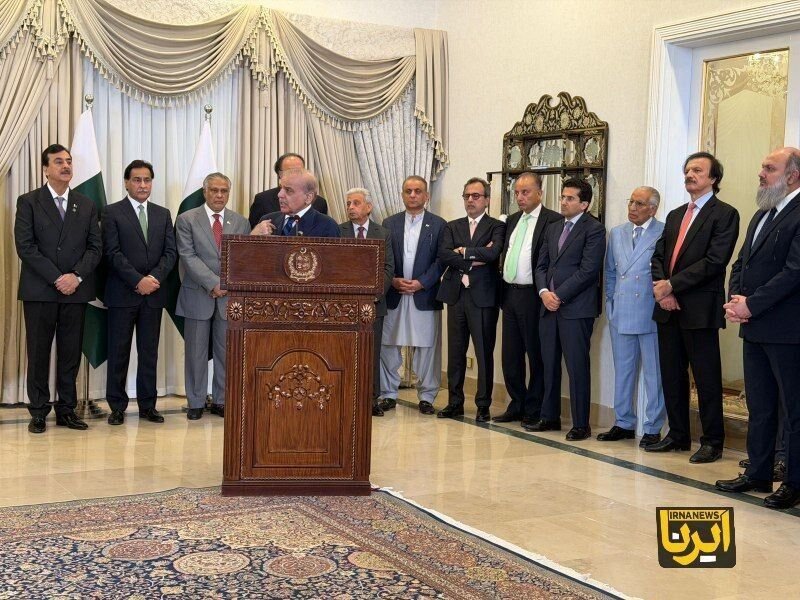
Two short public statements on 23 June 2026 — one defiant, one deferential — capture the gap between how Iran's leadership sees itself and how its neighbours are now willing to flatter it. Iran's President Masoud Pezeshkian told domestic audiences that without Iran's missiles, which he described as instruments of self-defence, Israel and the United States "would have plowed through Iran the way Gaza was plowed through." Within hours, Pakistan's Prime Minister Shehbaz Sharif told the same Iranian president, on a state visit, that "under your visionary leadership, Iran will transform into one of the fastest-growing economies in the world one day soon."
The juxtaposition is the story. A republic under sustained Western sanctions, with a currency under pressure and a security apparatus stretched across multiple theatres, is being addressed by a nuclear-armed neighbour of 240 million people in the language usually reserved for rising regional champions. The compliments are not subtle, and the venue matters: PressTV, Iran's English-language state outlet, carried Sharif's line directly, giving it the institutional weight of an Iranian broadcast rather than a passing diplomatic nicety. The subtext is that Tehran's deterrent credibility is now doing diplomatic work well beyond the missile sites themselves.
What Pezeshkian actually said
Pezeshkian's framing was blunt. The missiles, in his telling, are the only thing standing between Iran and a Gaza-style ground campaign. The comparison is provocative and, on its face, structurally loaded: it puts Israeli military action in Gaza and the implicit threat to Iran in the same sentence, and assigns the deterrent effect to the missile programme rather than to diplomacy, sanctions relief, or external balancing. The line was carried in full by the Telegram channel Clash Report, which has been a reliable wire for the Iranian president's direct quotes in English. There was no immediate response from the Israeli prime minister's office or the US State Department by midday UTC on 23 June; the framing therefore stands, for now, as the official Iranian position of the day.
What Sharif's line tells us
Sharif's phrasing is the kind of thing every host dreads a guest saying on the record: it is generous, specific, and very hard to walk back. "Fastest-growing economies in the world" is a forecast, not a courtesy, and forecasts made by the prime minister of Pakistan about another country's economic trajectory are read in markets and chancelleries as political signals. PressTV's choice to broadcast the line at length — and to attribute it directly to Sharif rather than paraphrase it — turns a bilateral photo-op into a piece of publicly archived state media. The Pakistani prime minister's office has not, as of the time of writing, issued a separate read-out expanding on the economic prediction.
Why the two lines sit together
The conventional Western reading is that this is theatre: sanctions have not broken Iran, and Iran is using missile confidence and bilateral flattery to project a status it cannot yet underwrite economically. That reading has force. But it understates what is actually being negotiated. Pakistan is a frontline state facing its own security pressures, including a long border with Afghanistan and a recently turbulent relationship with India. For Islamabad to publicly associate itself with Tehran's economic future — in English, on Iranian state media, at presidential level — is a quiet act of hedging against a future in which US-Iran détente collapses and Pakistan needs a partner that is not Washington or Beijing. Iran, for its part, gets exactly what it needs at this moment: visible diplomatic parity with a major Muslim-majority nuclear neighbour, on terms that cost nothing in missile terms and concede nothing in sanctions terms.
The structural frame
The pattern on display is the slow accumulation of a regional diplomatic architecture that does not run through Western capitals. Iran's missile deterrent is being openly justified in existential terms; a nuclear-armed neighbour is publicly endorsing Iran's economic trajectory; both moves are happening in English on Iranian state-aligned channels with full visibility to Washington, London, and Tel Aviv. The Western policy default — that pressure plus isolation produces a manageable Iran — is being outflanked not by a single dramatic alignment, but by a series of small, on-the-record courtesies that, taken together, look like a coalition forming in plain view. None of this resolves the underlying disputes: the missile programme, the sanctions regime, or the Gulf security architecture remain exactly where they were. What changes is the diplomatic floor under Iran's position, and that floor is being built out of words like "visionary" and "self-defence."
Stakes and the part we cannot verify
If the trajectory holds, Iran gains something sanctions were designed to deny it: a regional standing that is recognised in the language of equals rather than as a pariah case. Israel and the United States, in turn, face an Iran whose deterrent is openly named and whose neighbours are publicly unwilling to treat it as a regional outlier. The cost of any future escalation rises in proportion to the diplomatic capital Iran has accumulated. The honest caveat: the economic forecast Sharif endorsed is not, at this point, supported by independently verifiable data in the source material before us — it is a political statement carrying a financial-shaped verb. The diplomatic signal is real; the underlying economic reality is the part that still has to be demonstrated.
Desk note: where Western wires tend to file these two exchanges as separate stories — one Iran, one Pakistan — Monexus is reading them as a single, deliberate diplomatic sequence: the missile line sets the threat, the Sharif line sets the standing, and both travel in English on Iranian state-aligned channels.
Wire provenance
This editorial synthesis draws on the following public wire/social posts:
- https://t.me/ClashReport
- https://t.me/presstv
- https://t.me/ClashReport