A logistics hub burns near Moscow. The question Kyiv wants Russia to answer
Ukraine has hit a 250,000-square-metre Wildberries fulfilment complex in the Moscow region. The strike is part of a deliberate campaign to disrupt Russia's civilian supply backbone for the front, and it forces a reckoning about what counts as a military target.
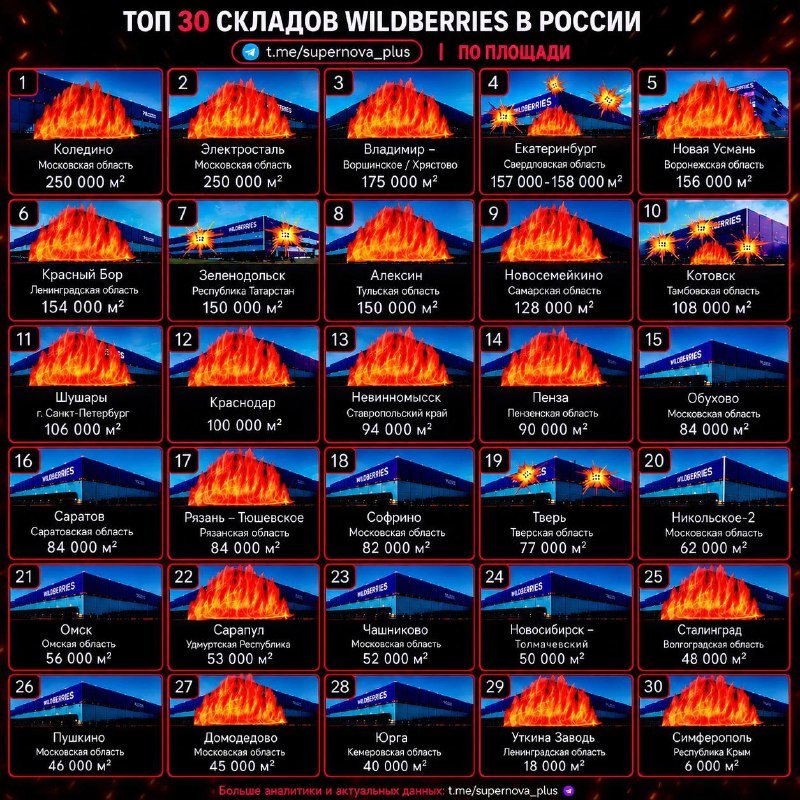
On 16 August 2026, Ukrainian unmanned aerial vehicles struck the largest fulfilment complex operated by Wildberries in Kaladino, Moscow region. The site spans roughly 250,000 square metres, according to a Telegram-channel dispatch on the day of the strike. A fire at the site was visible in footage and aerial-extinguishing effort reported in the same Telegram post. Al Jazeera's breaking-news feed said Moscow reported intercepting 822 drones in what it called the largest Ukrainian drone attack on Russian territory to date, with at least six people killed and a Wildberries logistics hub among the targets.
Ukraine's targeting of Wildberries is not improvised. Since mid-July 2026, according to Deutsche Welle's reporting, Kyiv has been striking warehouses belonging to Russia's largest online retailer on an almost every-day cadence. The stated rationale from Ukraine is that these facilities are functionally part of the front-line supply chain: military-relevant parcels, dual-use equipment, and routing capacity that the Russian armed forces have integrated into their logistics. The implicit logic is older than the war: if you cannot sever the enemy's rail arteries, you sever the civilian arteries they have been quietly conscripted.
What Kyiv is actually doing
The campaign is the clearest escalation in Ukraine's long-range strike programme to be documented in the available reporting, and the most uncomfortable for Western observers. A Wildberries warehouse is not a refinery owned by a sanctioned oligarch; it is a working retail node that ordinary Russian households depend on for everyday goods. That is the point of pressure.
Deutsche Welle's reporting notes that military analysts outside Ukraine read the strikes differently: some argue they are less about disrupting specific deliveries than about imposing a creeping insurance and operating-cost burden on Russia's private logistics sector, a sector that has quietly become the rear-echelon of the Russian war effort. Both readings can be true. The structural point is that the boundary between Russia's commercial logistics backbone and its military one has eroded to the point where a single fulfilment centre can plausibly be defended as a legitimate military target.
The counter-frame, taken seriously
The Russian framing, predictable, state-aligned, and worth steelmanning rather than dismissing, runs as follows. Civilian commerce is civilian commerce. Striking a 250,000-square-metre retail warehouse with military-grade drones in the Moscow region, well behind any front line, is an attack on the Russian population, not on Russian forces. The fact that the Russian state has integrated private logistics into its wartime logistics does not, on this reading, transform a shopping-centre-scale facility into a lawful military objective. Under international humanitarian law, dual-use status is not a rubber stamp: it requires demonstrable contribution to military action and a definite military advantage from the attack, balanced against civilian harm and proportionality.
This is a serious objection. It is also incomplete. If Russia's armed forces have, in fact, routed procurement and frontline replenishment through commercial fulfilment centres, as Deutsche Welle's sources suggest, then those nodes are, at minimum, dual-use. The legal debate is not whether the strikes are civilian casualties in the abstract; it is whether the specific facilities struck meet the dual-use test. Ukraine's burden is to make that case, facility by facility. The available reporting does not yet show that case being made publicly with the granularity it requires.
Why Moscow cannot simply escalate back
Moscow's claim of 822 drones intercepted in a single attack, if accurate, is the headline number of the war so far. But the volume is itself the problem. Defending the entire western Russian airspace against a sustained low-cost drone campaign at this tempo is materially impossible; each intercept is a missile or a radar-second that is not defending a refinery, an airfield, or a command node elsewhere. The arithmetic of cheap drones against expensive intercepts has been a known strategic asymmetry for years. Kyiv has now forced Moscow to either accept losses deep in the homeland, dedicate air-defence to commercial infrastructure, or both.
There is also a softer cost. A Wildberries fire in Kaladino is visible to Russian consumers within hours. The insurance underwriting, the warehouse-construction pipeline, the labour market around Moscow-region fulfilment: each absorbs a discrete shock. That is the design. Monexus assessment: the campaign is best read as a deliberate imposition of cumulative civilian-economic cost on the Russian rear, layered on top of military attrition, not as a substitute for it.
What this changes, and what it does not
The strike does not change the war's centre of gravity. Russian ground forces continue to grind forward in the Donbas at high cost in men and material; Ukrainian manpower constraints remain the binding factor on Kyiv's side; Western aid flows remain politically conditional. What the Wildberries campaign does is open a third front, the commercial rear, that is harder for the Russian state to insulate from public sentiment and harder for Western publics to claim ignorance of.
The honest uncertainty here is real. The available reporting does not specify the proportion of Wildberries throughput that can be reliably linked to Russian military procurement, nor does it confirm the precise casualty breakdown at Kaladino beyond the at-least-six figure from Russian emergency-services statements relayed by Al Jazeera. Both numbers will shift. The legal characterisation of any specific warehouse as a lawful military objective will be contested strike by strike. That contest is the point.
The next data point to watch is whether Moscow publishes a facility-by-facility breakdown of the 16 August attack, and whether Ukrainian General Staff briefings identify, by name, the military-logistics function they attribute to the Kaladino complex. Until one side or the other does so, the question of whether this is a legitimate dual-use strike or an attack on a civilian target will remain exactly where Kyiv's strategists want it: unresolved, and therefore politically live.
Desk note: Monexus frames this as Ukraine's deliberate extension of long-range strike into Russia's commercial logistics backbone, with the legal and political ambiguity around dual-use status treated as a feature of the campaign rather than a flaw in the reporting. Wire framing has so far led on the 822-drone interception claim; the structural argument here puts that number in the context of an unsustainable defensive arithmetic.
Wire provenance
This editorial synthesis draws on the following public wire/social posts:
- https://www.dw.com/en/ukraine-attacks-wildberries-russia-s-biggest-online-market/a-78384605?maca=en-rss-en-all-1573-rdf
- https://www.aljazeera.com/video/newsfeed/2026/8/16/16-08-sv-ukraine-largest-drone-attack-russia-ua?traffic_source=rss
- https://t.me/englishabuali/77839
- https://www.investing.com/news/economy-news/wildberries-warehouse-burns-near-moscow-as-russia-strikes-across-ukraine-4861958
- https://www.dw.com/en/ukraine-attacks-wildberries-russia-s-biggest-online-market/a-78384605?maca=en-rss-en-all-1573-rdf
- https://www.aljazeera.com/video/newsfeed/2026/8/16/16-08-sv-ukraine-largest-drone-attack-russia-ua?traffic_source=rss
- https://t.me/englishabuali/77839
- https://www.investing.com/news/economy-news/wildberries-warehouse-burns-near-moscow-as-russia-strikes-across-ukraine-4861958