France confronts a twin shock: record heatwave collides with first domestic Ebola case
As temperatures break national records and firefighters battle forest blazes, a doctor returning from the Democratic Republic of the Congo has been isolated in France after testing positive for Ebola — the country's first confirmed case of the virus.
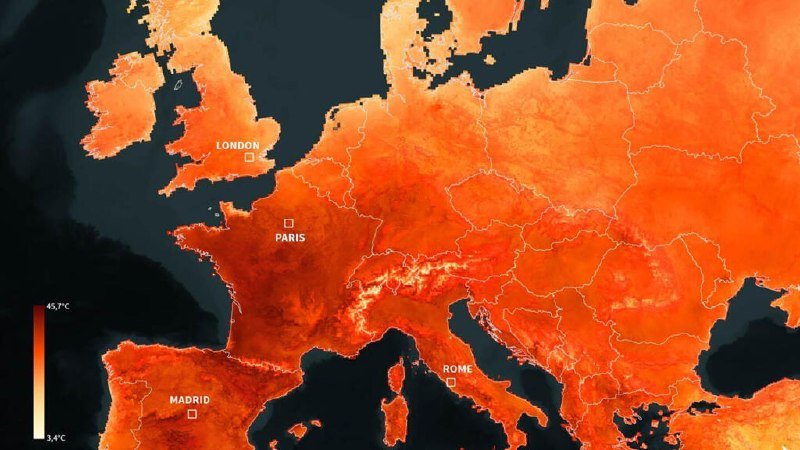
France entered 24 June 2026 managing two emergencies at once. The country is in the grip of what authorities have called its most severe June heatwave on record, with 23 June registering as the hottest day ever measured nationally, and emergency services are now fully mobilised against forest fires across the south. Within hours, the French health system confronted a different kind of crisis: confirmation of the country's first-ever case of Ebola virus disease, in a doctor who returned from the Democratic Republic of the Congo and was isolated on arrival in metropolitan France. The simultaneity is unusual, but the two stories sit inside the same operating environment — a public-health and civil-protection apparatus stretched across competing, climate-driven and pathogen-driven demands.
What is unfolding is a stress test of European preparedness at the precise moment when the continent's southern member states are also the most exposed to heat-linked mortality. France's case is the most visible, but it is not the only one. The heat is the dominant story in the wire today; the Ebola confirmation is the sharper one.
A heatwave that has already rewritten the record book
The thermal picture is unambiguous. According to France 24's reporting on 24 June 2026 at 11:09 UTC, France on Tuesday recorded its hottest day in the history of national measurements, with the extreme heat also deepening drought conditions and sharply raising the risk of forest fires across the Mediterranean rim and the Massif Central. The meteorological agency Météo-France has placed much of the country under orange and red alerts, with the most acute warnings in departments bordering the Mediterranean and along the Rhône valley. Local authorities in the Bouches-du-Rhône, Var, and Gironde have pre-positioned water-bombing aircraft and banned outdoor work on construction sites during peak afternoon hours.
The fires are the visible manifestation. Several blazes have already forced evacuations in the Aude and Corsica, and the Civil Security service has reported a multi-day operational tempo not seen since the 2022 and 2023 summer fire seasons. France's neighbour, Spain, has activated the EU Civil Protection Mechanism for mutual aid, sending two Canadair amphibious aircraft to assist in the south. The structural point is straightforward: as Mediterranean summers lengthen, the operating tempo of European fire services now resembles that of countries further south. National fire budgets in France have grown year-on-year since 2020, but the working assumption — that each summer will be worse than the last — has now become the planning baseline.
The Ebola case: what is known, and what is not
The clinical picture is more contained, but no less significant. Al Jazeera's breaking news desk reported at 10:19 UTC on 24 June 2026 that France had confirmed its first case of Ebola virus disease, in a doctor returning from the Democratic Republic of the Congo. A second wire item from Standard Kenya's Telegram feed, timestamped 10:36 UTC the same day, corroborated the confirmation and added that the patient was isolated immediately on arrival in mainland France, in line with strict biosafety protocols. The patient is a medical professional — a French national who had been working in the DRC, one of two countries currently experiencing active Ebola outbreaks in central Africa, and who began showing symptoms consistent with the disease during or shortly after return travel.
The relevant French authorities — Santé publique France and the Direction générale de la santé — are now conducting contact tracing across the flight, the receiving airport, and the receiving hospital. The Ebola virus disease (EVD) is a viral haemorrhagic fever with case fatality rates historically ranging from 25% to 90% depending on the strain and the quality of supportive care, and is transmitted through direct contact with the blood, secretions, organs, or other bodily fluids of infected people, as well as contaminated surfaces and materials. There is an approved vaccine, Ervebo, which has been used to ring-fence outbreaks in the DRC since 2018, and there are therapeutic monoclonal antibodies that have dramatically altered outcomes for confirmed cases treated early.
The framing matters. France's first-ever domestic Ebola case is a sentinel event, not a runaway outbreak. The case was identified in a returning medical worker — precisely the population most likely to be alert to early symptoms, and the one most likely to seek immediate care. The isolation took place before any documented onward transmission, which is the metric public-health authorities care about. The risk to the general French population is currently assessed as low; the risk to the patient's close contacts, including the treating medical team, is being actively managed.
What the dual shock reveals about European preparedness
Read together, the two stories expose a system that is competent but converging under pressure. France's heatwave response relies on a layered architecture: Météo-France for forecasting, the prefectures for local command, the Civil Security service for firefighting, and the European Civil Protection Mechanism for cross-border reinforcement. The Ebola response relies on a different architecture: airport screening that catches symptomatic travellers, hospital isolation capacity, contact-tracing teams, and laboratory networks that can confirm or rule out a viral haemorrhagic fever within hours.
Neither of those architectures was built for the moment when both fire risk and a high-consequence infectious disease converge on the same week. This is the point. Capacity that is adequate in normal conditions becomes strained when the exceptional becomes routine. The heatwave is not, strictly, a public-health emergency of the same order as an Ebola case — but the heat itself is a public-health emergency, with documented excess mortality among older people and outdoor workers. So the system is now running two parallel emergency operations, each absorbing senior decision-makers' time and political attention.
There is a second-order point worth making. Both emergencies point outward. The heatwave is in part a function of global atmospheric patterns that no single European government can offset, though it can adapt. The Ebola case is a function of a pathogen that circulates in central Africa and reaches Europe via travel. European resilience in this decade is increasingly defined not by what happens inside European borders but by what arrives across them and what the climate delivers from above. The two stories in the French wire today are a single lesson: the operating environment for European governments is global, and the planning horizon is the planning problem.
Stakes and the weeks ahead
The heatwave is forecast to persist through the end of June, with the highest temperatures moving eastward into Germany, Italy, and the Balkans by the weekend. Fire risk across the Mediterranean is therefore likely to remain elevated. The Ebola case, by contrast, is a contained public-health event — but the contact-tracing window is now open, and any secondary case within the next 21 days (the standard maximum incubation period for Ebola virus disease) would change the operational picture materially. The DRC itself is managing active outbreaks, and any escalation there directly affects the risk calculus for European returning medical staff.
The plausible counter-narrative is that neither story is a leading indicator: heatwaves are now a regular feature of European summers, and an isolated imported case of a viral haemorrhagic fever, in a country with functioning isolation and laboratory capacity, is precisely the scenario the system is designed to handle. That reading is defensible. The evidence supports it. The same evidence, however, also supports a different read: that the tempo of compound emergencies is rising, and that the planning margin between routine and crisis is narrowing. France's 24 June is a small, illuminating case study in that narrowing.
How Monexus framed this: the wire today led with the heatwave as the dominant story and the Ebola confirmation as the sharper one. We treat them as a single compound event, on the view that public-health preparedness in 2026 is increasingly defined by what arrives across borders and by what the climate delivers from above. Both frames — the contained clinical case and the structural climate load — belong on the same page.
Wire provenance
This editorial synthesis draws on the following public wire/social posts:
- https://t.me/StandardKenya/