Venezuela's twin earthquakes expose a country the world keeps at arm's length
Two quakes within hours have killed at least 235 people and wounded more than 4,300 in Venezuela — and reopened the question of what the international community actually owes a sanctioned, oil-dependent state in crisis.
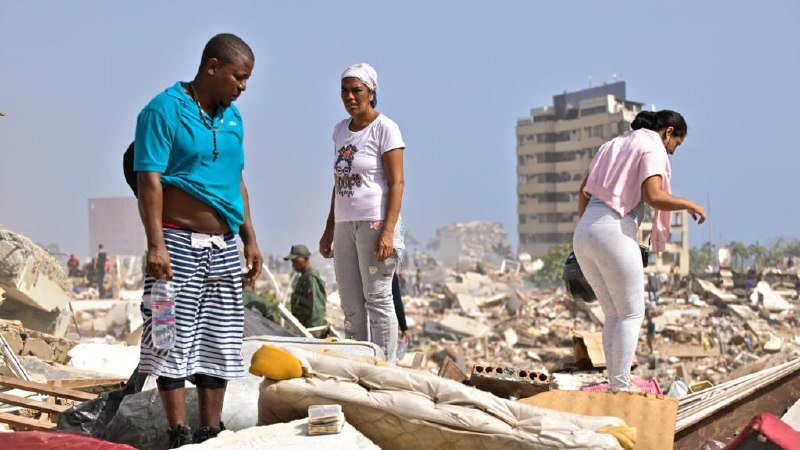
Two earthquakes struck Venezuela within hours of one another on 26 June 2026, killing at least 235 people and injuring more than 4,300, according to figures carried by Iranian state broadcaster PressTV. The tremors — felt as far as Caracas, where a video recorded from a stationary aircraft at Maiquetia Airport circulated widely on X — have thrown a country already deep in economic and political distress into its worst humanitarian emergency in years. Among the wreckage, footage posted by @sprinterpress on X showed a woman who had gone into labour delivering her baby successfully amid the ruins, a small note of survival inside a vast casualty ledger that authorities say is still climbing.
The disaster is real and the numbers are still moving. What the next 72 hours expose is older: the gap between the rhetoric of international solidarity and the architecture of a sanctions regime that has, for nearly a decade, constrained the Venezuelan state's ability to import fuel, medicine, and basic equipment — including the kind of search-and-rescue hardware that determines how many of the missing are pulled out alive.
A country already on its knees
Venezuela entered this earthquake season already broken. A decade of hyperinflation, mass emigration on a scale rarely seen outside a war zone, and a formal United States sanctions regime layered over a quiet blockade of dollar-clearing have hollowed out the state's emergency-response capacity. Hospitals run on intermittent power. The national oil company, once the spine of the economy, produces a fraction of its mid-2010s output. Local reporting from the disaster zone on 26 June describes streets blocked by rubble, overwhelmed clinics, and families digging through collapsed structures by hand because the heavy machinery to do it properly is in short supply.
The first response, inevitably, has come from Caracas itself — military units, civil defence, and neighbourhood committees — supplemented by the regional players with standing relationships in Caracas. PressTV's coverage, citing Venezuelan authorities, frames the response as a moment of national unity under President Nicolás Maduro. That framing serves a propaganda purpose, but it does not invent the underlying fact: the state's emergency machinery, diminished as it is, is the only one operating at scale inside Venezuelan territory in the hours that matter most.
The sanctions question nobody in Washington wants to answer
It is worth stating plainly what the conventional Western commentary will not. US secondary sanctions, the OFAC general licences that have grown narrower year by year, and the de-risking by European banks that followed, have measurably reduced the volume of dollars, euros, and hard-currency-denominated goods — including medical equipment and reconstruction machinery — that can reach Venezuelan ports and airports without prohibitive compliance friction. The US Treasury's humanitarian licences exist. Their track record of operational usability for foreign NGOs and importers is contested.
The counter-position is also worth stating. The Maduro government has diverted humanitarian resources for political purposes in the past, and a more permissive sanctions environment does not guarantee better outcomes for Venezuelans who live in opposition neighbourhoods. Some European governments, which share the human-rights concerns but not the maximalist US position, have argued for targeted rather than sectoral relief for years. The earthquake does not resolve that debate. It makes the debate suddenly urgent.
What the footage tells us — and what it does not
The videos circulating on 26 June — the labouring mother in the ruins, the visibly shaking cabin of the aircraft at Maiquetia, the panhandled streets of Caracas and the stricken towns to the west — are evidence of a seismic event, not a structural assessment. They do not, on their own, tell us the magnitude, the depth, the fault segment, or the precise death toll. Those determinations will come from the Venezuelan Foundation for Seismological Research and from the US Geological Survey in the days ahead. What the footage does confirm is the human scale: ordinary infrastructure, ordinary vehicles, ordinary lives, interrupted by something the building codes were not designed to absorb.
PressTV's reporting on the casualty figures — 235 dead, more than 4,300 injured — is the working number as of the early afternoon UTC. The thread context also references "thousands" feared dead in the wider affected zone; that figure should be treated as a floor of the plausible rather than a confirmed count. Disaster tallies in poorly mapped terrain, with limited cellular coverage and damaged roads, almost always rise over the first 72 hours.
The pattern, and what comes next
Emergencies in sanctioned states follow a recognisable rhythm. Day one is chaos and heroic local response. Day three is when foreign search-and-rescue teams would normally begin arriving, and when the political question — whether and how to ease sanctions for the duration of the humanitarian operation — becomes unavoidable. By day seven, the diaspora begins to organise remittance drives, and the question of reconstruction funding opens the longer fight about what kind of Venezuela the international community is willing to help rebuild.
The pattern matters because it is where leverage lives. The US Treasury holds, in effect, a temporary off-switch on a portion of the sanctions architecture. European capitals hold discretionary latitude on banking-channel access. China and Russia hold oil-for-debt arrangements that already give Caracas a partial alternative dollar-routing capability. None of these levers cost their holders much to pull. All of them materially change how many people come out of the rubble alive.
The honest reading is that the structural frame here is not really about earthquakes. It is about a sanctioned petro-state whose government is widely disliked in Western capitals, whose opposition is widely distrusted, and whose population is now, once again, the absorbing surface for a geopolitical standoff that has very little to do with them. The earthquake changes nothing about that standoff. It does, briefly, make it visible.
This publication has framed the disaster through the lens of humanitarian access and sanctions architecture rather than the regime-vs-opposition framing that dominates most US cable coverage. The reason is operational: the first question for anyone trying to help Venezuelans in the next 72 hours is what is allowed to move through which financial channels — and that is a question only one set of actors can answer.
Wire provenance
This editorial synthesis draws on the following public wire/social posts:
- https://t.me/presstv/
- https://t.me/presstv/
- https://x.com/sprinterpress/status/
- https://x.com/sprinterpress/status/