Asymmetric Hardware and Sentiment Whiplash: Reading the Ukraine Story on 27 June 2026
A marine drone presentation in Kyiv, a burning commuter train, a noisy foreign-policy tweet cycle and a $540 billion investor survey converge to define a week that is less about territory than about capability and credit.
On the evening of 27 June 2026, Ukraine's TSN newsroom aired footage of a small grey craft — the MOBIDIK — being demonstrated to operators at an undisclosed coastal site. The same day's news cycle carried a second, more banal image: a suburban commuter train alight on its own right-of-way, passengers evacuated by the driver rather than the emergency services. Hours later, on a separate continent, an institutional risk survey covering 198 fund managers overseeing roughly $540 billion in assets closed its collection window. None of those three items, taken alone, defines the war. Taken together, they sketch the terrain on which the war is now being fought: a contest of asymmetric hardware, brittle domestic logistics, and the cost of capital that underwrites everything else.
The argument running through this dispatch is straightforward. The ground war in Ukraine has not ended, but the centre of gravity has migrated — from trenches and artillery exchanges to small unmanned platforms, to repairable civilian infrastructure, and to the willingness of global capital to keep financing the gap between the two. Each of the day's news items is a data point inside that migration.
The MOBIDIK and the new centre of gravity
Ukrainian outlet TSN reported the presentation of the MOBIDIK, described in its own coverage as a multi-purpose marine drone, on 27 June 2026 at 20:14 UTC. The framing matters. Ukraine's unmanned surface vessels have, over the preceding two years, reshaped the Black Sea campaign from a contest of navies into a contest of mass-produced, low-signature hulls. The MOBIDIK belongs to the same family of systems that have struck Russian-flagged tankers, the Crimean bridge approach, and Russian naval logistics hubs in occupied ports.
What the TSN clip makes visible is the industrial character of the new contest. A marine drone is not a one-off weapons platform; it is a small, modular boat with a hull, a power train, a guidance package, and a payload bay. Every component is replaceable; every loss is a depreciation event rather than a strategic setback. That is the structural change worth naming. The hardware is cheap, recoverable in industrial terms, and built in workshops that are themselves hard to target because they are distributed. The platform has effectively converted naval warfare into something closer to consumer electronics — a quarterly production cadence, a supplier base, and an export pipeline in both directions.
For readers unfamiliar with the geography, the relevant fact is that Ukraine's coastline runs along the north-western Black Sea, including the approaches to Odesa and the Danube delta, and that occupied Crimea sits across the water to the south-east. Anything that moves on that water is, by default, a military problem. A marine drone that is cheap enough to lose and useful enough to threaten large warships is, on the economics alone, a category change.
The burning train and the second front
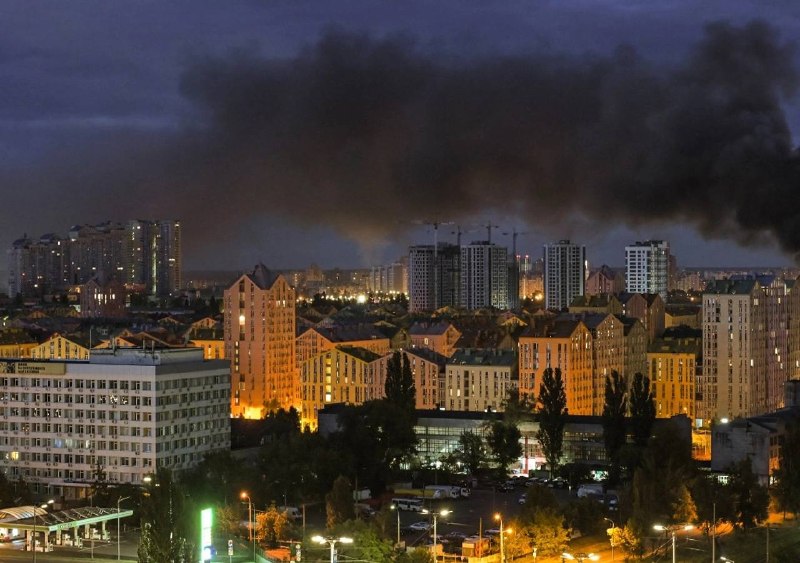
The second TSN item carried on the same 20:14 UTC wire is smaller and easier to miss: a suburban commuter train caught fire in motion; passengers were evacuated by the train's own drivers. No casualty count beyond the implied survival of the passengers has been verified in the available reporting. The incident is not, on its own, a strategic event.
But it sits inside a category that has grown steadily heavier since 2024: attacks on Ukrainian rail and energy infrastructure. The country's rail grid is the spine of civilian logistics, refugee movement, and military resupply. When a train burns, the question a careful reader asks is not "was this an accident" but "what does this incident tell us about the condition of the rolling stock, the maintenance cycle, and the load on the network". Wartime freight volumes are higher than peacetime; maintenance windows are shorter; rolling stock ages faster. A fire on a suburban service is the visible tip of a fatigue curve in the metal.
There is a second, sharper reading. Ukraine's rail network has, on the record, been a deliberate Russian target set since the early months of the full-scale invasion. Whether the 27 June fire falls into that category is not stated in the available reporting, and Monexus does not speculate beyond the evidence. What is supportable in plain prose is this: the same country that has fielded the MOBIDIK is also the country whose suburban trains are catching fire, and both facts are true on the same day. The asymmetry is not only between Ukraine and Russia. It is between the high-end of Ukrainian defence industry and the unglamorous resilience of the systems that hold the country together in peacetime.
The foreign-policy tweet cycle
At 19:28 UTC on the same day, the X account @boweschay posted a thread in which it described Ukraine as "a terrorist state, corrupt, brutal, uncontrollable," and argued that "its governing elites will sacrifice literally anyone, and anything" to maintain the war effort. The post sits inside a familiar genre: the foreign-policy polemic from a non-aligned observer that recycles an older Russian framing — maximalist, moralising, and pitched at an English-speaking audience.
The post is not evidence of anything except the continued existence of that genre. It is, however, useful as a marker of how the information environment around Ukraine has hardened. Two and a half years into the full-scale invasion, the space between Ukrainian official communication and the sceptical Anglophone reply has narrowed into a script that both sides recite. Monexus's reading is that the polemic inverts a real problem — corruption is a documented feature of Ukrainian governance and wartime contracting — into a totalising claim that the state itself is illegitimate. That inversion is itself a tell: when an argument leans entirely on the word "terrorist" applied to the invaded party, it usually signals that the speaker has run out of more specific things to say.
The journalistic standard to apply is simple. Corruption in wartime procurement is a real, verifiable subject. The status of Ukraine under international law — invaded, defending its territorial integrity, with documented war crimes committed against its civilian population — is also a real, verifiable subject. These are not the same subject. Conflating them is the move that should be resisted.
The $540 billion question
The day's most consequential item for the financial spine of the war came via the Unusual Whales wire at 23:31 UTC on 26 June 2026: a Bank of America survey of 198 institutional fund managers overseeing approximately $540 billion in assets. The headline from that survey, as Unusual Whales summarised it, was a 40 percent no-landing scenario — meaning four in ten of the largest professional allocators in the survey now see a path in which growth slows without a clean recession, and inflation fails to return cleanly to target.
For Ukraine, the link is mechanical. The country finances its external gap through a combination of European Union budget support, IMF programmes, bilateral aid from the United States, Japan and the United Kingdom, and — at the margin — private capital markets for selected instruments. The willingness of those donors to keep writing cheques is, in turn, a function of the political economies of their own capitals. If the 40 percent no-landing crowd in the BofA survey is right, the political pressure on every Western finance minister to redirect resources inward grows. If they are wrong and growth surprises to the upside, the aid pipeline stays open longer.
The structural point is that aid to Ukraine is now hostage, in a measurable way, to the rate path in Frankfurt, Washington and London. The hardware on the Black Sea — marine drones, air defence interceptors, artillery rounds — is paid for in currencies whose value is set in those three cities. When those cities tighten, the hardware bill becomes harder to clear.
What the day says about the war
Three patterns are worth holding onto from 27 June 2026. First, the centre of gravity is moving toward cheap, mass-produced, distributed hardware. The MOBIDIK is one data point; the broader category is the story. Second, the civilian infrastructure on which the war effort depends is under continuous, unglamorous stress, and that stress will show up first in places like commuter rail rather than in headline-grabbing strikes. Third, the political-economy tail that wags the military dog is being set, increasingly, by institutional investors' reading of macro conditions.
What remains genuinely uncertain is the pace of all three. The available reporting does not specify MOBIDIK production volume, unit cost, or operational employment. The commuter-train incident is reported without a confirmed cause. The 40 percent no-landing figure is one survey's snapshot and not a forecast. Each of those gaps is a place where a careful reader should expect further reporting to land, and where this publication will continue to watch.
What can be said with confidence is more modest. Ukraine is the invaded party; the hardware and the infrastructure are real; the cost of capital is real; and the war will be settled — or not — along those three axes simultaneously.
This article sits at the intersection of a defence-industrial beat and a capital-markets beat, neither of which the wire services typically cover in the same dispatch. Monexus treats that intersection as the story.
Wire provenance
This editorial synthesis draws on the following public wire/social posts:
- https://t.me/TSN_ua
- https://t.me/TSN_ua
- https://en.wikipedia.org/wiki/Black_Sea
- https://en.wikipedia.org/wiki/Unmanned_surface_vehicle
- https://en.wikipedia.org/wiki/Ukrainian_Railways
- https://en.wikipedia.org/wiki/Ukraine
Follow the event.
These dated source records provide context. They do not retrospectively verify this archive article.
A dated voting record is evidence of one decision. Use the original UN record before turning it into an alignment label.
Visual explainer · historical vote of 2022-03-02 →