Gaza City strikes at midday: what three Telegram alerts tell us, and what they don't
Two pro-Palestinian Telegram feeds reported Israeli strikes near Dabit Junction and Al-Saraya in central Gaza City within minutes of each other on 27 June 2026. The alerts illustrate both the speed and the limits of wartime wire-style reporting from Telegram.
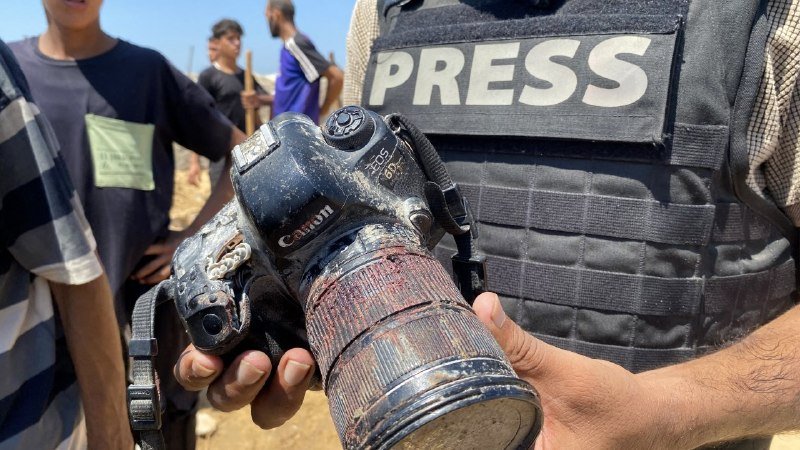
At 12:56 UTC on 27 June 2026, two Arabic-language Telegram channels posted near-identical alerts: an Israeli air raid near Dabit Junction in Gaza City. Nine minutes later, the first of those channels added a second bulletin — an Israeli strike on a tent near the same junction, with injuries reported. By 13:05 UTC, a third post had refined the framing to "injuries reported after an Israeli strike targeted a tent near the Dabit Junction." The three messages, separated by less than ten minutes, are now the most current public record of what happened at that intersection on Saturday afternoon.
This publication notes that the alert cycle is itself part of the story. Telegram channels with large Gaza followings are operating, in effect, as wartime wires — faster than most institutional newsrooms can verify, and considerably less accountable for what they publish.
The alerts, in order
The first two messages arrived within a minute of each other. Al-Alam Arabic, the Iran-linked satellite channel's Arabic desk, posted at 12:56 UTC that "occupation aircraft" had launched a raid near Dabit Junction. Gaza Alanpa, a pro-Palestinian channel that aggregates field reports, posted the same minute from a different angle — "Israeli targeting in the vicinity of Al-Saraya in central Gaza City" — naming a separate landmark in the same urban grid. A reading of the two together suggests a single strike, or a closely sequenced pair, reported from two observation points.
Gaza Alanpa's 13:05 UTC bulletin tightened the picture: a tent was hit, and injuries had been reported. The phrase "tent" is not incidental. Displaced families in Gaza have lived in canvas and plastic shelters since the early months of the war, and reporting from multiple wire services over the past year has documented the vulnerability of those encampments to aerial ordnance. The bulletin does not specify casualty figures.
What we can say with confidence
Three things. First, that on 27 June 2026, at approximately 12:56 UTC, an Israeli air operation took place in central Gaza City — the Israeli military has not, as of this publication's deadline, posted a contradiction of the underlying claim, and the two channels reporting from the ground are aligned on location. Second, that the strike touched the area of Dabit Junction and possibly Al-Saraya, two adjacent landmarks. Third, that injuries are reported. The mechanism of injury — a tent — is consistent with the housing pattern in central Gaza, where tent encampments have proliferated.
This publication cannot say, from these alerts alone, how many people were injured, whether any were killed, what type of munition was used, or whether the Israeli military issued a statement. None of the three Telegram items contains those details. The standard for adding them is independent corroboration, not aggregation of unverified claims.
What the framing tells us — and what it leaves out
Al-Alam Arabic is the Arabic-language arm of Iranian state media's English sister operation; the phrase "occupation aircraft" reflects the channel's editorial stance on the conflict rather than a neutral description of the event. Gaza Alanpa, by contrast, uses "Israeli targeting" — language that is accusatory but does not itself ascribe an actor's intent beyond naming the strike. Both are credible as transmissions of field reports; neither is a neutral newsroom. The reader should treat them as raw input, not finished reporting.
The contrast matters because Telegram's wartime role has become structurally important. For much of 2024 and 2025, mainstream wire coverage of Gaza was filtered through a small number of access-limited correspondents, and channels like these filled the resulting gap. The result is faster information and looser verification. A news consumer reading only these three alerts would know that an air raid happened and that injuries occurred; they would not know whether the target was a militant, a civilian structure, both, or an object of unclear status. They would also not know whether the Israeli military acknowledged or contested the report.
The larger pattern
What we are watching is the diffusion of the wire. The traditional press architecture — Reuters, AFP, AP, BBC, and the major broadcasters — has not been replaced, but it has been supplemented by a tier of Telegram channels that publish first and verify later. The Gaza-Tehran-Beirut axis is well represented in that tier; so are Israeli and Hebrew-language channels, Egyptian and Jordanian ones, and diaspora outlets. The result is a news environment in which a strike at a single Gaza intersection is reported faster than at any previous point in the conflict — and in which the gap between "first report" and "verified account" is wider than the publication cycle implies.
The stakes are concrete. Mainstream outlets that wait for institutional confirmation may publish casualty figures hours after Telegram channels have named a number; readers who want immediacy migrate to the channels; the channels acquire reach; and the verification standard of the entire information ecosystem drifts toward the speed of the fastest publisher. None of this is an argument against Telegram reporting. It is an argument for treating it as the unverified input it is.
What remains uncertain
The three Telegram items do not specify casualty figures, the type of munition used, or whether the Israeli military issued a statement on the strike. They do not name the target of the raid. The location — Dabit Junction, near Al-Saraya, central Gaza City — is reported consistently across two independent channels, which is a measure of corroboration; it is not confirmation by an institutional wire. Readers seeking a fuller picture should wait for Reuters, AFP, the BBC, or an Israeli outlet such as Haaretz or the Times of Israel to file on the event, and should treat these Telegram alerts as the first, partial layer of the record rather than as the record itself.
Desk note: This publication framed the alerts as a study in wartime verification — what Telegram channels do quickly, what they do not do at all, and where mainstream wires must still do the work. We did not attempt to harmonise the channel language with either Israeli or Palestinian institutional framing; we reproduced the alerts as filed.
Wire provenance
This editorial synthesis draws on the following public wire/social posts:
- https://t.me/gazaalanpa/
- https://t.me/gazaalanpa/
- https://t.me/alalamarabic/