A framework in Beirut: Israel, Lebanon, and the limits of a Hezbollah veto
A US-brokered framework would let Israel keep a security zone in southern Lebanon with operational freedom inside it. Hezbollah says it will not recognise the deal. The gap between those two facts is the story.
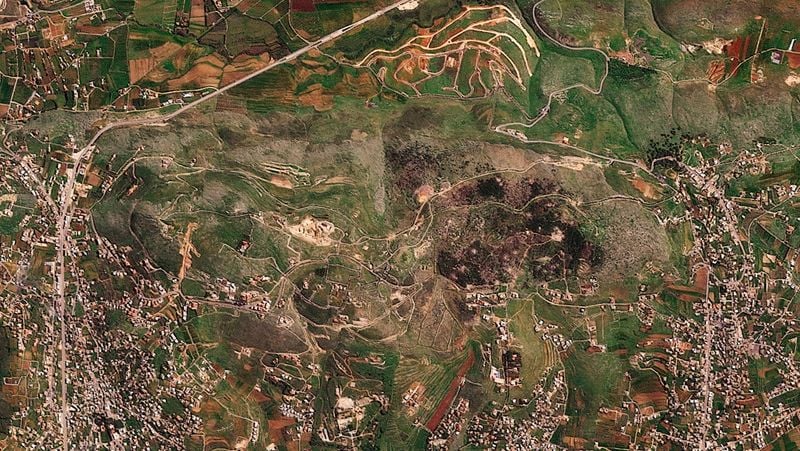
The signatures were not yet dry when the rejection arrived. On 26 June 2026, a US-brokered framework between Israel and Lebanon was reported as signed, allowing the Israel Defense Forces to maintain a security zone inside southern Lebanon and to retain operational freedom within it. Within hours, Hezbollah's media infrastructure made clear the movement would not accept any arrangement that codified those terms. By 27 June 2026, the central question was no longer whether a deal existed on paper, but whether it could hold against a party that considers itself the legitimate defender of the territory it would carve up.
The framework, as described in reporting circulated on 26 June, is the first publicly disclosed US-mediated arrangement between Israel and Lebanon that formally recognises an Israeli security zone on Lebanese soil since the 2000 withdrawal. It pairs that recognition with explicit operational latitude for Israeli forces inside the zone. For Washington, the arrangement is a deliverable — a concrete, documentable result of a diplomacy track that has run intermittently since the November 2024 ceasefire. For Beirut's political class, it is a sovereignty test. For Hezbollah, it is a red line.
What the framework actually says
The reporting shared on 26 June describes three operative elements. First, Israel maintains a security zone in southern Lebanon — a strip of territory inside Lebanese borders in which Israeli forces operate. Second, within that zone the IDF retains "operational freedom," a term that, in the absence of a published text, has been read by analysts as covering both ground movement and the conduct of targeted operations without prior Lebanese-government coordination. Third, the framework is signed by the US, Israel, and Lebanon — a trilateral structure that puts a Lebanese official signature on a document that Hezbollah's leadership has already rejected.
Two things are notable about what has been disclosed. The first is the absence of a published text. The arrangement is being characterised in social-media reporting rather than read in a signed document, which leaves room for the parties to describe its scope differently once political pressure builds at home. The second is the choice of trilateral architecture. A bilateral Israel-Lebanon understanding would have been one thing; bringing the US in as a co-signatory changes the enforcement geometry and makes the deal a US diplomatic asset as well as a regional one.
The Lebanese state's capacity to enforce any arrangement in the south is itself the unresolved variable. Lebanon has not exercised effective control over its southern border since at least the 2006 war, and the period since has only widened the gap between the Beirut government's writ and the territory south of the Litani. A framework signed in that context is, in practical terms, an agreement between the Lebanese state and external powers about a region the state does not administer.
Hezbollah's veto — and what it costs
Al Jazeera English's reporting on 27 June, sourced to Hezbollah's own media operation, stated bluntly that the movement "will not support" the framework. The phrasing matters. Hezbollah is not declaring war on the deal; it is denying it political legitimacy inside Lebanon. The distinction is the difference between an immediate security crisis and a slower constitutional one. By refusing recognition, Hezbollah signals that any Lebanese government implementing the framework will be doing so over the explicit objection of the largest non-state military actor in the country — and the political coalition that surrounds it.
That posture has costs on both sides of the ledger. For the Lebanese government, signing a deal that the dominant Shia political-military force rejects is to assume the bill for enforcement. For Hezbollah, publicly opposing a US-backed arrangement is to reaffirm its role as the armed guarantor of southern Lebanon — a posture that has carried political weight inside Lebanon but also produced the conditions, including the 2024 war and its aftermath, that the framework is meant to lock down.
The asymmetry is real. The Lebanese army does not have the force ratio to control the south against a determined Hezbollah; Hezbollah does not have the force ratio, the air defence, or the political latitude to roll back an Israeli position that is backed by Washington. The framework therefore rests on the assumption that both sides will treat the signed text as preferable to the alternative — a calculation that Hezbollah's rejection makes explicit but does not, by itself, refute.
A prediction market reads the gap
On 26 June, the prediction market Polymarket priced an Israeli withdrawal from Lebanon within 2026 at 29 percent — a figure that has been treated in market commentary as a quiet referendum on how seriously traders take the framework's durability. The number is low. A withdrawal that is supposed to follow a framework deal, priced below one in three by participants with money on the line, is a framework the market does not fully believe in.
Prediction markets are not foreign policy. They compress scattered information into a price, and the participants are often retail. But in the absence of a published text and a defined withdrawal timeline, the price is one of the few available quantitative signals. It suggests that the people closest to the information flow do not currently see a clean Israeli exit as the base case. That, more than any statement out of Beirut or Tel Aviv, is the framing worth holding onto.
What this looks like in plain terms
A framework that requires the Israeli military to retain a security zone and operational freedom inside a third country, with the co-signature of a government that does not fully control the territory in question, and over the opposition of the most powerful armed faction in that country, is not a peace deal in the historic sense. It is an armistice architecture — a way of managing an unresolved conflict without re-fighting it on a defined timetable.
The pattern is not new. The UN-monitored Blue Line arrangement that governed the Israel-Lebanon border from 2000 until 2023 was, in effect, an internationally backstopped armistice. The 2024 ceasefire extended that logic with US and French monitoring and explicit enforcement mechanisms. The June 2026 framework is a further iteration in the same direction: less aspirational, more transactional, and more dependent on the continued willingness of the parties — including Hezbollah — to treat non-bellicosity as cheaper than escalation.
The deeper question is whether armistice architectures of this kind delay conflict or simply reschedule it. The historical record in this corridor is unflattering. Each successive arrangement has held for a period, then failed when one of the parties concluded that the cost of holding it had risen above the cost of breaking it. The framework being reported this week lowers the immediate temperature; it does not, by itself, raise the long-term cost of breach.
What remains uncertain
Three things are not clear from the reporting on hand. The first is the published text. Without it, every characterisation — including this one — is working from summaries circulated on social media, and the scope of "operational freedom" in particular is contested. The second is the position of the Lebanese army. A framework of this kind succeeds or fails on whether the LAF can be positioned in the south as a credible implementing actor; reporting on the army's posture and resourcing has not, in the material available, been detailed. The third is Hezbollah's enforcement capacity in the zone. The movement has said it will not support the deal; whether it has the operational means to make that opposition felt, in the absence of a return to open war, is a separate question.
A framework in Beirut is, in the end, a forecast. It says what the signatories intend the next phase to look like. Whether the forecast holds depends on forces the signatories do not fully control — and on a veto that has just been made explicit.
This publication treats Israeli security concerns and Palestinian and Lebanese civilian harm as first-order facts with equal human weight; in this story, the live question is the durability of an arrangement signed by a state that does not fully administer the territory it has agreed to manage.
Wire provenance
This editorial synthesis draws on the following public wire/social posts:
- https://t.me/aljazeeraglobal
- https://t.me/aljazeeraglobal