Putin and Lukashenko's Surprise Two-Day Summit and the Optics of an Alliance Under Pressure
Two days of unscheduled one-on-one talks between Vladimir Putin and Alexander Lukashenko, disclosed only through Russian state-aligned channels, expose the fragility behind the pageantry of the Union State.
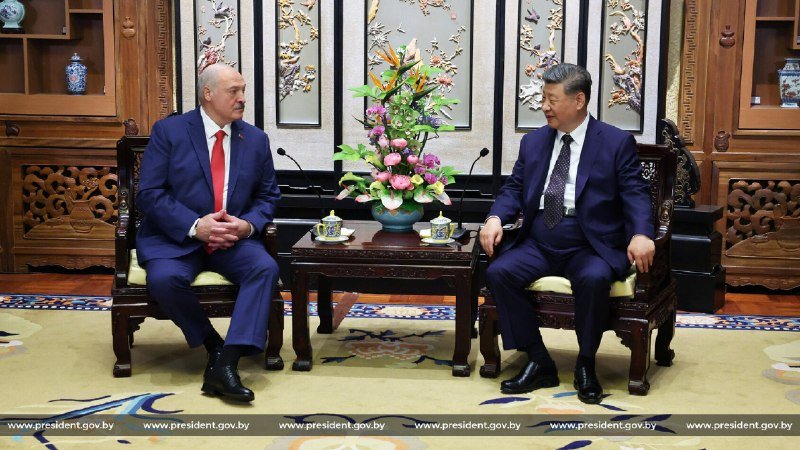
Two men walked into a closed room on 26 June 2026 and, by the time Russian state-aligned channels noticed on 27 June, had not come out. Vladimir Putin and Alexander Lukashenko are now in their second consecutive day of unscheduled, agenda-less, media-free bilateral talks, according to Russian-language outlets monitored by independent war-translation feeds on Telegram. The disclosure pattern is itself the story: nothing came from the Kremlin press service, nothing from the Belarusian presidential pool, and nothing from the Russian foreign ministry. Instead, the first English-language signal reached open-source researchers at 12:46 UTC on 27 June via the Ukrainian journalist Andriy Tsaplienko's feed, which attributed the reporting to "rosZMI" — the shorthand Telegram's Russia-watchers use for Russian state-aligned outlets — and was echoed minutes later by WarTranslated and the OSINTLive aggregation accounts at 12:49 and 13:07 UTC.
The silence out of Minsk and Moscow is not a communications failure. It is the communications. The Union State, the two-decade-old Russia-Belarus integration project that has produced more paperwork than factories, does not stage surprises — it stages ceremonies. What we are watching is the opposite: two presidents who cannot agree on the script.
The shape of the silence
Russian state-aligned channels have, in the past, used the phrase "closed-door talks" as a courtesy wrapper around carefully leaked readouts. This time there is no wrapper. Tsaplienko's 12:46 UTC post, citing rosZMI directly, described only that the meetings "were not planned" and have now stretched into a second day. WarTranslated's parallel post at 12:49 UTC repeated the same point. Neither Telegram account — both of them run by experienced Russia watchers with track records of accurately relaying Russian state media — could point to a single substantive readout by mid-afternoon UTC.
The geography matters. Lukashenko has not been seen publicly in Minsk for the duration, and the working language inside the Kremlin has historically been Belarusian-Russian bilingual diplomacy of the kind that thrives on back-channels and dies under klieg lights. The fact that the meeting is happening on Russian soil, away from the Belarusian press corps, is also telling: it strips Minsk of the home-court optics that Lukashenko uses to remind domestic audiences that he is a host, not a client.
What the wire is not saying
The mainstream wire services — Reuters, AP, AFP, the BBC Russian service — have not, as of the timestamps visible in the open-source feeds, picked up the story. That is unusual for a Putin-Lukashenko meeting of any length, and doubly so for one that has now run into a second day. The vacuum has been filled entirely by Russian state media's downstream chatter and the independent Telegram accounts that translate it.
This is worth pausing on. The default Western frame — Putin summons Lukashenko, Lukashenko complies — does not survive contact with the available evidence. A Kremlin that wanted to project control would have produced a four-paragraph readout by now, complete with a working lunch menu and a signing ceremony. The absence suggests either a substantive disagreement serious enough to foreclose the usual optics, or a calculation that no readout is safer than a bad one. Either way, it is the Kremlin's silence, not Lukashenko's, that is the deviation from the baseline.
The structural read
For all the talk of the Union State's military integration — the joint air defence, the regional force grouping, the cross-stationing of Russian tactical nuclear weapons inside Belarus — the political settlement underneath has always been transactional. Minsk buys subsidised hydrocarbons and a security guarantee against a domestic challenge to Lukashenko's personal rule; Moscow buys depth — a 1,000-kilometre buffer against NATO, and a launch pad for operations against northern Ukraine. The arrangement holds because both sides keep renegotiating the price, not because either side trusts the other.
Two consecutive days of unscheduled one-on-one talks, announced only by the Russian side and only obliquely, fit a familiar pattern in that relationship. They are the diplomatic equivalent of a corporate board holding an emergency session with no agenda distributed to shareholders. Something is being worked out — or, more pointedly, something is being worked out and one side is signalling that it is not yet settled.
The plausible subjects are limited. The war in Ukraine, now in its fourth year, has imposed asymmetric costs on the two economies. Russian defence spending has industrialised parts of central Russia while draining labour reserves; Belarus has been a logistics hub and a sanctions-laundering corridor, but it has also absorbed the reputational damage of hosting Russian forward bases. A second round of war economy bargaining — energy pricing, transit fees, access to Chinese components routed through Belarusian firms — is overdue.
There is also a less flattering possibility: that the talks are about the succession question in Minsk itself, which the Kremlin has long treated as a managed variable and Lukashenko has long treated as non-negotiable. Eight years past the constitutional limit that supposedly ended his eligibility, Lukashenko has been consolidating a hereditary transition plan that Moscow neither endorses nor openly opposes. A two-day closed meeting is the kind of venue in which that question gets tested without cameras.
What the evidence does not yet support
It is worth being honest about what the open-source record, as of the UTC timestamps above, does not tell us. We do not know who initiated the meeting, whether a third party — a senior prime minister, a defence minister, the head of Rosatom — is in the room, or whether the second day produced any signed document at all. The Telegram posts that surfaced the story cite Russian state-aligned reporting without quoting a single named Russian official by name. War-translation channels are reliable at relaying what Russian media says; they cannot tell us what Russian media has been told not to say.
That is the appropriate epistemic posture. Two days of unscheduled talks, disclosed only by leaks into Russian-aligned channels and then relayed by independent monitors, are evidence of a meeting, evidence of an information-management decision, and a strong hint that the two sides have something to discuss that does not survive daylight. They are not yet evidence of a crisis, a rupture, or a deal. The story is real; the conclusion is not yet written.
Monexus framed this as a story about alliance maintenance under asymmetric strain, drawing on the Telegram open-source feeds that first surfaced the unscheduled meeting rather than on wire copy — because, as of the timestamps above, there is no wire copy to draw on.
Wire provenance
This editorial synthesis draws on the following public wire/social posts:
- https://t.me/Tsaplienko
- https://t.me/wartranslated
- https://t.me/osintlive