Venezuela's quake response puts Caracas's foreign-policy isolation in plain view
Nearly 1,500 dead in western Venezuela after a series of earthquakes; foreign rescuers arrive to find debris, scarcity and a government whose sanctions-era isolation complicates relief.
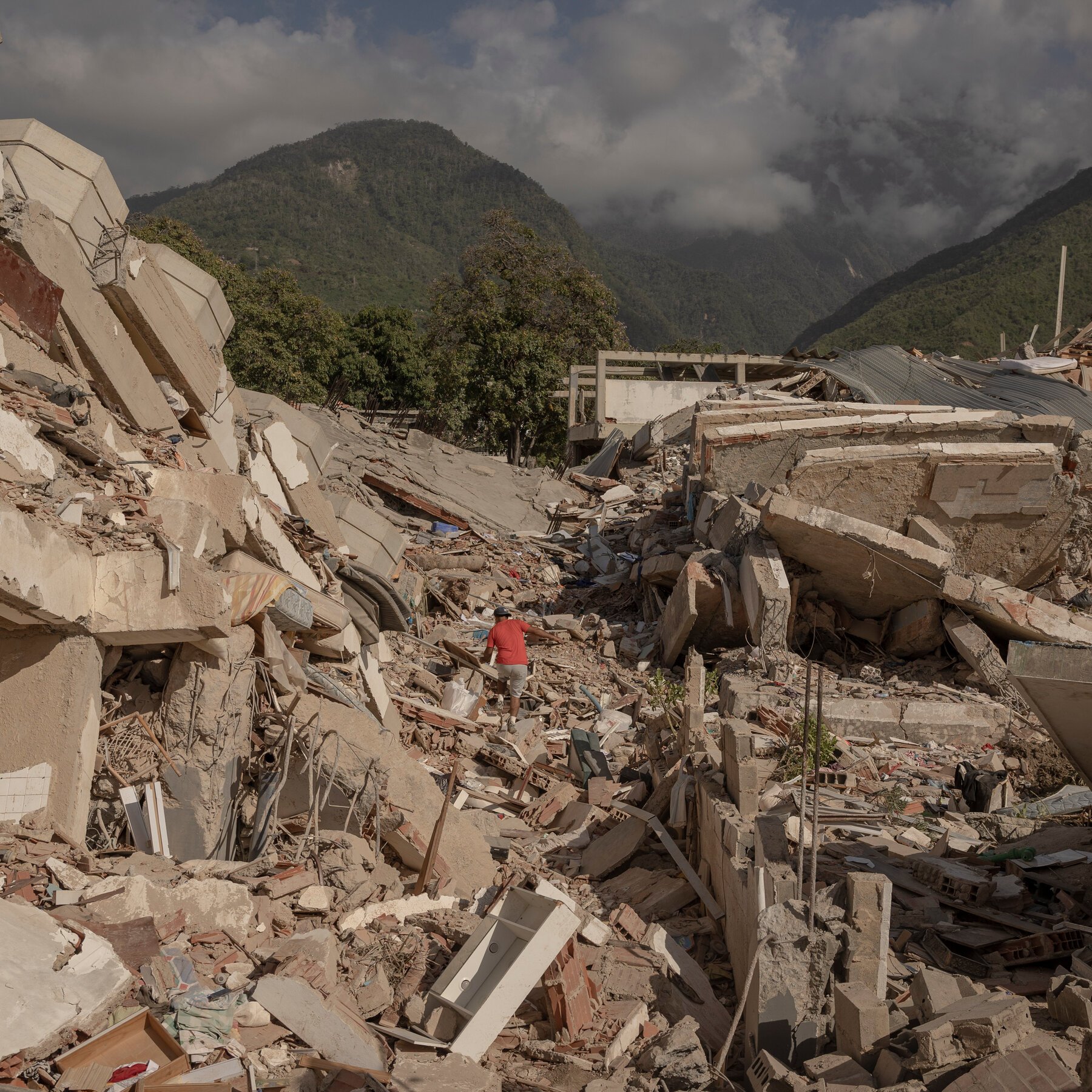
Nearly 1,500 people are dead across western Venezuela and millions more lack clean water and basic sanitation after a series of earthquakes struck the country's Andean fringe on 27 June 2026. Foreign rescue teams were on the ground within hours of the first shock, working through debris and supply shortages as a fresh 4.8-magnitude tremor hit the same zone in the evening. The picture emerging on day one is of a humanitarian emergency compounded, not merely aggravated, by Caracas's long-running estrangement from much of the international financial system.
The disaster tests a question that has trailed Caracas for years: what does a state do when a natural catastrophe collides with a sanctions architecture that limits its access to global finance, insurance and logistics? The answer, on the early evidence, is that help arrives in a patchwork, slowly, and on terms the government cannot fully dictate.
What the early reporting shows
Al Jazeera English reported a 4.8-magnitude aftershock near Venezuela on 27 June 2026, hours after the initial destructive sequence, confirming a region still seismically active and unsafe for the displaced. The New York Times's world desk described foreign rescuers battling debris and a scarcity of supplies, working against the clock in conditions that aid workers routinely describe as a race against the next tremor. Insider Paper's wire tally, citing early official and relief-agency figures, put the death toll near 1,500 with millions feared without access to clean water, sanitation and basic medical care — a scale that places this among the more serious natural-disaster losses recorded in Latin America in recent memory.
Three things stand out in those early dispatches. The first is operational: rescue crews were physically in the rubble within hours, which speaks to the standing capacity of regional and international relief agencies rather than to any improvisation by Caracas. The second is logistical: the recurring word in the field reporting is "scarcity" — of clean water, of heavy equipment, of fuel to run generators in damaged hospitals. The third is political: the framing across the Western wires is tightly focused on humanitarian mechanics and almost silent on the sanctions question, even though the constraints on Caracas's ability to import and distribute relief goods run through financial channels that have been narrowed by US and allied measures since 2017.
The counter-narrative worth stating plainly
There is a counter-narrative that the early coverage is not centering. Venezuela sits inside an oil-revenue collapse that began before the current sanctions regime and was deepened by it; the country's oil sector was already in steep decline during the mid-2010s as a result of mismanagement and underinvestment. Sanctions intensified the financing squeeze but did not create it, and a serious structural read of the relief bottleneck has to acknowledge both layers. Equally, the government's own crisis-management record — the speed of public communications, the willingness to accept foreign teams without political theatre, the distribution of fuel and water in the first 24 hours — is the variable that determines how many of the next 1,500 deaths the country will be able to prevent. The early reporting suggests acceptance of foreign help has been relatively frictionless; that is to Caracas's credit and is worth saying so.
There is also a less comfortable point. The Western wire's instinct to bracket sanctions out of the frame is not neutrality; it is a particular editorial choice that treats relief operations as separable from the financial architecture the affected state lives inside. Monexus finds that choice unpersuasive. When the cost of importing water-purification chemicals, paying foreign carriers, or insuring a chartered relief flight is partly a function of restrictions on Venezuelan state entities, the humanitarian arithmetic changes.
The structural picture, in plain language
What is being watched in real time is a recurring pattern of this decade: a state that has been locked out of large parts of the dollar-based financial system, that cannot freely move reserves, that cannot easily insure or charter at scale, is hit by a shock that requires all three of those capabilities. The dollar-based architecture is not designed as a humanitarian tool, but it functions as one whether Washington intends it to or not. The episodes pile up — the Iranian earthquake responses of the late 2010s, the Afghan earthquake relief of 2022 and 2023, the Syrian earthquake of 2023 — each one a reminder that the same financial plumbing that constrains a sanctioned government's reach also constrains its ability to recover.
The Global South frame for this story is not exotic. Latin American capitals have spent two decades building regional disaster-response mechanisms precisely because the assumption that US-led relief coordination will be available, or appropriate, is not one every affected government treats as reliable. That institutional layer — the regional, the South–South — is what carries a meaningful share of the operational load when an event like this lands.
What is contested, what is not
The death toll near 1,500 is the figure carried by Insider Paper's wire in the immediate aftermath; Venezuelan government sources and independent verification may revise it upward as rural Andean areas are reached. The number of people "without basic needs" — millions, per the same dispatch — is necessarily an estimate at this stage and will be refined as assessments mature. Whether the 4.8-magnitude event reported by Al Jazeera English is itself a damaging shock or one in an ongoing aftershock sequence is a distinction seismologists will settle; for relief planning, the operational reality is the same: collapsed structures stay collapsed, and people stay out of them.
What is not contested is that the need is large, that the response so far depends heavily on foreign teams, and that the political-economy backdrop is unusually hostile to fast, large-scale state action.
The stakes
If the relief effort consolidates — if fuel reaches the damaged hospitals, if water-purification gear gets through, if the regional financial architecture absorbs the logistics costs that Caracas cannot easily pay — the human loss stays close to today's number. If it fragments, the secondary mortality from contaminated water, untreated injuries and chronic-disease disruption runs into the thousands on its own. The political stakes are quieter but real: a successful relief operation, even one constrained by the financial architecture, would put a quiet counter-example in front of a Latin American audience that is increasingly skeptical of the claim that the existing order delivers in moments of need. A failed one would harden that skepticism for a generation.
This publication framed the story around the financial-architecture angle the wire desks bracketed out. The casualty and operational facts are taken from the wire sources cited; the structural reading is editorial.