Venezuela's Quake and the Politics of Who Counts the Dead
Two shallow back-to-back tremors have killed at least 1,430 people and left 68,900 missing along Venezuela's Caribbean coast. The disaster is also a stress test for the country's information system — and for the sanctions regime that has shaped its emergency response capacity.
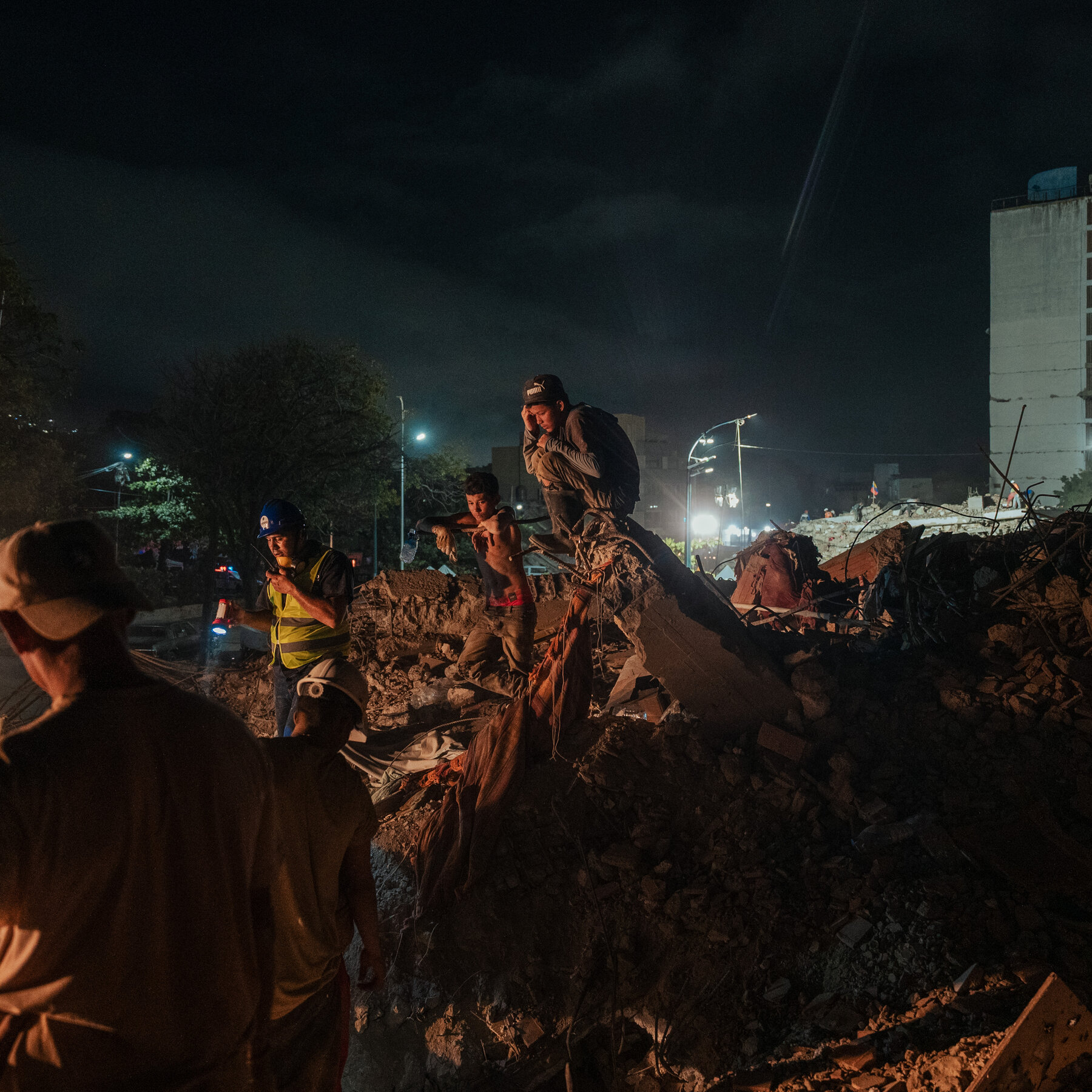
Three days after a pair of shallow tremors tore through Venezuela's Caribbean coast, the country's casualty ledger is moving in the wrong direction. According to the Telegram channel Clash Report, citing figures circulating on 27 June 2026, the death toll has climbed past 1,430 and the missing-persons list has ballooned to roughly 68,900 — overwhelmingly concentrated in coastal La Guaira state and the surrounding municipalities where the quakes' epicentres sat closest to population centres. PressTV footage from the same day shows rescuers clawing through rubble that has, in places, begun to ignite and collapse in on itself — an explosion captured mid-operation — and a separately posted clip of an infant pulled out alive and reunited with the father waiting on the other side of the debris.
The pictures are a reminder that whatever the politics around Caracas, the arithmetic of this disaster is measured in bodies. The argument worth making now is simpler: a quake of this magnitude anywhere is a humanitarian emergency. A quake of this magnitude in a country locked out of dollar-clearing systems and unable to freely import rescue equipment is a categorically different one. Venezuela's exposure is not just geological. It is financial, institutional, and informational — and the next 72 hours will determine how visible that exposure becomes to the outside world.
What we know, what we don't
The two shocks — magnitudes M7.2 and M7.5 in the framing used by Clash Report — were shallow. That detail matters: shallow ruptures convert more energy into surface shaking, which is why a rural hillside can be stripped of vegetation and a coastal urban grid can pancake in seconds. La Guaira, sitting on a narrow strip between the Ávila massif and the Caribbean, is exactly the topography where a shallow event compounds. Damage assessment is still partial, but the early pattern — concentrated destruction along the coast, an outsized missing-persons count relative to confirmed fatalities — points to neighbourhoods that were buried rather than burned.
The institutional plumbing around the response is harder to read. The thread sources available to this publication do not yet include a Venezuelan government death toll broken down by municipality, a Venezuelan civil defence press conference, or independent verification of the 68,900 figure from a major wire service. PressTV, the Iranian state broadcaster whose correspondent was on the ground, is a legitimate witness to the rescue operations on camera but is not a neutral verifier of Venezuelan state numbers. Reuters, AP, AFP and BBC have not yet published the kind of municipality-level accounting that would let an outside reader reconcile the headline casualty figure with the missing list. Until they do, the 1,430 dead and 68,900 missing should be read as an order-of-magnitude estimate — a number consistent with the visual evidence, not one independently audited against it.
The counter-frame, and why it doesn't hold cleanly
The default Western commentary on any Venezuelan crisis tends to fold quickly into a sanctions debate. That frame is not wrong — it is just incomplete as the only frame. The U.S. Treasury's existing licence architecture around Venezuelan oil revenue has, over several administrations, restricted Caracas's access to hard-currency procurement for emergency equipment, fuel imports and parts for an already-strained electrical grid. Read narrowly, that is a contributing factor to the scale of any disaster response, including this one. Read narrowly, it is also the reason a 7.5 shallow event lands differently on a Caribbean coast than on, say, the coast of Chile, which has spent three decades investing in tsunami early-warning and base-isolation retrofitting.
But the counter-frame — that this is solely a sanctions story — also doesn't hold. The Caracas–La Guaira corridor has been politically marginalised by successive Venezuelan governments of different ideological stripes; the housing stock along the coast is a mix of barrios built informally and older port infrastructure long under-invested regardless of who sat in Miraflores. Local fire and rescue capacity was thin before any sanctions regime took its current shape. A reader who lands on the disaster from a Western wire tomorrow will be told a story about geopolitics; a reader who lands on it from Caracas will be told a story about a state that stopped maintaining its periphery a generation ago. Both stories are partial. The honest framing holds both.
What the coverage will miss unless someone holds the line
What we should be watching over the next reporting cycle is whether the wire coverage names the missing — not just as a number, but as a verification problem. A 68,900 figure three days into a disaster is a signal of one of three things: genuinely catastrophic surface damage in coastal municipalities, communication collapse that has separated families faster than rescuers can reunite them, or institutional inflation by an interested party. Two of those are catastrophic in the conventional humanitarian sense. The third is a different problem, and it requires the kind of OSINT-led corroboration that takes longer than a news cycle to assemble.
There is also a quieter story underneath the casualty figure: the Venezuelan information environment itself. PressTV being on the ground is not, in itself, a verdict on Caracas's openness — it is a verdict on who sent a crew. The bigger absence in the thread sources so far is any sizeable independent international press presence on the rubble. That absence is structural. Caracas accreditation is not routine for major Western outlets; where crews do land, the coverage tends to run through the lens of the country's broader political crisis rather than the disaster in front of the camera. La Guaira's residents will get less column-inches, per casualty, than a comparably affected coastal city in a country with a more accessible press environment. That is not a conspiracy. It is how the global news economy prices access.
Stakes, plainly stated
If the trajectory of the next 72 hours holds, the political economy of the disaster will harden into a familiar argument: did sanctions kill people, or did the state? The more useful question is who, in the next ten days, can deliver a working seismograph, a fuel truck, and a field hospital to a buried barrio in La Guaira. That is not a sanctions question. It is not a sovereignty question. It is a logistics question with a death toll attached to it, and it is the only question whose answer can still move in the right direction.
The bodies under the rubble are not a talking point. They are the test.
This publication holds the view that disasters are reported best when the wire coverage names the institutional plumbing that shaped the response — including, where relevant, sanctions regimes, accreditation frictions, and the composition of the press pool on the ground — rather than collapsing the story into a single causal line. The figures cited above reflect the thread sources available at 27 June 2026; this piece will be updated as wire verification arrives.
Wire provenance
This editorial synthesis draws on the following public wire/social posts:
- https://t.me/ClashReport
- https://t.me/presstv
- https://t.me/presstv