Abdeen, Daraa, and the price of being 'protected' by the Jolani administration
Residents of Abdeen are reported to be blocking roads with stones against Israeli helicopters, a small village gesture that exposes the structural bind of Syrian governance under the Damascus-administration's quiet accommodation with Tel Aviv.
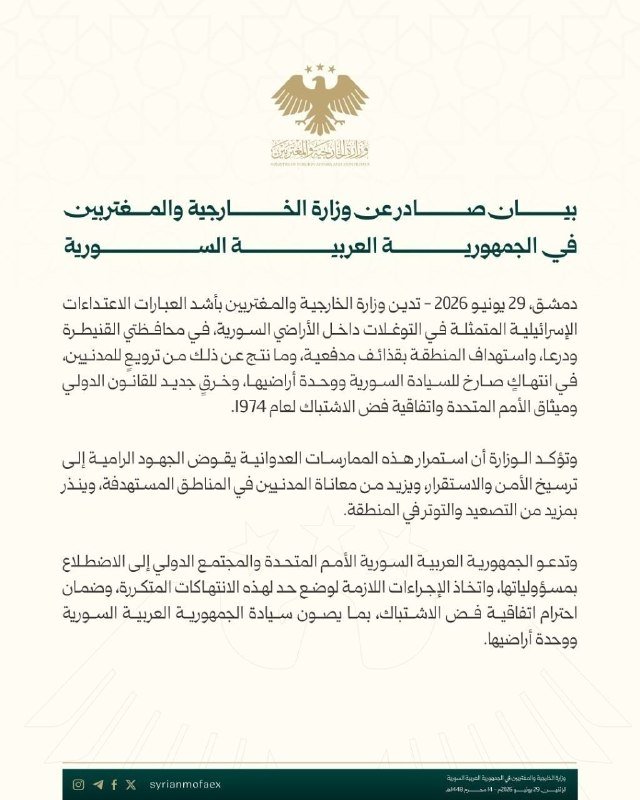
On the evening of 28 June 2026, residents of Abdeen, a village in the Yarmouk Basin area of Syria's western Daraa countryside, were reported to be placing stones across approach roads in a desperate attempt to slow Israeli helicopters firing machine guns into the village. The Syrian state news agency SANA, relayed through regional channels, said Israeli forces had shelled the village with artillery and that overflights were active over both the Quneitra and Daraa countrysides. By 20:42 UTC, al-Alam Arabic was reporting that the helicopter fire had resumed after local residents tried to push back the incursion on foot. By 22:27 UTC, a Daraa-focused correspondent on X was describing villagers who had "lost hope" that the Jolani-led authorities in Damascus would defend them.
What is unfolding in Abdeen is not a border skirmish. It is the predictable end-state of an arrangement that has held for most of 2026: a Syrian transitional administration whose grip on southern Syria rests on quiet accommodation with Israel, while the civilians in its nominal care absorb the consequences of Israeli operations against southern Syria's armed infrastructure — and occasionally, by proximity, against the villages themselves.
The pattern: helicopter fire, artillery, displacement
Reporting on Abdeen is consistent across the sources clustering around 20:02–22:27 UTC on 28 June. The sequence opens with an Israeli strike on the outskirts of the village in the Yarmouk Basin region of Daraa Governorate, quickly followed by SANA reports of artillery fire into Abdeen's western countryside and Israeli overflights across Quneitra and Daraa. By 20:42 UTC, Syrian sources cited by al-Alam Arabic describe Israeli helicopters firing into the village itself, with clashes breaking out after villagers tried to respond to the incursion on foot. Within minutes, SANA — relayed by the @wfwitness channel on Telegram — was reporting displacement from Abdeen toward nearby villages.
The geography matters. The Yarmouk Basin and the western Daraa countryside sit along the 1974 disengagement line's memory — the same terrain where Israeli ground operations have repeatedly probed, and where Israeli strikes have historically targeted Iranian-affiliated assets, weapons stockpiles, and infrastructure tied to the Shia-led presence that dominated southern Syria for much of the past decade. The pattern is familiar: an airstrike, then reports of returning fire or attempted ground response, then renewed fire, then displacement.
The structural bind of "protection" under Jolani
The Damascus administration led by Ahmed al-Sharaa — known publicly by his nom de guerre Jolani, retained in many regional outlets — took power in late 2024 and inherited a southern Syria shaped by more than a decade of Iranian military entrenchment, Russian air support, and Hezbollah-linked logistics. The administration's posture toward Israel has been deliberately quiet: a non-aggression de facto, with Israeli air operations in Syrian airspace continuing at a tempo that, in 2025 and into 2026, regional analysts have repeatedly described as an open secret. The arithmetic for Damascus has been simple. Renewed war with Israel would invite the kind of saturation campaign that flattened Syrian military infrastructure in late 2024. Stability at home requires friction with Jerusalem at a minimum.
But minimum friction in Jerusalem's definition is not nothing. When Israeli forces strike a target in southern Syria, the response is reported not by Israeli strikes on a Damascus headquarters but by Syrian villages absorbing the rounds. Abdeen is reportedly one such target. And the residents of Abdeen — reported via the Daraa-based @sprinterpress account at 22:27 UTC to be physically blocking roads with stones against Israeli helicopters — have drawn the obvious conclusion: there is no defender coming from the capital.
Why the stones are the story
It is tempting to read the Abdeen episode as another iteration of a familiar regional script — Israeli strike, Syrian civilian displacement, muted international reaction. The more revealing detail is what residents reportedly did next. Where the Syrian state's security services might once have arrived to clear roads and seal off an area, residents in Abdeen reportedly chose to seal them themselves, with stones, against Israeli aircraft.
The framing matters. This is not an uprising against Damascus; it is a withdrawal of confidence. The Daraa countryside is not unfamiliar with that posture — the province was the cradle of the 2011 uprising and has cycled through reconciliation agreements, forced conscription, and armed resistance for most of the post-2011 period. What is new is the coalition context. The Jolani administration's claim to govern rests in significant part on its promise of protection and orderly administration across the territory it took from the former Assad order. If the villages along the Yarmouk Basin conclude that protection is not forthcoming — and the road-blocks in Abdeen suggest they are concluding exactly that — the political cost is not paid by Tel Aviv but by Damascus.
What remains uncertain
Three things are not yet established in the open-source record on the evening of 28 June. First, the precise target of the Israeli strikes: sources reference artillery and helicopter fire on Abdeen and reports of clashes with residents, but do not specify whether a discrete weapons cache, an armed cell, or a senior figure was the proximate objective. Second, the casualty figure. SANA's reporting at 20:11 UTC referenced displacement; later dispatches referenced renewed clashes; none of the items before this publication specified a death or injury toll. Third, the posture of Damascus in real time. The Daraa-based @sprinterpress account framed residents as having "lost hope" that Jolani-aligned formations would intervene, but the administration itself had not, in the items reviewed, issued a public statement on the Abdeen operations by the time of publication.
Until those gaps are filled — by wire reporting from the Quneitra–Daraa corridor, by an Israeli military readout, or by a Damascus statement — the Abdeen episode sits inside the broader pattern of 2026: southern Syrian villages absorbing Israeli fire, a transitional administration that prefers quiet, and residents left to improvise their own response. Stones on a road are not a strategy. They are the absence of one.
Desk note: Monexus is sourcing this developing story from the SANA relay via @wfwitness, al-Alam Arabic, Liveuamap, and the Daraa-focused @sprinterpress account. Israeli military and Damascus-administration statements have not yet entered the open record on this specific incident.
Wire provenance
This editorial synthesis draws on the following public wire/social posts:
- https://t.me/sprinterpress
- https://t.me/alalamarabic
- https://t.me/wfwitness
- https://t.me/wfwitness
- https://t.me/Liveuamap