Ferrari's Austrian GP practice pace leaves Mercedes chasing shadows
Leclerc and Hamilton traded P1 and P2 in the opening practice at the Red Bull Ring, while Antonelli's late lap of 1:06.763 salvaged Mercedes' afternoon and Russell's Turn 3 lock-up left the silver cars with more questions than answers.
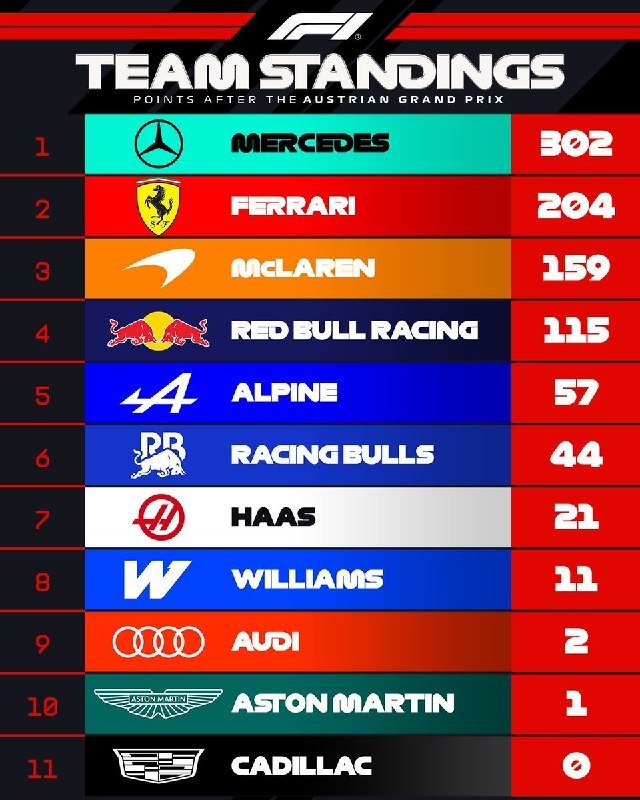
Charles Leclerc and Lewis Hamilton parked their scarlet Ferraris at the top of the timesheet in opening practice for the Austrian Grand Prix on 27 June 2026, with the Monexus-tapped Formula 1 channel reporting at 14:35 UTC that the two Maranello cars had traded P1 and P2 before either Mercedes had registered a representative lap. By 14:38 UTC the picture had hardened into a familiar shape of the modern turbo-hybrid era: Ferrari early, Mercedes scrambling, Kimi Antonelli's late flier of 1:06.763 the only bright note for the silver arrows in an afternoon otherwise defined by George Russell's Turn 3 lock-up.
The opening session at the Red Bull Ring in Spielberg is rarely more than a reconnaissance lap dressed up as competition. Cars run low-fuel trimmed-out runs to map brake points, then heavier race-sim stints once track evolution has bitten in. What the timesheet actually tells a watching team principal is whether the car is happy in the slow corners — Turns 3 and 4 — and whether the rear is planted through the penultimate double-right. On both counts the early evidence favours the side that has won three of the last four Austrian Grands Prix.
A Ferrari one-two that means what it usually means
Ferrari's Friday template is well rehearsed by now: a soft-tyre one-two in FP1, an aero-correlation debrief at Maranello, and the question of whether the car can carry the same pace into qualifying trim. Leclerc's benchmark and Hamilton's P2 echo the form that has pushed the Scuderia to the top of the constructors' standings through the European leg of the calendar. The 14:35 UTC update records Hamilton slotted in behind his team-mate, a hair's breadth back, suggesting both drivers had clean air and identical machinery — the conditions under which Ferrari's floor concept has looked strongest all season.
There is a counter-read worth flagging. Practice-one timesheets at power-sensitive circuits like Spielberg flatter cars that bolt on softs early and accept the fuel penalty. The Red Bull Ring's three long straights and two heavy braking zones magnify engine-mode differences, and Ferrari's power-unit deployment has historically looked more aggressive in practice than in qualifying. The honest caveat is that nobody outside the garage knows the fuel loads, and a Friday P1 has a long and inglorious history of evaporating by Saturday afternoon.
Mercedes' salvage run and a Turn 3 problem
The 14:38 UTC update is where the Mercedes picture turns interesting. Antonelli's 1:06.763 is the fastest lap the Italian had logged all weekend, and crucially the only clean Mercedes lap on a board that, twenty seconds earlier, had shown both Brackley cars as yet-to-set. Russell's lock-up at Turn 3 — the heavy braking zone at the apex of the uphill right-hander — explains the gap: the reigning champion had been on a representative run before the front-right protested.
The reading here is mixed for the silver cars. On one hand, a late clean lap shows the W17 chassis has the rear-end stability to put a soft together in the final sector — a known weak spot last year. On the other, the fact that both drivers spent the first quarter of the session off the pace board is a warning that something in the long-run balance has shifted; whether that is tyre-preparation, track-rubber, or simply a sandbagged engine mode will not be clear until FP2.
What the structural picture says
Look across the season, not the session, and the Friday ordering starts to rhyme with the constructors' table. Ferrari have been the team to beat on circuits that reward low-speed traction and rear stability. Mercedes, for their part, have been more competitive on tracks with longer corner phases and higher minimum speeds. Spielberg sits awkwardly between the two — its corners are slow, but the straights are long enough that any deficit in power-unit deployment shows up in sector one. A P1-P2 in FP1 is therefore less a prediction of Sunday than a confirmation of which side of the engineering compromise the track leans.
The structural pattern is the one that has defined the hybrid era: two-and-a-half teams at the front — Ferrari, Mercedes, and the persistent question of Red Bull's recovery pace — with a development war that turns on who reads the new technical directives fastest. Friday is too early to call any of that. It is not too early to notice that the cars on top today are the cars that have been on top all month.
Stakes and what remains uncertain
For Ferrari, the obvious stake is a constructors' lead that compounds with every weekend the gap to Mercedes stretches. For Antonelli, whose 2026 campaign has been a story of steady consolidation rather than headlines, a clean lap on a Friday afternoon matters more than the timesheet position: it is the kind of data point a team principal files away when the contract renewal conversations start. For Russell, the Turn 3 lock-up is the kind of small thing that becomes a large thing only if Saturday's qualifying lap goes the same way.
What the sources do not yet say is the gap to Red Bull, the long-run pace in either car, or the tyre-degradation behaviour over a ten-lap stint. Those numbers come with FP2 and FP3. Until then, the only honest line on Friday at the Red Bull Ring is the one the timing screens printed at 14:38 UTC: Ferrari one-two, Antonelli third, Russell chasing a clean lap.
Desk note: Monexus reports Friday practice timesheets at face value, then asks what they would look like with realistic fuel loads — a habit the wire copy has not yet acquired.
Wire provenance
This editorial synthesis draws on the following public wire/social posts:
- https://t.me/s/formula1/2026-06-27-14-38
- https://t.me/s/formula1/2026-06-27-14-35
- https://en.wikipedia.org/wiki/Austrian_Grand_Prix
- https://en.wikipedia.org/wiki/Red_Bull_Ring