Four hundred drones over Crimea: what the latest salvo tells us about the war's industrial tempo
A reported 400-drone Ukrainian barrage across Russian-occupied Crimea and Krasnodar on 28 June 2026 is less a single strike than a data point on an industrial curve that is bending the war's economics.
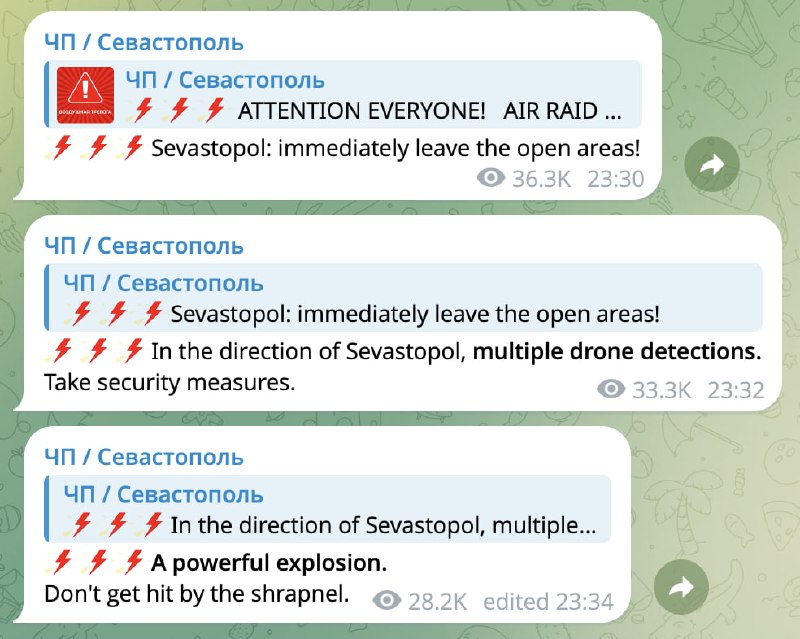
On the evening of 28 June 2026, the open-source monitoring channel @DrnBmbr, as relayed by the Ukrainian translation account WarTranslated, reported that roughly four hundred Ukrainian drones were striking targets across Russian-occupied Crimea and into Krasnodar Krai. Air alerts sounded across the peninsula; the channel described the heaviest activity over the peninsula itself, with additional drones hitting Krasnodar. The figure, if confirmed, would mark one of the largest single-night unmanned salvos of the war so far, and a continuation of an unmistakable tempo: a steady, monthly escalation in the size and reach of Ukrainian deep-strike packages.
The number matters less than what it represents. By late June 2026, the defining feature of the Russo-Ukrainian war is no longer manoeuvre but throughput — the industrial capacity to put cheap hardware into the sky in batches large enough to saturate Russian air defences across several oblasts at once. Each salvo functions as both a military strike and a forcing function on Russian interceptor economics. Read together, the barrages of recent weeks describe a curve, not a headline.
What the salvo actually does
A package of this size is not designed to destroy a single high-value target. It is designed to overwhelm. Russian short-range air defence — Pantsir units, Tor batteries, mobile SHORAD teams — operates on finite interceptor stocks and finite radar attention. A four-hundred-drone package arriving across several axes forces the defender to spend interceptors against decoys and loitering munitions rather than against the cruise missiles or one-way attack drones that may be embedded inside the same swarm. The residual that gets through is the actual weapon; the rest is a tax levied on Russian ammunition.
Crimea, in particular, is the strategic centre of gravity for any Ukrainian effort to push Russian aviation and naval logistics beyond strike range of the southern front. Airfields at Saky, Belbek and Hvardiiske, the Kerch bridge rail link, and the port infrastructure at Sevastopol have been the recurring targets of packages like this one throughout 2026. Krasnodar — mainland Russia — widens the political cost: drones reaching civilian-visible infrastructure on Russian soil force the domestic audience to confront the war in ways the official line about a "special military operation" increasingly cannot absorb.
Why the industrial framing matters
Western coverage of the war tends to treat each big salvo as an event. That framing is wrong. The relevant unit of analysis is the production line in Ukraine that turns out first-person-view strike drones at scale, and the parallel Ukrainian ecosystem of long-range unmanned aerial vehicle manufacturers that has matured under wartime conditions. By 2026, Ukraine's domestic drone output — measured in units rather than dollars — has grown to the point where a four-hundred-aircraft night is no longer an exceptional feat but a planned output of an industry that has learned to operate at this cadence.
That industrial shift has a counterpart on the Russian side, where Shahed-type one-way attack drones supplied by Iran, alongside growing domestic analogues, have similarly changed the economics of strike. The war is becoming a contest of unmanned production lines and interception budgets. The side that runs out of either — interceptors for the defender, airframes for the attacker — loses.
What the wire framing gets wrong
Most reporting on barrages of this size gravitates to two narratives: a tactical story about a specific air base or radar station hit, and a moral story about escalation. Both are real, but neither is the lead. The lead is industrial policy. The decision to allocate scarce Ukrainian engineering talent, fibre-optic spools, warhead supply, and pilot training to a package of this size is a political-economic choice with consequences that outlast the night's footage. So is the Russian decision about how many interceptors to spend and what gets through.
Coverage also underplays how asymmetric the cost equation has become. The interceptor that meets a $500 Ukrainian drone has cost the Russian state many multiples of that. Even allowing for the price of Ukrainian airframes and launch crews, the salvo imposes a cost-per-effect that favours the attacker the longer the cadence holds.
The stakes over the next quarter
If the production curve continues, expect monthly packages of this size or larger to become the norm rather than the exception. That has three downstream consequences. First, Russian military logistics in Crimea will face a sustained pressure campaign that complicates resupply of the southern front. Second, the Russian interceptor budget — already visibly strained by the tempo of Shahed strikes on Ukrainian cities — will be tested in both directions at once. Third, the diplomatic signal changes: each salvo demonstrates to European capitals and to Washington that Ukraine retains the means to impose costs without Western-supplied long-range systems, which feeds back into debates about the depth of further military aid.
What remains genuinely uncertain is the verification question. @DrnBmbr is an open-source monitoring channel, not an official Ukrainian source, and WarTranslated is a translation intermediary. Russian-side reporting on impacts, where it appears, will need to be read against the usual caveats of wartime information environments. The number four hundred is the figure being reported at 20:54 UTC on 28 June 2026; the full damage assessment will take days, not hours, to corroborate, and the strike count may be revised upward or downward as imagery and acoustic data come in.
This publication treats the event as a tempo marker rather than a finish line. The war's centre of gravity in the second half of 2026 sits in the production lines that fed this salvo — and in the Russian decision about whether to keep absorbing the bill.
Desk note: Monexus frames this as an industrial-tempo story, not an escalation headline. Where wire coverage will lead with crater footage, we lead with the production curve and the interceptor budget — the two variables that actually determine what comes next.
Wire provenance
This editorial synthesis draws on the following public wire/social posts:
- https://t.me/wartranslated/19234
- https://t.me/osintlive/18472
- https://t.me/DrnBmbr