India's T20I wobble in Dublin is not an upset — it's a warning about depth
A 2-0 series loss to Ireland in Dublin has reopened an uncomfortable question for Indian cricket: when the top of the order wobbles, the bench is thinner than the broadcast graphics suggest.
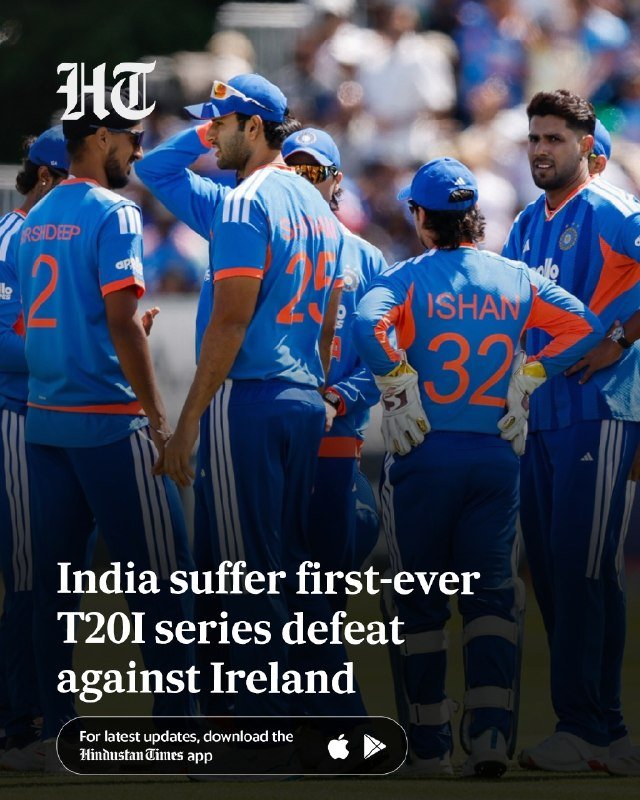
Ireland are not supposed to do this. Ranked well outside the elite bracket of white-ball cricket, playing in front of a home crowd in Dublin, they have just taken a second consecutive T20I off India and sealed the series 2-0, according to The Indian Express's reporting on 28 June 2026. India's batters, the same outlet noted in a companion piece the same day, failed again at the top of the order, and the question being asked in the Indian press is no longer whether the loss is a fluke — it is what it reveals about the bench.
The headline is the result. The story is the squad. India's T20I cricket has spent two years treating the top three as a closed shop, with the rest of the batting card rotated around them. Ireland have now exposed, twice in three days, what that policy looks like when the closed shop misfires: a long, exposed tail and very little margin for error.
The result in Dublin
The Indian Express's dispatch on the second T20I of the series, time-stamped 17:52 UTC on 28 June 2026, frames the contest bluntly: "India stunned by Ireland for 2nd game in row to lose series 2-0." The win gave Ireland their second successive victory in the series and handed India their first T20I series defeat to a Full Member ranked outside the traditional top tier in recent memory. The Indian Express companion piece filed from the same news cycle, "Quick Comment: Who does Sooryavanshi replace, after India's top 3 flop against Ireland," makes the structural point: India's top order has been the load-bearing wall of the format for so long that the moment it cracks, the selection conversation collapses into a single sentence — who comes in, and for whom.
That is the unusual feature of this defeat. India's losses in bilateral cricket over the past two seasons have typically been one-off: a freak chase, a collapsed middle order, a wet outfield. What Dublin produced was a repeat. The same top-order failure, against the same attack, on consecutive outings. Repeatability is what turns a bad day into a structural finding.
What the top three actually did
The Indian Express's commentary piece does not speculate on technical causes — it poses the selection question directly. The framing matters: the implication is that the issue is not that India's top three played badly in some abstract sense, but that they played badly in a specific, repeatable way that a settled replacement would address. The discussion of Sooryavanshi — the young batter who has been waiting in the format's second tier — as the obvious candidate for a promotion is, in effect, an admission that the depth chart has not been tested in live conditions.
This is the part of the story that matters for readers outside the cricket bubble. India's white-ball cricket is a publicly visible proxy for the country's wider sporting depth. When the top three score, the system looks self-evidently strong. When they don't, the question that follows is whether the system has been built around three names, or whether three names have been allowed to hide the absence of a system.
The structural read
Cricket boards talk about depth the way finance ministries talk about liquidity: everyone agrees it matters, almost nobody pays for it when conditions are easy. India's white-ball setup over the past 24 months has had the luxury of a settled, world-class top order that has, more often than not, scored enough runs to mask middle-order and lower-order frailties. That is a rational allocation of resources in the short run — captaincy, batting-order slots, middle-overs bowling rotations — but it is a fragile equilibrium.
Ireland's win in Dublin is, in that sense, a stress test the Indians did not ask for and were not prepared for. The Indian Express's selection question — who does Sooryavanshi replace — is the right question, but it is also a narrow one. The deeper question is whether the bench has been given enough cricket at this level to be ready when the call comes, or whether the bench has spent the last two years watching from the dressing room.
What remains uncertain
It is worth being honest about what two T20I results do and do not prove. A two-match sample is small, and Ireland at home in June, on surfaces that Indian players rarely encounter, is not the same problem as India will face at a World Cup in the subcontinent. The sources do not specify pitch conditions, individual scores, or the precise composition of the Indian XI in either match beyond the implication that the top three were retained. The Indian Express's framing is pointed but cautious — it does not call for anyone's head, it asks a selection question and leaves the rest for the selectors.
What the reporting does establish, with reasonable certainty, is the headline outcome: India lost the series 2-0 in Dublin, the top order failed twice, and the post-mortem in the Indian press has begun in real time. The structural interpretation — that India's T20I depth is thinner than the broadcast graphics suggest — is an inference from the pattern the source describes, and Monexus offers it as analysis, not as a verdict.
The stakes are simple. If the selectors respond by promoting one batter and leaving the rest of the system unchanged, the next time the top three wobble — and they will wobble again — India will be back in Dublin, asking the same question. If the selectors treat this as a depth problem rather than a selection problem, the answer is less photogenic and more durable.
Desk note: Monexus treats India's bilateral cricket as a public-interest story when the result is structurally informative. The Indian Express set the frame with two short pieces in the same 17:52 UTC window — the result and the selection question — and our analysis extends that frame rather than restating it.