Israel Strikes Syria's Daraa Countryside as the Wire Goes Quiet
Israeli artillery and airstrikes hit the village of Abdeen in Syria's western Daraa countryside on 28 June 2026, yet the major wires have not yet assigned bylines to the reports circulating on Telegram.
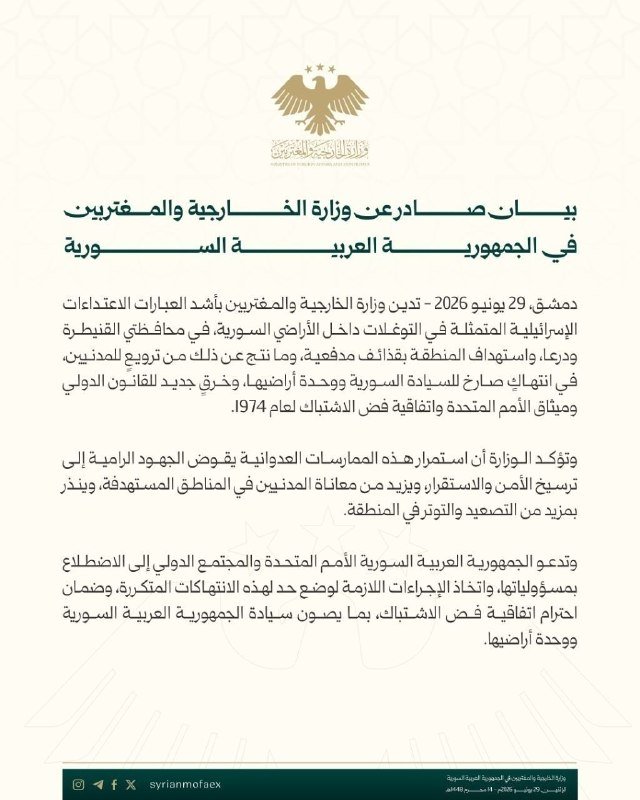
Israeli forces shelled the village of Abdeen in Syria's western Daraa countryside on the evening of 28 June 2026, with the Syrian state news agency SANA reporting artillery fire and ongoing overflights across the neighbouring Quneitra and Daraa districts. The accounts surfaced first on Telegram channels @wfwitness and @Liveuamap at roughly 20:02–20:11 UTC on 28 June 2026, attributing the strikes to Israeli forces without immediate comment from Jerusalem.
The pattern of reporting tells its own story. Western wires had not, as of 20:11 UTC on 28 June, attached a byline or dateline to the strikes; what is on the record is SANA's correspondent in Daraa, relayed through two monitoring channels, describing artillery fire at Abdeen and aircraft overflights above Quneitra and Daraa. The geography — Abdeen in the Yarmouk Basin, on the western edge of Daraa governorate — places the village within a strip that Israel has struck repeatedly since the 2024 collapse of the Assad-era buffer arrangements. None of the available reporting specifies casualties, struck targets, or whether the operation was directed at individuals, infrastructure, or convoys.
Why the strike site matters
Daraa and Quneitra together form Syria's southwestern shoulder, pressed against the Golan and the Israeli-held Mount Hermon area. The Yarmouk Basin, where Abdeen sits, is the agricultural and transit corridor that links Damascus to the Jordanian border. Israeli operations in this strip over the past two years have been framed by Israeli officials as defensive — preventing the re-establishment of Iranian logistics, Hezbollah re-supply routes, and armed factions loyal to the former regime from re-entering the demilitarised zone. Damascus, since the change of government in late 2024, has pursued an accommodation track with Riyadh, Ankara, and Washington, but has not signed a security pact with Israel. That ambiguity is the operating environment for tonight's strikes.
What the sourcing actually shows
The Telegram channels carrying the report — @wfwitness, a frequently-cited field-aggregation account, and @Liveuamap, a long-running conflict-monitoring feed — both trace the language to "SANA correspondent in Daraa." SANA is the Syrian Arab News Agency, a state outlet whose reports during the conflict have repeatedly framed Israeli strikes in the language of unprovoked aggression. That framing is part of the source, not an artefact of it. The most one can say at 20:11 UTC on 28 June 2026 is: Syrian state media, relayed by two independent monitoring channels, describe Israeli artillery at Abdeen and aircraft overflights over Quneitra and Daraa — and nothing more substantial has yet been published elsewhere.
The structural frame, in plain terms
Israel's strikes inside Syrian territory since 2024 have largely escaped sustained international attention because they sit inside a wider regional reordering that the major wires treat episodically. The arithmetic of attention is lopsided: a strike in the Yarmouk Basin producing no visible casualties rarely makes the front pages of the outlets that dominate global news flows, while similar strikes in Lebanon, Gaza, or Iran do. The result is a coverage gradient in which the same Israeli military instrument — long-range artillery and airstrikes — gets read in different registers depending on the political geography it is used in. Tonight's reporting is a small case of that gradient: the strike is on the wire, but only just, and only through channels whose editorial logic differs from the major agencies.
Counter-narrative and what remains uncertain
Israel has, in past operations against Iranian logistics in Syria, refused to confirm or deny individual strikes; that pattern is likely to repeat itself tonight. The plausible alternative reading of SANA's account is that the fire was directed at a specific convoy, weapons cache, or individual associated with networks Israel has previously targeted — and that the civilian village language in SANA's report is the standard framing the agency applies to any strike inside Syrian territory. The sources available as of 20:11 UTC on 28 June 2026 do not adjudicate between these readings. There are no casualty figures, no struck-object identification, no Israeli spokesperson statement, no Western-wire confirmation, and no footage beyond what the two Telegram channels have posted.
Stakes and what to watch
The immediate stakes are local: residents of Abdeen, surrounding villages in the Yarmouk Basin, and the wider Quneitra-Daraa corridor. The downstream stakes are diplomatic — Damascus's fragile accommodation with Jerusalem, mediated through Amman and Washington, has not been tested by a strike of this scale in several months, and a cluster of strikes near the Jordanian transit corridor would complicate that arrangement more than one near the Golan fence. Watch, over the next 24 hours, for three signals: an Israeli military comment, however oblique; a Syrian foreign ministry statement; and a Western-wire follow-up that either confirms or qualifies SANA's description. Until then, what is on the record is narrow, the casualty count is unknown, and the framing is entirely Syrian-state.
Monexus note: where Reuters, AP and the BBC have not yet filed, we hold the line at what SANA said, in what words, and at what time — and resist the temptation to fill the silence with framing the underlying sources do not support.
Wire provenance
This editorial synthesis draws on the following public wire/social posts:
- https://t.me/wfwitness
- https://t.me/wfwitness
- https://t.me/Liveuamap
- https://en.wikipedia.org/wiki/Daraa_Governorate
- https://en.wikipedia.org/wiki/Quneitra_Governorate