Khamenei's Judiciary-Week message lands at a moment of regime consolidation
A scheduled address from Ayatollah Khamenei marking Judiciary Week is being framed by state-aligned media as a signal of institutional resolve, at a moment when Iran's leadership faces intensifying internal and external pressure.
On 28 June 2026, at roughly 10:11–10:19 UTC, four Iranian state-aligned outlets — Tasnim, Al-Alam (Arabic and Persian), and Tasnim's English service — issued back-to-back alerts that a written message from Ayatollah Ali Khamenei marking Judiciary Week and the 1981 anniversary of Ayatollah Mohammad Beheshti's assassination was imminent. The clustering of these alerts, repeated across the Persian and Arabic-language wires within minutes of each other, indicates a choreographed release designed to carry the Leader's words simultaneously to domestic and regional audiences.
Read on its own terms, the message is annual and ceremonial. Read against the political weather of mid-2026, it lands at a moment when the Iranian judiciary has been visibly recast as an instrument of state hardening, and when Tehran's external posture — including its posture toward the United States and toward Israel — has narrowed the regime's domestic room for manoeuvre. The Leader's choice of date is itself the message.
A choreographed release, four channels deep
The Telegram channels Tasnim (Persian), Tasnim English, Al-Alam Persian, and Al-Alam Arabic each ran "in a few minutes" teasers within an eight-minute window on the morning of 28 June 2026. The Persian-language Tasnim alert carried the Leader's title in the form used by Iranian state media — "Leader of the Revolution" — while the Al-Alam Persian alert rendered it as "message of the Leader of the Islamic Revolution, Ayatollah Seyed Jamtabi Khamenei" (a transliteration variant of the same title). The Arabic Al-Alam channel and Tasnim English used parallel constructions, the former with the title "Ayatollah Seyyed Mojtaba Khamenei" — a transliteration that diverges from the standard rendering but unmistakably refers to the same office. The redundancy is deliberate: it ensures that domestic Persian readers, Arabic-speaking regional audiences, and English-tracking analysts outside the country each receive the message through a channel they already trust.
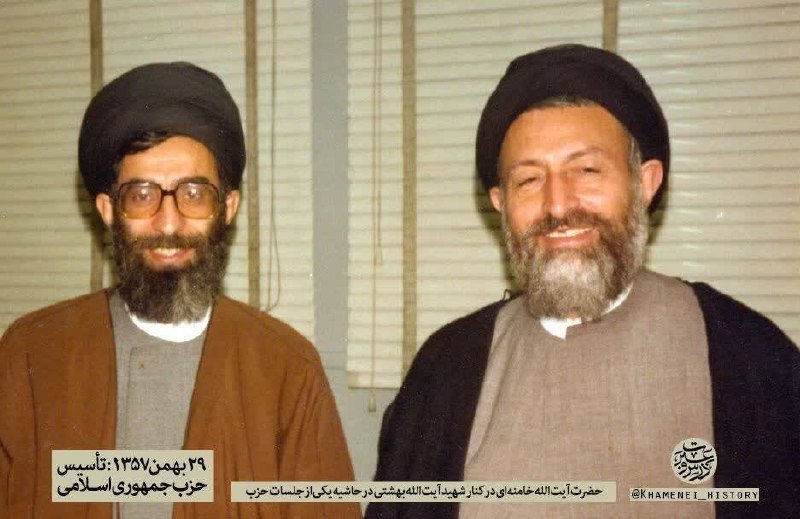
The commemorative anchor is Mohammad Beheshti, the head of Iran's revolutionary judiciary who was killed, along with dozens of officials and aides, in a June 1981 bombing of the Islamic Republic Party headquarters in Tehran. Beheshti is, in the official historiography, the architect of the post-revolutionary legal order. Pairing his name with the judiciary is therefore not a neutral annual observance; it is a reminder that the courts, as currently configured, are the direct inheritors of Beheshti's founding design.
Why the timing matters
Judiciary Week in Iran is an annual institutional showcase, but the late-June 2026 iteration arrives with the institution under unusual scrutiny. Reporting from independent outlets tracked by Iran International and the BBC over recent months has described a judiciary increasingly mobilised against dual-national detainees, activists, and journalists, with sentences handed down by revolutionary courts rather than ordinary benches. None of those specific cases is named in the four Telegram alerts in the source feed; the alerts do not need to name them. The Leader's choice to personally open the week, rather than leaving it to the head of the judiciary, signals that the institution's current direction has the Supreme Leader's explicit endorsement rather than his passive acquiescence.
A second, quieter signal sits in the date itself. The 28 June commemoration overlaps with the period in which Iranian and US negotiators have, per Axios and Reuters reporting earlier in the spring, traded drafts around a possible nuclear framework. By anchoring a high-profile message on a date that foregrounds judicial authority, Khamenei is reinforcing the domestic pillar of state power that any eventual deal — or any decision to walk away from talks — will rest on. Sanctions enforcement, the prosecution of alleged spies, and the policing of public dissent all run through the courts.
The counter-frame: why read the message this way at all
A sceptical read holds that we are over-interpreting a routine event. Iranian state media covers annual institutional weeks with metronomic regularity; Tasnim, Al-Alam, and the English Tasnim service routinely pre-announce messages that turn out to be doctrinal, cautionary, and broadly continuous with prior messaging, rather than sharply new. The four near-simultaneous alerts may therefore be exactly what they claim to be: production discipline.
That reading holds some weight. The Leader's annual judicial addresses are almost always long, doctrinal, and focused on corruption, judicial independence in the regime's own sense of the term, and the protection of "revolutionary values." A reader who skims only for a new directive will usually be disappointed. But the bar for what counts as significant is not novelty alone; it is whether the Leader chooses to personally lend weight to an institution at a moment when that institution is doing politically consequential work. In June 2026, the answer is yes.
Stakes over the next quarter
If the Leader's message frames the judiciary as a stabilising pillar, expect two operational consequences. First, courts handling cases with a national-security or sanctions dimension will read the message as licence to continue current sentencing practice — a point relevant for European and dual-national detainees whose files are active. Second, Iranian state media's parallel Persian-and-Arabic rollout signals that the judiciary's audience is regional: Shia-majority Arab states, Lebanese and Iraqi audiences reached via Hezbollah- and Iran-aligned outlets, and Gulf-watchers tracking Iran's posture. Any nuclear-file movement in Geneva, Vienna, or Muscat will sit on top of an internal political machine that has just been publicly greased by the Leader himself.
The honest note of caution: the four Telegram alerts in the source feed tell us only that the message is imminent and what it commemorates. The text itself had not, at the time of the alerts, been released. Any sharper reading — of tone, of specific instructions, of veiled criticism of a particular faction — requires the published text and the official IRNA, Tasnim, and PressTV coverage that will follow. Until that text lands, this analysis is about timing and choreography, not content.
This article reads the choreography of Iranian state-media alerts as itself a signal. The wire desks typically wait for the published text before assigning significance; Monexus is naming the release pattern as the story it already is.
Wire provenance
This editorial synthesis draws on the following public wire/social posts:
- https://t.me/tasnimnews_en
- https://t.me/tasnimplus
- https://t.me/alalamfa
- https://t.me/alalamarabic