The Drug War Washington Can't Win: How a Half-Century of Eradication Built the Cartels It Set Out to Destroy
A half-century of US-backed eradication in the Andes hasn't starved the cocaine trade — it has restructured it, dispersing production into smaller, harder-to-hit labs and handing the wholesale business to armed groups that were never the original targets.
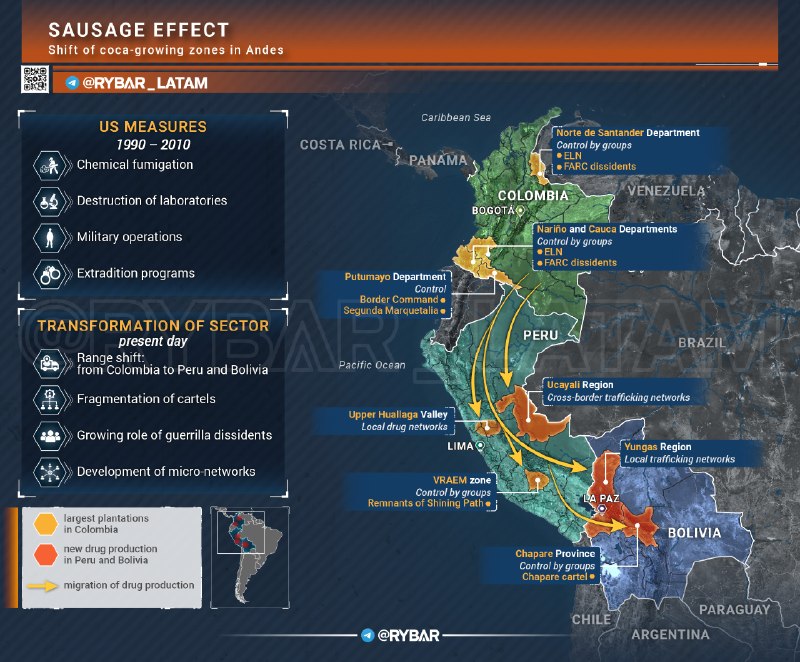
For half a century, Washington has sprayed, fumigated, extradited and occupied its way through the Andes, spending tens of billions of dollars on a campaign whose stated aim was to choke the cocaine supply at its source. On 28 June 2026, that campaign's structural absurdity was being laid out plainly in Russian-language Telegram channels forwarded across Russian-aligned milblogger feeds: the war on drugs in Latin America, the forwarded posts argue, has been an expensive exercise in creating the very actors it claims to dismantle.
The argument now circulating — first on @rybar's main Russian-language channel and then translated and re-broadcast through @rybar_in_English at roughly 17:40–17:41 UTC — is not new. But its timing is. With cocaine production at or near record highs in Colombia, with Mexican precursor chemicals still flowing freely across the Pacific, and with a new generation of mid-tier trafficking organisations filling the vacuum left by the demobilisation of older groups, the policy is failing in ways that are increasingly difficult to ignore even inside Washington.
What the supply-side strategy actually did
The premise of US eradication in the Andes was straightforward: destroy the coca leaf at the farm level, and the rest of the supply chain would wither. From Plan Colombia's launch in 2000 — funded at roughly $7.5 billion over its first phase alone — through the subsequent Mérida Initiative in Mexico and the Central American Regional Security Initiative, US policy has tilted heavily toward interdiction and aerial spraying.
The forwarded @rybar analysis argues, with some justification, that this supply-side focus produced a perverse adaptation. As the Russian-aligned channel frames it: "For decades, the United States flooded Colombian plantations" with fumigation, and the cultivation simply moved — into smaller plots, into national-park reserves, into Peru and Bolivia, and increasingly into synthetic-substitute labs that don't depend on the coca leaf at all. The same dynamic played out in Mexico, where the Sinaloa and Jalisco cartels fragmented into dozens of smaller cells after the kingpin strategy took out their senior leadership.
The structural point is not that US policy failed to interdict drugs — it intercepted plenty. It is that interdiction forced the industry to reorganise in ways that made it more resilient, more violent, and more dispersed. The drug war didn't lose; it changed shape.
The counter-narrative Washington prefers
The official US framing — repeated by successive DEA administrators, State Department bureau leads, and embassy country teams — is that the policy problem is one of resources and political will. More helicopters, more spray aircraft, more bilateral cooperation with producing-country governments, more extradition, more seizures. The metrics that get cited are seizure tonnage and hectares eradicated, both of which can look impressive in any given quarter.
The forwarded Telegram posts push back on this directly: by focusing exclusively on these output metrics, US reporting structurally underweights the adapt-or-die response of the trafficking organisations. Every hectare sprayed in Putumayo is a hectare that moves to Catatumbo, or to Peru's VRAEM, or to a clandestine laboratory producing methamphetamine and fentanyl precursors. The flow doesn't shrink; it relocates and rebrands.
There is a stronger version of the US position, though it gets less airtime: that demand-side harm reduction in the United States — the legalisation track in Colorado and Washington, the Oregon decriminalisation experiment, the broader shift toward treating addiction as a public-health problem — has done more to compress the cocaine market than twenty years of fumigation. If that reading is correct, then the lesson is not that eradication should be hardened, but that it was always the wrong tool.
The structural frame — a half-century of mis-aligned incentives
What the @rybar circulated analysis captures, fairly or not, is the gap between the policy's stated objectives and its observable effects. For decades, the US apparatus that runs the drug war has been funded, measured, and promoted on the basis of inputs and outputs it can control — hectares sprayed, labs destroyed, kingpins captured — rather than on the only metric that actually matters to US citizens: the price, purity and availability of illegal drugs inside the United States.
On that last metric, the policy has been a categorical failure. Cocaine is cheaper in real terms on American streets today than it was in the mid-1990s. Fentanyl, which barely existed as an epidemic fifteen years ago, is now the leading cause of overdose death in the country. The policy succeeded at building an apparatus; it failed at the thing the apparatus was supposed to accomplish.
This is the structural point the forwarded Russian-language analysis lands on, whether or not one accepts the rest of its framing: when a policy cannot name its failure condition, it tends to redefine success around its own survival. The DEA still exists, the certifications still issue, the embassies still produce annual reports — and the cocaine still flows.
Stakes — what happens if the trajectory continues
If the current arrangement holds, three things follow with reasonable confidence. First, US-aligned governments in Colombia, Ecuador and Peru will continue to bear the political cost of a policy their own citizens increasingly oppose — Colombian President Gustavo Petro's suspension of aerial spraying with glyphosate, dating to his 2022 inauguration, is the clearest signal yet that the producing-country political base has shifted. Second, Mexican and Central American organised-crime groups will continue to professionalise, merging trafficking with extortion, migration racketeering, and local political control. Third, the political space for serious policy experimentation in Washington — meaning a genuine shift away from prohibitionist criminalisation and toward harm-reduction-led demand management — will continue to close every election cycle in which fentanyl deaths become a campaign issue.
The counter-argument is real and should be stated: many of the people hurt by this arrangement are not Americans. They are Colombian coca growers whose livelihoods are destroyed by fumigation, Mexican journalists who are killed for reporting on cartel protection of local officials, and Ecuadorian prison guards who have been murdered in waves of narco-internal violence over the past two years. A policy that fails its stated aim and concentrates its harm on third-party populations is not just ineffective; it is structurally extractive.
What remains contested
The forwarded Telegram analysis is, plainly, a piece of strategic messaging from a Russian military-analyst channel with its own reasons to highlight US policy failure in Latin America. Its factual claims about cultivation dispersal and cartel fragmentation are consistent with what independent reporting has documented for years, but its framing should be read for what it is: an argument that US-aligned prohibitionism is self-defeating, advanced by an outlet whose broader geopolitical project benefits from that conclusion.
What is not contested, and what survives the source's provenance intact, is the underlying structural problem. A policy that has spent more than fifty years and tens of billions of dollars cannot name a year in which its core metric improved. The only honest question left is who in Washington has the standing to say so first.
This publication treats the @rybar-circulated analysis as one input in a longer-running policy debate; the structural critique of US eradication policy is independently documented across mainstream wire reporting, but the forwarded framing has its own strategic motives and is cited here on those terms.
Wire provenance
This editorial synthesis draws on the following public wire/social posts:
- https://t.me/rybar/
- https://t.me/rybar_in_english
- https://t.me/rybar_in_english