Newsom's Billionaires' Pivot: A Federal Tax by Way of Sacramento
California's governor rejected a state-level billionaires' tax, then proposed a federal one. The sequence matters more than either announcement alone.
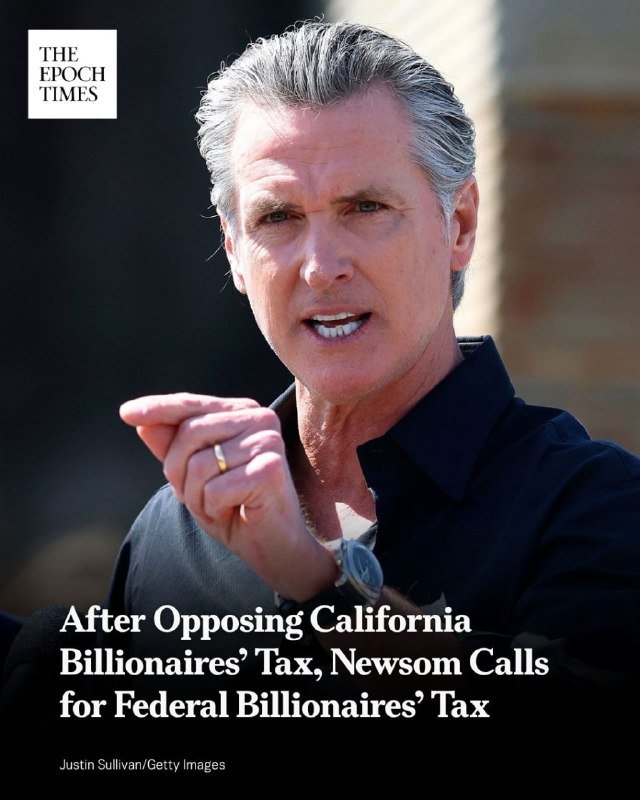
On 26 June 2026, California Governor Gavin Newsom proposed a federal tax on individuals with net worths exceeding $100 million, a striking reversal from his repeated public opposition to a proposed California billionaires' tax. The state-level measure he had rejected, a one-time levy on the ultra-wealthy, has nonetheless gained enough momentum that prediction markets now price a roughly 36% chance of passage, per Polymarket's 27 June 2026 update.
The governor's pivot is the story. A Democrat with national ambitions spent weeks opposing a tax on California's richest residents, then proposed a version of the same tax pitched at Washington instead. Read literally, this is policy entrepreneurship. Read structurally, it is an attempt to own the framing of a measure that is building momentum without him.
What Newsom actually said
Newsom's federal proposal, reported by The Epoch Times on 29 June 2026 and echoed by the market-data account Unusual Whales on 28 June 2026, would impose a minimum tax on individuals whose net worth exceeds $100 million. The shift from Sacramento to Washington is the operative move: a state-level tax on billionaires is, in the governor's telling, the wrong instrument; a federal version is the right one. The framing protects him from a fight he had been losing in his own legislature while positioning him as the author of a more ambitious alternative.
The state-level measure he rejected is narrower in scope but more politically combustible. It would apply once, to a defined pool of California-resident wealth, and the proceeds would stay inside the state. The federal version Newsom now champions would spread the incidence across the country and concentrate the revenue with the federal government.
The prediction-market read
Polymarket's 27 June 2026 update put the implied probability of the California one-time billionaire tax passing at 36%, a sharp upward move that the platform attributed to a Newsom video urging what he called an "economic reset." Prediction-market prices are not forecasts, but they are real-money signals about what informed traders think a bill's prospects are. A 36% probability on a measure that the governor of the state has publicly opposed is not a rounding error. It is a signal that the political coalition behind the tax does not consider Newsom's opposition terminal.
This is the part of the story that does not fit the press-release read. The governor says no. The market says maybe. The market is closer to the legislative calendar than the press release is.
Why the federal pivot, structurally
A governor who wants a national platform cannot be on the wrong side of a popular tax-the-rich story in his own state. He can, however, be on the right side of a federal version. The mechanics are familiar: when a state-level measure becomes electorally sticky, ambitious Democrats have two options — kill it or upscale it. Newsom spent weeks trying to kill it. When that failed to dampen enthusiasm, he upscaled.
The structural pattern here is not new. It is the same playbook that has run in reverse for decades: a state passes something ambitious on housing, climate, or labour; the national party either absorbs it as a brand or distances itself from it. The difference in 2026 is that the ambition and the distancing are happening inside one politician's press cycle.
Stakes and counter-reads
The counter-read is straightforward: Newsom is genuinely opposed to the California bill on the merits and is offering a federal alternative in good faith. The state version, in this telling, is poorly drafted, easy to evade, and would push wealth out of California. The federal version, by contrast, has a broader base and harder enforcement.
The dominant read holds more weight given the sequence. Newsom opposed the state bill multiple times before proposing the federal one. A governor who wanted to substitute federalism for state action would have proposed the federal version first and let the state version die. The order matters.
The honest uncertainty sits in the numbers. The sources do not specify the rate Newsom's federal proposal would set, the threshold behaviour above $100 million, or whether the proposal is a serious legislative draft or a marker for a future presidential run. What is verifiable is the position: opposed to a state tax on billionaires, in favour of a federal one with a similar incidence profile.
Forward view
The California legislative calendar will resolve the state question before the federal one moves. If the state bill passes despite Newsom's opposition, the governor will spend the rest of the year explaining why his federal version is better. If it fails, he will spend the rest of the year explaining why he was right all along. Either outcome leaves him holding the brand of the issue. That is the point of the pivot.
This publication framed the federal proposal as the substantive story rather than the state-level opposition, because the position Newsom now holds — federal tax, state no — is the position he will be defending through the 2028 primaries.
Wire provenance
This editorial synthesis draws on the following public wire/social posts:
- https://t.me/s/TSN_ua
- https://x.com/Polymarket/status/2070988484094119936
- https://t.me/s/epochtimes