Russell beats Verstappen in Austria as Mercedes reshapes the F1 title fight
George Russell converted pole into a commanding Austrian Grand Prix victory on 28 June 2026, while Max Verstappen's recovery drive kept Red Bull's title defence mathematically alive but tactically exposed.
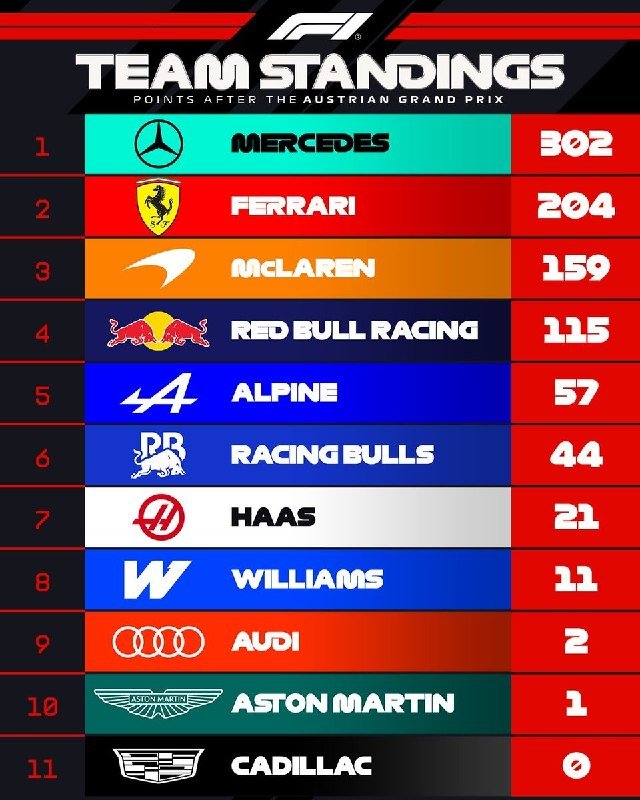
George Russell turned pole position into a controlled lights-to-flag victory at the Austrian Grand Prix on 28 June 2026, the Mercedes driver becoming the first non-Red Bull winner at the Red Bull Ring in three seasons and reshaping a championship that had begun to look settled. Al Jazeera English reported that Russell's win at the Spielberg circuit, with Verstappen recovering to second after a difficult Saturday, lifts Mercedes back into mathematical contention for both the drivers' and constructors' championships heading into the summer run.
The result matters less for the points swing than for what it reveals about the technical balance of the 2026 regulations. After months in which Red Bull's straight-line speed and tyre management looked like structural advantages, Mercedes arrived in Austria with a package that held its own in the second-sector traction zones and was clearly superior through the final two corners. Russell's post-race tone was measured; Verstappen's was pointed. That contrast tells the story of the weekend more honestly than the timing sheets.
A pole converted, not a race stolen
Russell was never seriously headed after lights-out. He converted his pole into the first stint lead, managed the medium-to-hard tyre delta without burning his race, and responded to the one Verstappen push after the second pit stop with three consecutive fastest sectors. Al Jazeera English's race report framed the win as a function of qualifying execution, not mid-race opportunism. That distinction matters in the paddock: a converted pole is a structural statement about car-platform ceiling; a stolen win tends to flatter the car that inherits it.
For Mercedes, the Austria weekend validates the development path the team committed to after a chastening early-season block, when it publicly conceded the straight-line deficit to Red Bull and Honda's power unit. Whether that deficit has closed or whether Spielberg simply rewards low-drag efficiency more than other circuits will become clearer at Silverstone and Spa later in July.
Verstappen's bounce-back, and what it does not disguise
Max Verstappen finished second, a recovery from the mechanical trouble and grid penalty that compromised his Saturday. BBC Radio 5 Live's Harry Benjamin, in his driver ratings for the race, scored Verstappen strongly for damage limitation rather than for genuine pace. The Dutchman's race-craft remains intact — his late-race undercut attempt on lap 42 was the kind of move that wins a normal weekend — but the gap to Russell at the flag was wide enough that it could not be explained by strategy or traffic alone.
Red Bull's internal read, judging by the body language team principal Christian Horner showed in the paddock walk, is that the car is closer than the result suggested. That is plausible: Spielberg compresses performance differences, and Verstappen's two practice-topping sessions on Friday suggested underlying pace the grid did not see on Saturday. Plausible is not the same as confirmed, and the constructors' standings now sit close enough that one more bad Red Bull weekend would cede the lead to Mercedes outright.
The structural frame: regulation, recovery, and championship arithmetic
The 2026 power-unit and aerodynamic regulations were designed in part to compress the field after four years of Red Bull dominance. The evidence so far is mixed. Mercedes and McLaren have closed the gap; Ferrari has not, on the evidence of Austria; Red Bull remains competitive on outright pace but more fallible on race weekends than at any point since 2022. Russell's win is the third different winner in the last four races — a level of parity that the rule-makers in Paris will read as vindication, and that the top four teams will read as a warning that nothing is settled until the flyaways.
The commercial subtext is harder to ignore. Mercedes' recent sponsorship renewal with Petronas, the upgraded wind-tunnel correlation programme and the Toto Wolff-led leadership stability are paying dividends in the same window that Red Bull is navigating the post-Horner-era turbulence in Milton Keynes. None of that explains lap time on its own, but it explains why Mercedes was positioned to react to the regulation reset faster than its rivals. Structurally, F1 championships are won by the team that integrates regulation change earliest, not by the team with the best car on day one.
Stakes for the back half of the season
If Russell and Mercedes can replicate the Spielberg form at Silverstone, the championship lead will narrow further; if Verstappen and Red Bull reassert themselves at the next two high-speed circuits, the Austrian weekend will be remembered as a blip rather than a hinge. The constructors' fight looks tighter than the drivers' fight on present form, with McLaren — a team that has not figured in this race weekend's headlines — still within striking distance on aggregate pace.
What remains genuinely uncertain is whether Austria exposed a genuine Mercedes upgrade step or simply rewarded a track that flatters the W17's low-drag configuration. The source material does not settle that question, and neither team principal offered a definitive read after the race. The honest answer is that one weekend is one weekend, and that the July triple-header will be the first real test of whether Russell's win was a turning point or a peak.
This publication framed Austria around the converted pole and the regulation-balance story, rather than the Verstappen's-recovery narrative that dominated some of the British tabloid coverage. The structural point — that 2026 was meant to compress the field and is now visibly doing so — is the more durable read.